

Inside the COFDM Tech and Wireless Systems Delivering Olympic Broadcasting Special Camera Angles
Those athlete’s-eye shots alongside a downhill skier come from half-pound drones at 80 mph, and the hard part is not the flying – it is pushing HD video off a fast aircraft through crowded airwaves.
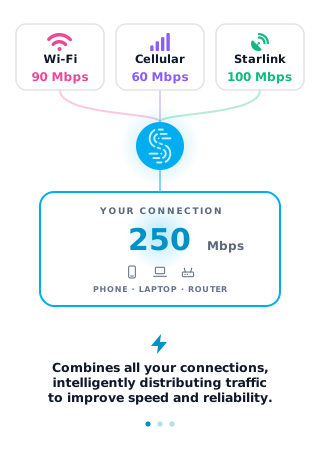
Broadcast crews use COFDM, a radio method that splits one video feed across many small carriers so interference on a few does not ruin the picture. Speedify is an app that runs your internet over two or more internet connections at once – Wi-Fi, 4G/5G cellular data, wired Ethernet, Starlink and others.
This article covers the drone rigs, the COFDM link, interference and cold-weather limits; using Speedify keeps your viewing steady when one internet connection weakens.
Speedify gives you the upload headroom a clean stream needs
The Scale of Olympic Drone Operations
Olympic Broadcasting Services (OBS) deployed 25 drones across Milano Cortina 2026, including 15 dedicated FPV units covering everything from alpine skiing to speed skating. Each drone team consists of three specialists: a pilot wearing VR goggles for real-time control, a spotter ensuring safety, and a director coordinating shots with the broadcast team.
According to FPV drone expert Oscar Liang, the racing drones are custom-built 5-inch models weighing 600-800 grams with batteries. They use DJI Goggles 3 and the DJI O4 Air Unit for pilot control, with Radiomaster Boxer radios (likely running ExpressLRS) handling the commands. These aren’t your average consumer drones: they’re capable of exceeding 180 km/h (112 mph), making them more than fast enough to chase Olympic athletes.
The Olympic Drones’ Two-Camera System: Control vs. Broadcast
Here’s where things get interesting. Each Olympic FPV drone carries two completely separate camera systems:
1. The Low-Resolution Control Feed (DJI System): This camera sends real-time video directly to the pilot’s goggles via DJI’s O4 Air Unit. The resolution is intentionally lower to minimize latency, typically achieving 15-40 milliseconds of delay. This near-instantaneous feedback is critical when you’re piloting a drone at 80 mph just meters behind an Olympic athlete. The signal goes straight from drone to goggles, line-of-sight, with no intermediate processing.
2. The High-Definition Broadcast Feed (COFDM System): This is the footage you see on TV. Olympic drones use professional cameras from companies like Proton and Blackmagic, paired with the Domo Pico TXR transmitter. This system uses COFDM (Coded Orthogonal Frequency Division Multiplexing) technology to deliver broadcast-quality HD video with bulletproof reliability.
What Makes COFDM So Special and How Is It Used with Drones at the Olympics?
COFDM might sound like technical jargon, but it’s actually the secret sauce that makes live Olympic drone coverage possible. Here’s why it’s revolutionary:
Multiple Frequency Transmission: Unlike traditional single-carrier systems, COFDM splits the video signal across hundreds or even thousands of narrow sub-carriers operating on different frequencies simultaneously. Think of it like having multiple backup lanes on a highway: if one gets blocked, traffic keeps flowing through the others.
Extreme Error Correction: The “C” in COFDM stands for “Coded,” meaning the system adds multiple layers of error correction. The video data is essentially transmitted multiple times across different frequencies to ensure nothing gets lost. For live broadcasting where there’s no second chance, this redundancy is critical.
Multipath Advantage: In most RF systems, signal reflections cause interference. But COFDM’s clever design actually turns reflections into an advantage. When signals bounce off ice patches or mountain surfaces and arrive slightly delayed, they reinforce the primary signal instead of corrupting it. This is because each sub-carrier changes so slowly that the reflection arrives while the same bit is still being transmitted.
Non-Line-of-Sight Performance: According to COFDM specialists, this technology excels in challenging environments. Whether it’s skiing through tree-lined courses or bobsledding through covered sections, COFDM maintains signal integrity even when direct line-of-sight is lost.
The Domo Pico TXR used at the Olympics is frequency-selectable across 2-2.7 GHz and 4.9-6 GHz bands. This is essentially the same spectrum used by Wi-Fi, but with far more sophisticated encoding and transmission protocols.
Managing Drones Interference in a Wireless Jungle
With over 810 cameras, countless Wi-Fi hotspots, and 25 drones all operating simultaneously, the Milano Cortina Olympics present a massive RF coordination challenge. HPE (Hewlett Packard Enterprise) manages the entire Wi-Fi infrastructure, carefully orchestrating which frequencies each system uses.
The Olympic venues are connected via extensive fiber optic networks, creating what OBS CEO Yiannis Exarchos calls a “very controlled environment.” Unlike a typical public event where random Wi-Fi access points cause chaos, every wireless system at the Olympics is registered and coordinated to prevent interference.
The Cold Weather Challenge for Drone Operations
Battery performance in freezing alpine conditions presents another major hurdle. As anyone with an electric vehicle knows, cold temperatures drastically reduce battery capacity and voltage stability.
Olympic drone teams solve this with heated battery cases and rapid-swap pit crews. According to Design News reporting, each 250-gram drone battery only lasts for two athlete runs (roughly 3-6 minutes of flight time) before requiring replacement. Between races, technicians pull hot batteries from warming cases and swap them in seconds, a choreographed dance that would make NASCAR crews proud.
Can Anything Be Done About the Drones Buzzing?
The drone noise has become one of the most polarizing aspects of Olympic coverage. Why can’t they just filter it out?
The problem is more complex than it appears. Drones constantly vary their propeller speeds to maneuver: that’s how they steer and maintain position. This changing RPM creates a fluctuating sound signature that’s hard to isolate. Add in the Doppler effect (pitch changes as drones move toward or away from microphones) and the fact that every handmade drone sounds slightly different, and you have an audio engineer’s nightmare.
The good news? Athletes don’t hear it. Between their helmets, the rush of wind at 80 mph, and the drones staying behind them, competitors report zero noise disturbance. The buzzing only affects TV viewers.
Looking ahead, AI-powered noise cancellation may eventually solve this problem. Machine learning could potentially track and subtract the complex, changing drone signatures from the audio feed. But for now, that distinctive buzz is the price we pay for unprecedented camera angles.
The Future of Broadcast Drones
The success of FPV drones at Milano Cortina 2026 represents a watershed moment for sports broadcasting. NBC Olympics reports that this technology gives viewers the exact sensation athletes experience, something impossible with traditional camera systems.
While full AI automation remains years away (concerns about safety prevent it for now), the technology continues evolving rapidly. The combination of human piloting skills and sophisticated transmission systems like COFDM has proven that drones can deliver broadcast-quality footage under the most demanding conditions.
For drone enthusiasts, the Olympics provide fantastic exposure to FPV technology, showing mainstream audiences that not all drones are intrusive or problematic: they can be precision tools for storytelling.
Staying Connected While Watching the Olympics
Speaking of reliable connections, if you’re streaming Olympic coverage from multiple devices or locations, you need rock-solid internet just like those drone pilots need reliable video links.
Speedify uses channel bonding technology similar in concept to COFDM: it combines multiple internet connections (Wi-Fi, 4G, 5G, Starlink, Ethernet) into one unbreakable connection. Just as Olympic drones transmit video across multiple frequencies for reliability, Speedify bonds your internet sources to eliminate buffering and dropouts.
Whether you’re streaming the Olympics from a crowded venue, traveling abroad, or just want to ensure your connection doesn’t fail during the gold medal race, Speedify’s channel bonding keeps you connected. Learn more about optimizing your streaming with Speedify.
Olympic FPV Drones: the Bottom Line
Olympic FPV drones represent the cutting edge of wireless video technology, combining sophisticated COFDM transmission systems, rapid battery management, careful RF coordination, and skilled human pilots. While that buzzing sound may test viewers’ patience, the resulting footage – athletes flying down mountains at breakneck speeds, viewed from impossible angles – is genuinely revolutionary.
The technology powering these tiny cameras involves the same principles that keep critical communications working for emergency services, military operations, and professional broadcasts worldwide. As COFDM and related technologies continue improving, we can expect even more impressive drone coverage at future Olympic Games, hopefully with quieter propellers.
For now, the buzz is worth it. These drones are giving us a front-row seat to human achievement in ways we’ve never experienced before.
Speedify
Get started with Speedify today.
Combine Wi-Fi, 4G/5G cellular, Ethernet, Starlink, and more into one faster, steadier connection. Free to try — no credit card required.
🚀 Speed
Faster uploads and downloads by bonding all your connections at once.
📶 Stability
Automatic failover in under a second when any connection drops.
🔒 Security
AES-256 encryption on every connection, on every network you join.


15M+ downloads worldwide. 75K+ five-star reviews on iOS and Android.