


Setting Up Multiple Starlink Dishes for Better Internet
If you're experiencing slow speeds or frequent disconnections with your current Starlink setup, you might be wondering: how to add a second Starlink to your account for improved performance. The process is straightforward, and combining multiple Starlink dishes can solve connectivity issues more effectively than traditional troubleshooting methods.
Many users spend time adjusting dish positioning, restarting equipment, or contacting support when their internet underperforms. However, adding a second Starlink terminal to your existing setup provides measurable improvements in both speed and reliability when used together at once with Speedify. In this article we'll go through the setup guide for faster, more reliable Internet using two Starlink dishes and Speedify.
Should you get a second Starlink?
Is Starlink giving you great download speeds but weak uploads and random dropouts? Even with 100+ Mbps Starlink download speeds, many users get stuck with under 25 Mbps uploads, unstable connection issues.
A powerful way to upgrade your Starlink speed and stability is to run two Starlink dishes. But to actually combine both Starlink connections into one faster, stronger internet link, you need connection bonding software like Speedify.
Speedify bonds your Starlink dishes for more upload and download bandwidth, smoother Zoom and Teams calls, and far more reliable livestreams. And when one dish drops, as Starlink often does, the other instantly takes over without lag or interruptions.
If you want more reliable, faster Starlink uploads and downloads, bonding multiple Starlink connections with Speedify is the most effective way to level up your satellite internet.
Get instant Speedify alerts about Starlink interruptions and updates

Use Speedify to increase your upload and download speeds: combine internet connection sources like Wi-Fi, 4G, 5G, Starlink and wired broadband

Combine Wi-Fi, 4G, 5G, Starlink and wired broadband to fix slow upload and download speeds
Speedify is the only app that seamlessly combines all of your connections, including Wi-Fi, 4G, 5G, Ethernet, and Starlink, into one stronger connection to keep you online and secure.
In most cases, Speedify will automatically detect and start using any available Internet connections on your device while intelligently distributing your online traffic between them for optimal performance. If you need help we have quick start guides available for most common set ups.

Combine personal hotspots for better upload and download speeds
Speedify's Pair & Share feature enables you to connect to multiple hotspots at the same time and wirelessly share LTE, 4G, and 5G cellular connections back and forth between multiple Speedify users on the same local network to create a faster, more reliable connection for everyone.
For the first time, it's possible to share cellular data between multiple devices, including PCs, Macs, iPhones and Androids. Use multiple phones as hotspots for internet access and get increased bandwidth and mobile failover for all paired devices.
Can You Add Multiple Starlink Dishes to One Account? How to Do That
You CAN add multiple Starlink subscriptions to your account.
Important considerations: Each additional Starlink requires both hardware purchase and a separate subscription. You cannot share one subscription between multiple dishes at the same location.
Method 1: Ordering the Second Starlink Through Your Account
- Log into your Starlink account at starlink.com
- Navigate to the "Subscriptions" tab
- Click "Add Subscription" in the top right corner
- Select your desired plan and complete the purchase
- Each dish requires its own monthly subscription
Method 2: Activating Existing Starlink Hardware
If you already have a second Starlink kit, all you have to do is activate it. This process doesn't cancel or modify your current Starlink subscriptions.
- Visit starlink.com/activate
- Select "Existing Account" during setup
- Follow the activation prompts for your additional dish
- Your new terminal will be added to your current account
Why Add a Second Starlink to Your Account
The most important reason for using two Starlinks together is getting faster, more reliable Internet. This way, you can forget about that slow and often disconnecting Internet.

Most connectivity problems stem from factors beyond your control:
Satellite congestion: During peak usage hours, available satellites serve multiple users simultaneously, reducing individual connection speeds regardless of your troubleshooting efforts.
Weather interference: Rain fade, snow accumulation, or atmospheric conditions affect satellite communication. Having two dishes increases the likelihood that at least one maintains optimal signal.
Hardware limitations: Single dishes have physical bandwidth constraints. No amount of repositioning or equipment restarting will exceed these built-in limits.
Network maintenance: SpaceX occasionally performs satellite constellation updates that can temporarily affect service. Multiple dishes reduce the impact of these maintenance windows.
Traditional troubleshooting methods like dish repositioning, cable checking, or equipment resets address minor technical issues but cannot overcome fundamental capacity or infrastructure limitations.

By using two Starlinks at once through your account, you get:
Increased bandwidth: Two Starlink dishes can connect to different satellites in the constellation, significantly increasing your available bandwidth when properly configured.
Improved reliability: If one dish experiences signal obstruction or technical issues, the second maintains your internet connection without interruption.
Load distribution: Heavy usage scenarios like video conferences, large file uploads, and streaming can be distributed across multiple connections, preventing any single dish from becoming a bottleneck.
Geographic redundancy: Dishes positioned in slightly different locations may have varying line-of-sight to satellites, improving overall signal availability.
Using Speedify to Combine Two Starlinks
Speedify is the only app that allows you to combine two Starlink connections:
Connection bonding: Traffic is distributed across both dishes based on real-time performance, ensuring optimal utilization of available bandwidth.
Automatic detection: The software recognizes when multiple Starlink connections are available and begins bonding them without manual configuration.
Failover protection: Even before one Starlink connection experiences issues, traffic automatically shifts to the better performing dish without dropping active sessions.
Encryption: All bonded traffic passes through encrypted tunnels, maintaining security across multiple connection paths.
Adding a Second Starlink to Your Account: Real-World Performance Improvements and Considerations
Users implementing multiple Starlink setups typically report:
Speed increases: Combined download speeds often reach 150-250 Mbps, significantly higher than single-dish performance averaging 50-150 Mbps.
Uptime improvement: While both connections rely on the same Starlink network backend, having two dishes provides redundancy against individual hardware failures and local signal issues.
Consistent performance: Speed variations become less noticeable when load is distributed across multiple satellite connections.
Upload enhancement: Upload speeds, typically limited on single Starlink connections, improve substantially when aggregated across multiple dishes.

In terms of costs for adding a second Starlink to your Internet setup, you should think about:
Hardware costs: Each additional dish requires the full hardware purchase price, typically several hundred dollars.
Monthly subscriptions: Each dish needs its own service plan, doubling your monthly Starlink expenses.
Power requirements: Additional dishes increase power consumption, which may be relevant for off-grid installations.
Physical installation: Multiple dishes require separate mounting locations with clear sky visibility.
When Using Two Starlinks Together Makes Sense
Business operations: Companies requiring guaranteed uptime benefit from redundant satellite connections that eliminate single points of failure.
Remote work: Professionals whose income depends on reliable internet connectivity can justify the additional cost through prevented downtime.
Content creation: Video uploaders, streamers, and digital creators benefit from aggregated upload speeds that reduce file transfer times.
Large households: Families with multiple remote workers, students, and heavy streaming usage may saturate single connections during peak hours.
Critical applications: Medical monitoring, security systems, or other applications requiring constant connectivity benefit from redundant connections.
Getting Started with Your Second Starlink on Your Account
Instead of spending time troubleshooting connection issues that may be beyond your control, add a second Starlink to your account and combine both dishes with Speedify - this is a proven solution to your connectivity problems.
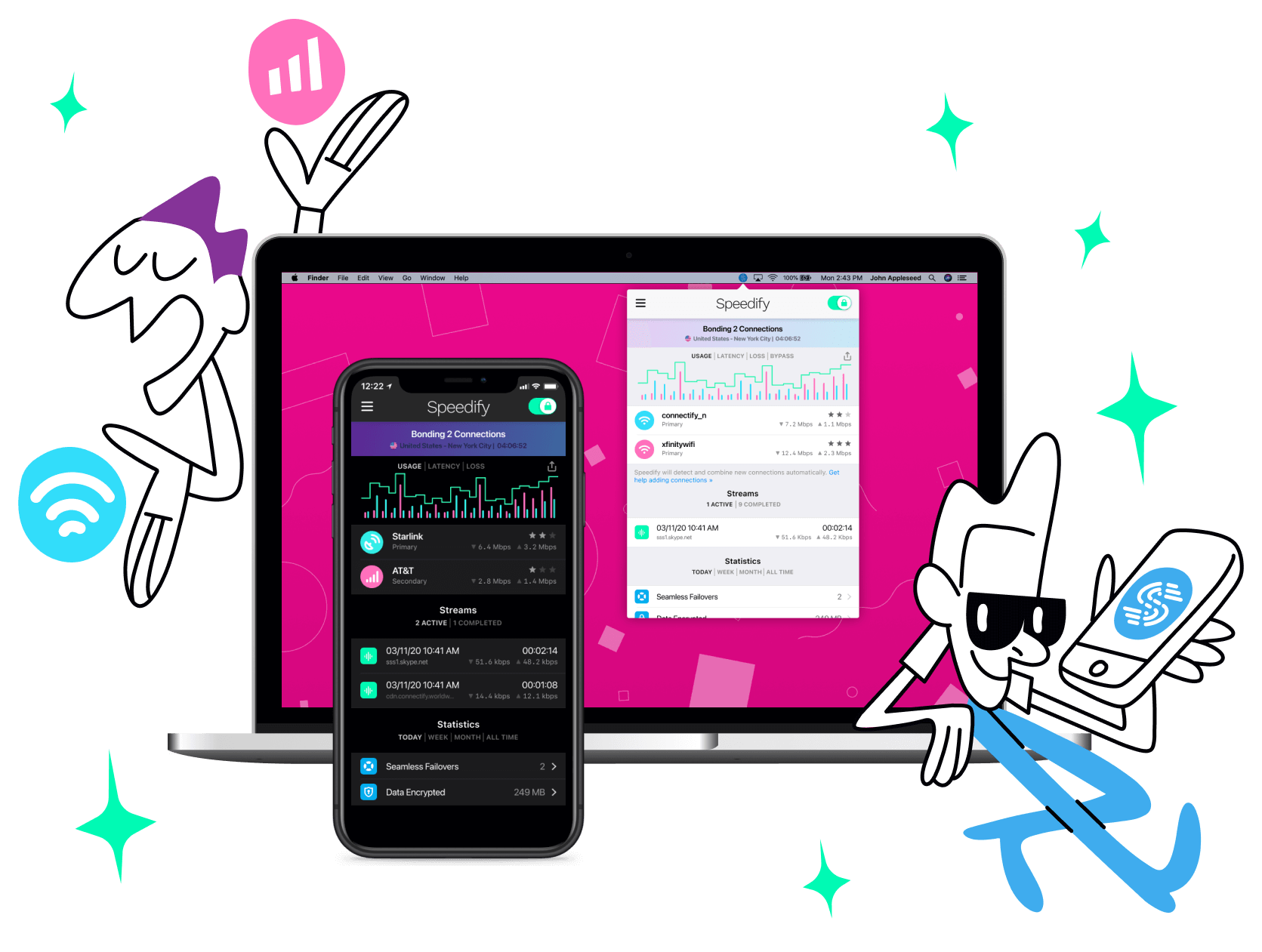
After getting the second Starlink and adding it to your account, just get Speedify on your computers, mobile devices and router(s) to start combining the two dishes together.
Best way to do this is combing both Starlink connection via a bonding capable router, like the Miri X510. You can also combine the two Starlink connections directly on your devices using the Speedify app.
Get started today!
With Speedify you can combine multiple internet sources into one bonded super-connection to improve livestreaming, video calling, gaming, web browsing, and everything else you do online.
Speed
Stability
Security
We love talking about technology!
Alex and the Speedify team are always exploring the latest in networking and security technology—like 5G, 6G, WiFi 7, laser and satellite internet—and sharing it in new discussion content across YouTube, TikTok, Instagram, and LinkedIn every week.
Got a tech question? Let's go deeper! Pop into Speedify Office Hours live every Wednesday at 10 AM Eastern. Speedify CEO Alex Gizis and our network engineers are standing by to break down your questions about networks, tech updates, and Speedify features.