

Getting Reliable Internet - Navigate through Mobile Tethering and Data Prioritization
Why Does Tethering Data Cost More?
Ryan: Why does Tethering Data cost more than regular Data?
Alex Gizis: There's two reasons. The first and most important is that the carriers have realized they can get away with charging more money for this, and they can make it a premium service, make some extra profit. The second thing, though, is that if they really did allow unlimited Tethering, some people would go crazy.
They've got this business model that says people may It uses tens of gigabytes per cell phone, but a laptop uses hundreds of gigabytes. And if you go ahead and plug instead your tethered phone into a router that runs a business with 50 computers in there, it's easy to run terabytes, tens of terabytes even, through a single 5G connection by using it 24 hours a day at full speed.
And so you can end out with this sort of one radio using more bandwidth than a hundred regular people. And so once a bunch of people start doing that, it actually does start costing them real money.
Ryan: And it affects other users sharing the cell phone tower.
Alex Gizis: Sure, sure. Once a couple people are blasting full speed, there's only one internet connection going to that tower, which all the phones are sharing.
How Do Carriers Detect Tethering Data?
Ryan: So how do carriers tell the difference between regular usage and Tethering usage?
Alex Gizis: That's kind of interesting. There's one field on IP packet, called TTL, Time to live. And that starts off at some number, and every time it goes through a router, the router lowers it by one. And the reason it does this is to avoid loops.
You can accidentally get routers set up wrong, where the packets looking for some website start going in a circle, bouncing from one router to the other one, who sends it back to the first. So on and so forth, until the network fills with these packets bouncing back and forth and the whole internet grinds to a halt.
They fixed that by putting this TTL. If the packet jumps back and forth a hundred times, TTL hits zero, they throw it away. So that's what's happening. It leaves whatever phone, goes to the phone that's the hotspot. The hotspot phone knocks down the TTL, then sends it on to Verizon, or whatever the carrier is, and they then spot this TTL is lower than usual. It's not a "fresh" packet. And so they say, oh, we'll count it as Tethering. Clever
What Is Data Deprioritization?
Ryan: I've seen the word deprioritization used a lot. Is that different from throttling?
Alex Gizis: I think deprioritization is a little more general. It implies that the carrier is now taking your traffic less seriously than the other people's. And that could mean it throttles it. It could just mean that it throttles it when their servers get busy. It could mean it's letting other users packets go first when both of you want to send packets, although that works out to basically throttling you.
So the implication though by deprioritization is that if the carrier is not busy, they'll still let you have full speed. But as other people get on, they're going to slow you down a lot, you know, more than the other people are getting slowed down by you.
Ryan: And that's not like a violation of net neutrality?
Alex Gizis: No. So the concept of net neutrality is that the internet service provider has to treat all those services and websites on the internet equally. It's a violation of net neutrality to say I'm going to slow down Netflix, but I'm gonna let Peacock go at full speed. But if you say, my network is very busy, I'm slowing everyone down, that's neutral.
Whether it's right or wrong, it's not a violation of network neutrality. And that's why Netflix created Fast.com. It's not just a speed test to the internet, like speedtest.net is. It is a speed test to how fast you can connect to Netflix. It runs on the same exact computers, on the same IP addresses, that are running the Netflix websites that are serving the videos.
So if they do anything to slow down your connection to Netflix, they've slowed down the results you'll get on fast.com. So it's not a measurement of internet speed, it's exactly a measurement of Netflix speed for you.
Use Speedify to Increase Your Upload and Download Speeds: Combine Wi-Fi, 4G / 5G Cellular, Ethernet, Starlink and Other Satellites
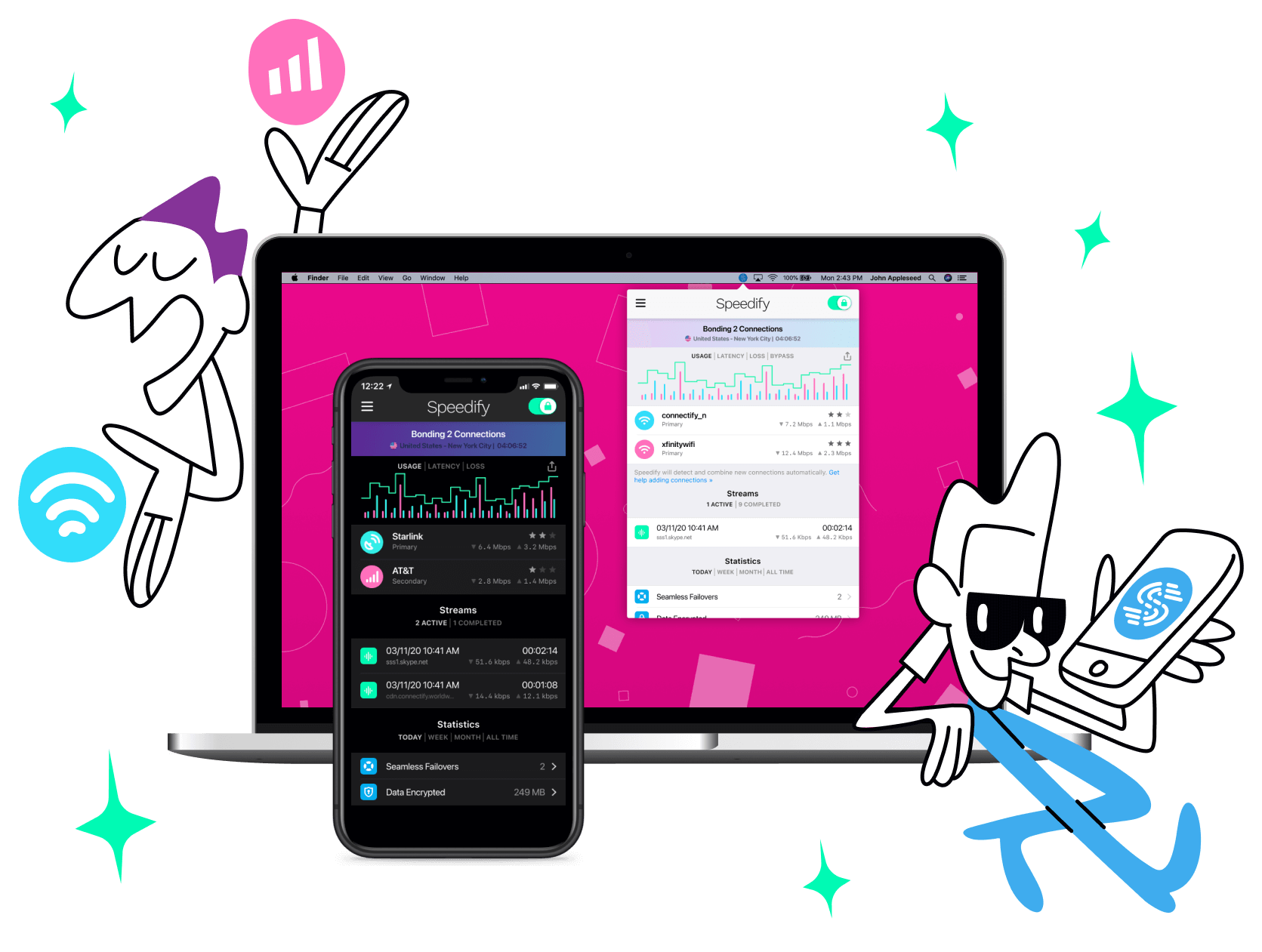
Speedify combines Wi-Fi, 4G / 5G cellular, Ethernet, Starlink, and other satellites for faster internet uploads and downloads
Speedify is the only software app that combines Wi-Fi, 4G / 5G cellular, Ethernet, Starlink and other satellites at once for secure, faster, and more reliable internet uploads and downloads so you stay online without interruptions.
Speedify will automatically detect and start using any available Internet connections on your device while intelligently distributing your online traffic between them for optimal performance. If you need help we have quick start guides available for most common set ups.
Speedify wirelessly joins multiple phone personal hotspots together for faster internet upload and download speeds
Speedify's Pair & Share feature enables you to connect to multiple hotspots at the same time for faster upload and download speeds and more reliable internet for everyone. Speedify's Pair & Share feature allows you to wirelessly share 4G / 5G cellular connections back and forth between multiple Speedify users on the same local network when live streaming from an event, calling from the commute or sharing from the field.
Speedify is the only app that allows you to share 4G / 5G cellular data between PCs, Macs, iPhones and Androids. Use multiple iPhones and Android phones as hotspots for internet access and get faster upload and download speeds and mobile failover for all paired devices.
See how you can use Speedify to combine different Internet connections:

How to Maintain Reliable Connectivity
Ryan: Those Tethering limits could still be a big problem for people that want to do things like Stream sports games outdoors or like event photographers.
Alex Gizis: Oh, yeah. It can be a huge problem trying to do these games, right? So people who try to live stream games, you can call your carrier and ask for a higher priority, larger Tethering plan. And aha, they've got you. They know you're doing something important. Maybe it's business. They'll charge you a lot more for the plans where they make sure that you're higher priority than other people.
They give you more Tethering Data. A lot of these things are either in stadiums where there's so many people that the carriers are running out of bandwidth. Or, they're out in fields where there's normally so few people that the nearest tower could be miles away and you end up with low bandwidth again.
So it's hard to stream games. And so what you want to do is you want to have multiple Cellular radios on different carriers. Verizon has dead spots, AT&T has dead spots, T-Mobile has dead spots, but they're usually not in the same place. So if you can get two of them, best yet three of them, the chances of you hitting some dead spot where your stream stops go to almost nothing.
How to Use More than Two Cellular Connections at Once
Alex Gizis: What we did is this is where we came up with Speedify, the bonding software. So all those live streams where I walked around the city with like mural arts and stuff looking at the artwork and managed to spend hours walking around Philly without ever going offline was all about I use a cell phone on AT&T, so using that, and then I joined the Wi-Fi hotspot with a Verizon phone, and then we used Speedify to bond the two.
So I'd hit dead spots for either one all the time, but as long as one was on, I was still streaming. But then people are saying "but I want to use three. I lose a thousand dollars an hour. I'm offline." You say, oh boy, then how do we get you to three? And the answer was the Pair & Share idea.
So this is where instead of joining some other phone's hotspot, you make a hotspot on your phone. You have other phones join it, running the Speedify app, and they'll offer up to your phone, do you want to use my Cellular? So, if you have three different devices join your hotspot, who let you use their Cellular, now you have four Cellular: the one built into your phone, and the three Cellulars from people who joined your hotspot, and now you're rock solid. You're on T-Mobile, and AT&T, and Verizon, and one more spare, so you can really put together a lot of bandwidth and get a lot, a lot of reliability.
Ryan: Pretty nifty.
Alex Gizis: It is nifty.

Connectivity Tech Discussions
Our Connectivity Tech Discussions Between Two Palms video series shines the spotlight on Alex and technical guests, diving deep into caonversations about the latest Internet technology, including Starlink satellite, WiFi 7, Apple, fiber optics, new routers, remote connectivity, and networking protocols.
Join us and let's talk tech!