

Speedify Uses Two Mounted Starlink Antennas Together as One Faster, More Reliable Internet Connection
The best way to connect two Starlink antennas together is to mount them apart, each with its own clear view of the sky, and plug both into one computer or router running Speedify. Speedify uses both Starlink internet connections at the same time, so you get nearly the full speed of both and stay online when one drops.
Mounting one Starlink antenna is simple: find a clear spot, point it at the open sky and secure it. With two, there’s more to get right. Below: how to mount two Starlink antennas, why you can only check one of them at a time, and how Speedify uses both.
Speedify combines Starlink internet connections with no extra hardware needed
Starlink Internet Connection Drops Happen to Everyone
Speedify measures thousands of Starlink users in more than 140 countries. In September 2026, fixed Starlink dishes went offline for about 38 minutes a day on average, and Starlink dishes on RVs and boats for about 46 minutes a day.
All Starlink dishes also see short dropouts roughly every 15 seconds as the Starlink internet connection switches from one moving satellite to the next. Even a perfectly installed Starlink dish goes offline, and about 7 in 10 Starlink users on Speedify use Starlink together with a second internet connection, like 4G/5G cellular.
How to Mount Two Starlink Antennas
- Mount the two Starlink antennas apart. Leave enough space that neither one shades the other and each keeps its own clear view of the sky: at least 0.9 meters (about 3 feet), following Starlink’s instructions for using several Starlink dishes at one site.
- Pick spots where different things are in the way. Choose spots where a tree or roofline that blocks one Starlink antenna doesn’t block the other, so both are rarely blocked at the same time.
- Check each spot in the Starlink app. Run the obstruction check in the Starlink app at each mounting spot separately, holding your phone exactly where that Starlink antenna will go.
- Use solid mounts. Pole, mast or roof mounts keep each Starlink antenna steady. On boats and vehicles, keep both Starlink antennas away from radar and other antennas.
Why You Can Only Check One of Two Starlink Antennas at a Time, and How Speedify Fixes It
Every Starlink antenna uses the same local address, 192.168.100.1, for its status page. With one Starlink antenna, that’s fine. With two, both answer at the same address, so from one computer you can reach the status of only one of them at a time. And a standard router sends your traffic over one internet connection at a time, so the second Starlink antenna just waits as a spare.
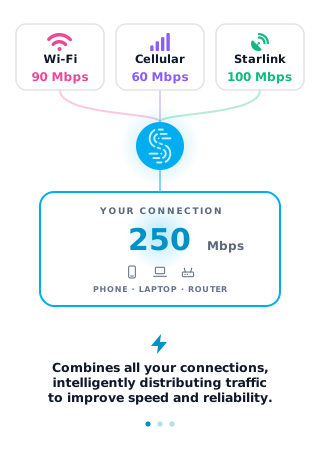
Speedify talks to each Starlink antenna separately, so the status of both shows up at once. Speedify uses all your internet connections at the same time, so you get nearly the full speed of both Starlink antennas combined, and Speedify moves your traffic to the other Starlink antenna if one drops. The Starlink Control Center in Speedify shows both Starlink antennas side by side, with their status and obstruction maps. For the full walkthrough, see how to manage two Starlink dishes at once with Speedify.
Both Starlink antennas still use the same Starlink network, so an outage of the whole Starlink network takes both down. A 4G/5G cellular connection added to Speedify keeps you online even then.
Who Mounts Two Starlink Antennas
Overlanders. Someone living out of a truck or van mounts two Starlink antennas on the roof rack. Used together with Speedify, the two keep work and maps online as the vehicle moves, and one blocked or broken Starlink antenna doesn’t take them offline.
Live event crews. A broadcast or live event crew mounts two Starlink antennas on a production truck to send live video out. Used together, the two add up their upload speed for live video, and one dropping doesn’t end the broadcast.
Sites with several buildings. A farm or construction site spread across several buildings mounts Starlink antennas on different roofs, each clear of different trees or structures. Speedify uses them together as one internet connection that covers the whole site and stays up when one Starlink antenna fails.
How to Set Up Two Mounted Starlink Antennas with Speedify
Once both Starlink antennas are mounted and connected, install Speedify on your computer or on a router that works with Speedify. Check that both Starlink antennas show up in Speedify as separate internet connections, and set each one to Always. Speedify starts using both Starlink antennas at once.
Two Mounted Starlink Antennas Work as One with Speedify
Mount the two Starlink antennas apart, each with its own clear view of the sky, connect both to Speedify, and the two work as one internet connection that adds up their speed and keeps you online when one Starlink antenna goes down. Speedify makes your Starlink faster, more reliable, and more secure.
Speedify
Get started with Speedify today.
Combine Wi-Fi, 4G/5G cellular, Ethernet, Starlink, and more into one faster, steadier connection. Free to try — no credit card required.
🚀 Speed
Faster uploads and downloads by bonding all your connections at once.
📶 Stability
Automatic failover in under a second when any connection drops.
🔒 Security
AES-256 encryption on every connection, on every network you join.


15M+ downloads worldwide. 75K+ five-star reviews on iOS and Android.