
Starshield Is Sold Only to Governments, and Speedify Keeps the Starlink Plans Everyone Else Can Buy Online
Starshield vs Starlink comes down to who each network serves. Starlink is SpaceX’s satellite internet service for homes, travelers, boats and businesses. Starshield is SpaceX’s satellite network and business unit for governments, built on Starlink technology and, for communications, on the same satellites plus about 240 of its own. SpaceX’s Starshield page describes it as a service for government use. Homes and businesses can’t buy Starshield; they buy Starlink plans.
Below: how the two networks differ in satellites, orbits, terminals and price, who buys Starshield, how speed limits on Starlink and Starshield terminals work, and a dated list of Starshield contracts (updated 20 November 2026). The last section covers Speedify, an app that uses Starlink and 4G/5G cellular at the same time, so your internet connection keeps going when Starlink drops. On a single Starlink internet connection, Speedify works as an encrypted VPN but can’t add speed or stop drops.
What Starshield Is and What It Does
SpaceX announced Starshield on its website in December 2022. SpaceX’s Starshield page describes three jobs:
- Earth observation: Starshield launches satellites with sensing payloads and delivers the processed data to the government user.
- Communications: Starshield provides global communications to government users through Starshield user equipment.
- Hosted payloads: Starshield builds satellite buses, the base spacecraft, that carry a customer’s own payload.
SpaceX also says Starshield adds high-assurance cryptography on top of Starlink’s encryption so it can carry classified payloads, and that Starlink’s laser terminal, which links satellites to each other, can be fitted to partner satellites so they join the Starshield network.
Starshield vs Starlink: The Main Differences
| Starlink | Starshield | |
|---|---|---|
| Who can buy it | Homes, travelers, boats and businesses in more than 160 countries, territories and other markets | Governments only: US military and intelligence agencies, plus allies such as the UK |
| Satellites | More than 11,000 in orbit | Uses Starlink’s satellites for communications, plus about 240 satellites of its own; no official count |
| Orbit | Low Earth orbit, roughly 340 to 570 km up | Low Earth orbit; not published, but trackers place most satellites in orbits tilted about 70 degrees, roughly 270 to 580 km up |
| Terminals and gateways | Starlink kits, such as the Standard dish and Starlink Mini | Dedicated Starshield terminals, or Starlink terminals set up for Starshield service; separate network gateways |
| Can use the other network | No: Starlink users can’t use Starshield | Yes: US national security users can also use Starlink |
| Encryption | SpaceX says user data is encrypted end to end | Adds high-assurance cryptography for classified data |
| Speeds | Typical speeds published for each plan | Not published |
| Price | Published plan prices | Not published; reported UK prices are £4,000 to £7,000 per terminal and from £5,500 a month |
| Who decides on limits | SpaceX | The US government, according to Elon Musk |
The satellite counts come from astronomer Jonathan McDowell, who tracks every launch: on 18 November 2026 he counted 11,208 Starlink satellites in orbit and 241 Starshield satellites. Starlink’s orbits are moving lower. SpaceX is lowering about 4,400 satellites from about 550 km to about 480 km during 2026 for safety reasons, according to SpaceX’s Michael Nicolls, and the FCC approved new Starlink shells between 340 km and 485 km in January 2026.
SpaceX doesn’t publish Starshield speeds, and no government user has, so there is no public answer to whether Starshield is faster than Starlink.
The terminal and gateway details come from Britain’s defence ministry, which told Reuters in September 2026 that its Starshield service uses the same satellite constellation and ground stations as Starlink, with its own dedicated terminals and separate network gateways. Reuters also reported that the UK pays £5,500 a month for a Starshield plan with 5 TB of data, or £25,000 a month for unlimited data, against £1,830 a month for a Starlink business plan with 2 TB.
Starshield doesn’t always need its own hardware. Starshield service runs on dedicated Starshield terminals or on Starlink terminals set up for Starshield (Space.com). In Ukraine, the December 2024 contract gave 2,500 Starlink terminals already in the country access to Starshield, on top of 500 connected earlier (Militarnyi, citing Bloomberg). Starshield terminals carry more encryption than those sold to consumers and can also connect to the commercial Starlink network (Breaking Defense). Defense suppliers sell rugged versions too: CopaSAT’s Storm V3 houses SpaceX’s Starshield antenna, weighs 30 pounds and costs $30,000 (SpaceNews).
Access runs one way. Starshield’s own satellites are physically separate from Starlink’s, and US national security users can also use the Starlink network, but a commercial Starlink user can’t use Starshield, Bleddyn Bowen, who studies space policy at Durham University, told Space.com. Bowen says Starshield satellites are built on the same base spacecraft as Starlink’s but carry more equipment, with more secure hardware and software.
Control differs too. SpaceX builds and runs Starshield, but Elon Musk said in October 2026 that the Starshield systems it sells are owned and controlled by the US government, while Starlink is a commercial service owned and controlled by SpaceX. Reuters noted that the two systems share much of the same satellite technology, and that secrecy keeps the line between them unclear.
Starshield also transmits on radio frequencies Starlink’s internet service doesn’t use. In October 2025, amateur satellite tracker Scott Tilley detected signals from 170 Starshield satellites in the 2025 to 2110 MHz band, which is reserved for sending signals up to satellites, not down from them (NPR). Starlink’s internet service runs at much higher frequencies. Tilley estimates the Starshield signal carries data at rates closer to 3G cellular. Its purpose is unknown: SpaceX and the NRO didn’t respond to NPR.
Neither SpaceX nor the Pentagon has said whether Starshield resists jamming better than Starlink, and no public test compares the two. The jamming reported in Ukraine targets terminals on the ground: Russia has used its Volna Kupol Garant electronic warfare system to jam Starlink terminals in Ukraine since 2025, according to Ukraine’s electronic warfare directorate (Janes). For how that jamming works, see Starlink jammers explained.
How Many Starshield Satellites Are in Orbit
Neither SpaceX nor the US government publishes a Starshield satellite count. Jonathan McDowell’s estimate of 241 includes 144 satellites in their working orbits and 97 still moving into place. His orbit plots show most of them tilted about 70 degrees to the equator, between roughly 270 km and 580 km up, and Tilley’s signal report matched the satellites he heard to orbits tilted about 70 degrees. The official pieces:
- 22 May 2024: the National Reconnaissance Office (NRO), the US spy satellite agency, launched the first satellites (mission NROL-146) of its new proliferated constellation, a large network of smaller satellites, on a SpaceX Falcon 9. The NRO did not say how many satellites were on board or who built them.
- June 2025: a Space Force commander described MILNET, the communications network SpaceX runs for the government, as “480-plus” satellites, a planned size, not a count in orbit.
- 18 June 2026: the NRO counted 14 launches of its proliferated constellation and described it as hundreds of satellites strong.
The NRO satellites are widely reported to be built on SpaceX’s Starlink design, but neither the NRO nor SpaceX has confirmed which satellites are Starshield.
Those satellites do more than carry data. They have communications and imaging payloads, and by December 2025 they had made more than 160,000 imagery and data collections and cut the time from collecting data to delivering it from hours to single-digit minutes, according to NRO deputy director Maj. Gen. Chris Povak, who said nearly 200 were in orbit then (Air & Space Forces Magazine). Reuters reported that Northrop Grumman is on contract alongside SpaceX.
Who Can Buy Starshield: The US Government and Its Allies
Starshield is sold to governments only. SpaceX sells it to the Pentagon under a 2023 agreement, and allied governments buy it directly or through US contracts:
- United Kingdom: the first country outside the US to say publicly that it uses Starshield. The defence ministry has bought about 1,000 Starshield terminals and spent about £13 million on the service since 2024, according to Reuters.
- New Zealand: the New Zealand Defence Force is trialing Starshield for military use.
- Ukraine: the US pays. In December 2024 the Pentagon gave SpaceX a contract to extend Starshield access to Ukrainian terminals (Bloomberg). That contract runs to mid-2027 (Breaking Defense).
Reuters says other US partners are evaluating Starshield. There is no public price list, and no report of Starshield being sold to a company or a household.
How a Starshield Speed Limit Works, and Why It Exists
Starlink and Starshield terminals can be cut off above a set speed. The concern is weapons: a satellite terminal on a fast drone turns an internet connection into a guidance link. In 2026, speed limits cut off terminals in Ukraine, mostly on drones. First came a limit on Starlink terminals that Russian attack drones were using for guidance, and Ukraine’s defence ministry started a whitelist that disconnects any terminal it hasn’t verified. In October, Ukraine’s own Starshield terminals moving faster than 160 km/h (100 mph) were also cut off, according to Ukrainian officials and units. Ordinary Starlink plans have a speed limit too: since March 2026, Roam and Priority plans work in motion only up to 100 mph, and faster use needs an aviation plan.
SpaceX has not published how its limits work. The reports describe three parts:
- The terminal knows its speed. A Starlink terminal has a GPS receiver and a motion sensor, as Speedify’s video above explains. Satnews describes the October limit as a firmware rule that uses those sensors.
- The network checks it. Russian units got around an earlier limit with boards that faked the speed data. Since then, according to Ukrainian adviser Serhiy Beskrestnov, Starlink measures a terminal’s position and speed through its own satellites instead of trusting the terminal.
- The rule lives in SpaceX’s software. A limit can apply by speed, by area or by terminal (whitelisted brigade terminals were exempt in February), with no hardware change. A terminal over the limit shows “Movement speed is too high” in the Starlink app and stops passing data.
Starshield Contract Timeline: Dated Awards and What Is Not Public
Updated 20 November 2026. Amounts are as reported; where an agency hasn’t confirmed a figure, the table says so.
| Date | What happened | Not public |
|---|---|---|
| 5 Dec 2022 | SpaceX unveils Starshield on its website (CNBC) | Customer list |
| March 2024 | Reuters reports SpaceX holds a classified NRO contract to build a network of spy satellites; Breaking Defense reported its value as $1.8 billion in April 2024 | The NRO and SpaceX have not confirmed the contract or its value |
| 22 Nov 2024 | A Space Force official says the Proliferated LEO program, which buys commercial satellite communications in low Earth orbit for the US military, has issued $660 million in orders, the majority to Starshield; the program’s spending ceiling had been raised from $900 million to $13 billion | Starshield’s share in dollars |
| Dec 2024 | The Pentagon contracts SpaceX to extend Starshield access to Ukraine (Bloomberg) | Contract value |
| 18 Jun 2025 | Breaking Defense reports the Space Force is contracting with SpaceX for MILNET, a government-owned, SpaceX-operated communications network of “480-plus” satellites | Contract value and terms |
| 26 May 2026 | Space Force awards SpaceX $2.29 billion for the Space Data Network backbone, a prototype due by the end of 2027; Via Satellite describes the network as derived from the NRO’s Starshield-based MILNET | Number of satellites, payment schedule |
| 29 May 2026 | Space Force awards SpaceX $4.16 billion for SB-AMTI, satellites that track aircraft and other airborne targets from orbit, with a constellation due by 2028 | Number of satellites; the reports don’t say whether the satellites are Starshield-based |
| 10 Sep 2026 | Britain’s defence ministry tells Reuters it has adopted Starshield, with about 1,000 terminals and about £13 million spent since 2024 | Contract terms |
What Homes and Businesses Get Instead of Starshield
Outside governments, everyone chooses from Starlink’s plans:
- Homes: Residential plans for a fixed address.
- Travelers, RVs and boats: Roam plans, which Starlink deprioritizes compared with its other plans during busy hours.
- Businesses: Priority plans (Local and Global Priority, renamed Business and Global Business from 1 December 2026). Starlink gives Priority data network precedence over Standard and Roam data, and Priority plans come with a service level agreement of 99.9% monthly network availability (Starlink Mini kits are excluded).
For a side-by-side of Starlink and its nearest rival, see Amazon Leo vs. Starlink compared.
Neither network is immune to dropouts. Both depend on radio links to satellites, so heavy rain, snow and anything that blocks the view of the sky, such as trees, can slow or cut a connection. Starlink says heavy rain or wind can mean slower speeds or a rare outage (see how weather affects Starlink). Starshield service can run on Starlink terminals, so weather and obstructions affect it the same way.
On 24 July 2025, a failure of the software that runs Starlink’s core network took the service down worldwide for about 2.5 hours, and Ukraine’s drone forces commander said Starlink was down across the entire front. The same failure took Starshield offline: Starshield runs over the Starlink network, so US military users lost service for the whole outage, the Space Force told FedScoop. A home or business on one Starlink dish has one path to the sky, and any outage takes it offline.
Starlink Internet Connection Dropouts Happen to Everyone
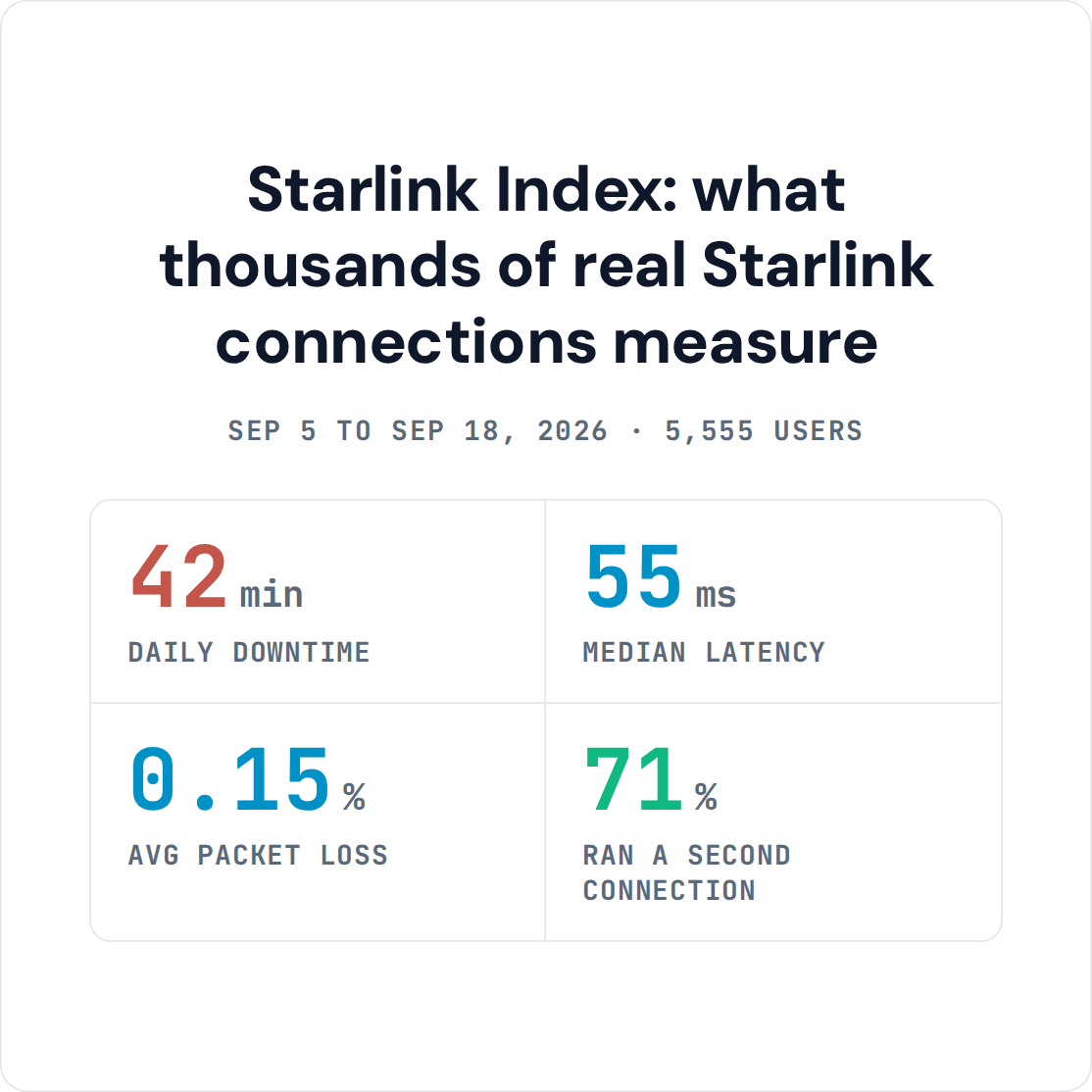
Speedify measures thousands of Starlink users in more than 150 countries. From 29 September to 12 October 2026, fixed Starlink dishes went offline for about 37 minutes a day on average, and Starlink dishes on RVs and boats for about 61 minutes a day.
Starlink also switches each dish to a new satellite every 15 seconds, and a switch can cause a short dropout. Even a perfectly installed Starlink dish goes offline, and about 7 in 10 Starlink users on Speedify use Starlink together with a second internet connection, like 4G/5G cellular.
Make the Starlink Plan You Can Buy More Reliable with Speedify
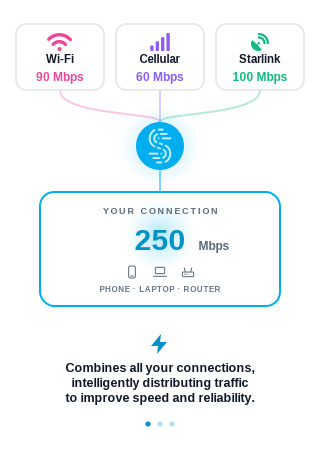
Speedify gives a Starlink internet connection the second path that a single dish lacks. Speedify combines Starlink with 4G/5G cellular, Wi-Fi or Ethernet, and Speedify says it delivers up to 95% of their combined speed. When Starlink drops, Speedify moves your traffic to the other connection in milliseconds, on the same public IP address, so calls and logins don’t reset. Speedify also encrypts your traffic from your device to a Speedify server. Read more about Starlink failover without dropped calls.
For home and RV users: Speedify’s free plan includes 5 GB a month with a free account, and the Individual plan costs $89.99 a year. Download Speedify to add 4G/5G cellular to your Starlink internet connection.
For businesses: Speedify Teams keeps offices, vehicles and remote sites online on Starlink and cellular under one company account, and a Speedify Dedicated Server adds a private Speedify server with a static public IP address. See Starlink failover for business, or Contact the Speedify team.
Speedify
Get started with Speedify today.
Speedify combines Wi-Fi, 4G/5G cellular, Ethernet, Starlink and satellite into one faster, more reliable internet connection. Free to try: 5 GB a month with a free account. No credit card required.
🚀 Speed
Faster uploads and downloads, because Speedify uses all your internet connections at once.
📶 Stability
If one internet connection drops, Speedify moves your traffic to the others in milliseconds.
🔒 Security
AES-256 encryption on every internet connection, on any network you join.


15M+ downloads worldwide. 75K+ five-star reviews on iOS and Android.