
Understanding the Satellite Internet Landscape: Amazon Leo vs Starlink
Amazon’s Leo and SpaceX’s Starlink are both satellite internet networks built on low Earth orbit satellites, and Amazon Leo is likely Starlink’s biggest competitor. This comparison covers the technology each one uses, expected speeds and the customer terminals, and how the Speedify app keeps you online by combining a satellite internet connection with 4G/5G cellular, Wi-Fi or wired Ethernet.
Amazon Leo: Amazon’s Own Satellite Internet Network
A common misunderstanding first: Amazon Leo is not part of Jeff Bezos’ Blue Origin. Amazon Leo is Amazon’s own project, built to bring fast and reliable satellite internet to locations all over the world.
Most probably Starlink’s biggest competitor, Amazon Leo has some clearly defined goals. Here is Amazon Leo at a glance, from what Amazon has announced so far:
- Planned Satellite Constellation: Over 3,000 satellites (3,232 satellites to be exact)
- Primary Goal: Provide affordable, high-speed internet globally
- Satellite deployment date: early 2025
- Service roll out date: 2025
Leo vs Starlink, the Technical Battleground: Satellite Deployment and Performance
Both Starlink and Amazon Leo will have similar main infrastructure elements: the satellites, the ground antennas and the satellite dishes. Both will use Low Earth Orbit (LEO) satellites.
When comparing Leo vs Starlink’s satellite constellations, one can see that Starlink clearly has more satellites planned and they orbit at a different altitude:
Starlink:
- Current satellite count: Over 6,000
- Orbital altitude: Approximately 400 kilometers
Amazon Leo:
- Planned satellite count: More than 3,000
- Orbital altitude: Around 500 kilometers
One of the differentiators of Amazon Leo lies in its orbital strategy. Their satellites, orbiting 100 kilometers above Starlink’s, expand their geographical reach. This higher altitude grants each unit a broader coverage area. But, this comes with a critical engineering challenge.
Radio signals follow an inverse square law: signal strength falls with the square of the distance. Because Leo satellites orbit higher, about 40% less signal power reaches the ground than from Starlink’s lower satellites, assuming the same transmit power and antenna size.
To counteract reduced signal strength, Leo plans to use slightly larger antennas. By increasing antenna size by roughly 20%, they can restore signal performance.
Orbital Considerations: Low Earth vs. Geosynchronous
How do traditional satellite networks differ from Starlink and Amazon Leo? Currently there are 3 main orbits that can hold satellites:
- Low Earth Orbit (LEO): 300 to 1,500 km, the closest orbit to Earth
- Medium Earth Orbit (MEO): 7,000 to 20,000 km
- Geostationary Orbit (GEO): 35,786 km. A satellite in this orbit circles the Earth at the same speed the Earth turns, so it appears to stay in a fixed position in the sky. That distance adds delay, which is why Starlink does not use high orbit satellites.
As most public communication satellites are deployed in LEO and GEO, here’s how these compare:
Starlink, Amazon Leo: LEO Satellites
- Much lower delay, or latency (Starlink says 25 to 60 ms on land)
- Higher bandwidth potential
- More responsive for real-time applications
- Lower power transmission requirements
Other providers: GEO Satellites
- Extreme latency (500+ ms)
- Restricted bandwidth
- Requires large, fixed directional dishes
- Less suitable for modern internet applications
MIMO Antenna Technology: Must Have for Starlink and Leo
Both Starlink and Leo use Multiple Input, Multiple Output (MIMO) antenna technology, a big change from the single large dish of traditional satellite internet.
How MIMO antennas help communications:
- They replace single large dish with multiple smaller, omnidirectional antennas
- Typically arranged in rows and columns (Starlink uses 64 antennas)
- Sophisticated software combines signals, creating a “virtual” directional antenna
- Enables dynamic tracking of moving satellites in real-time
The software works out the tiny differences in when the satellite’s signal reaches each small antenna and corrects for them, so the antennas add up to one strong signal, as if a dish were pointed straight at the satellite.
Combine Starlink or Amazon Leo with a Second Internet Connection Using Speedify
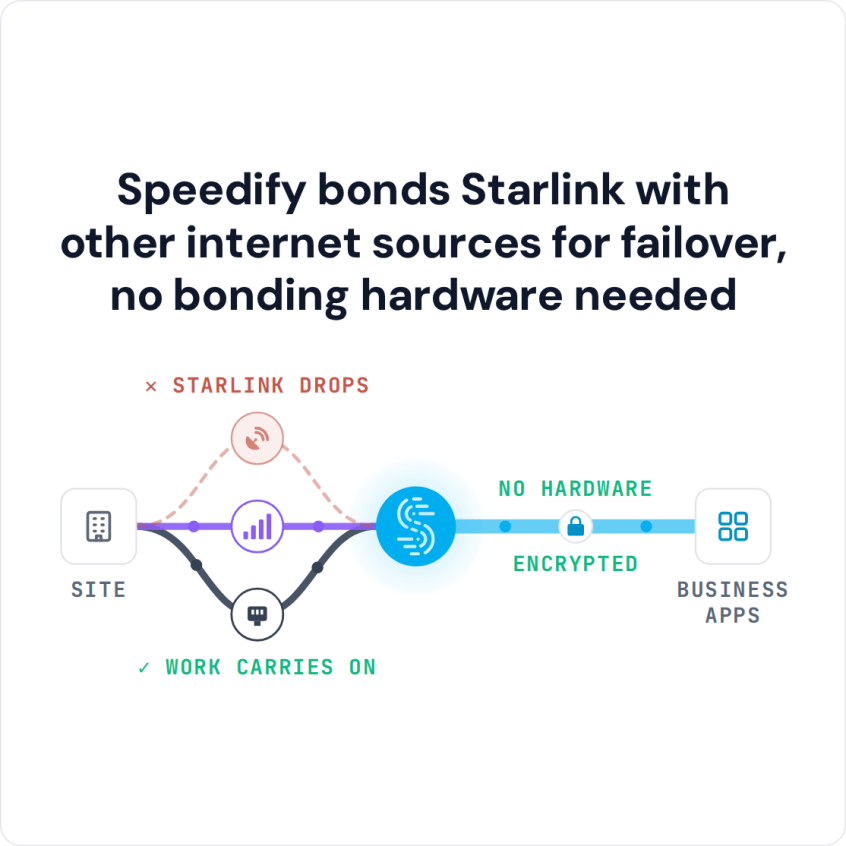
Speedify is an app that combines several internet connections and uses them at the same time, and it works with Starlink and Amazon Leo alike. You get a more reliable internet connection, especially during satellite switches.
Starlink dishes make synchronized satellite switches every 15 seconds: every dish changes satellites at the same moment, and each switch can cause a short dropout. Speedify gives you automatic failover on Starlink and on Amazon Leo, so your traffic moves to another internet connection during those dropouts.
Speedify can combine a satellite connection with an existing DSL, cable, tethered phone or another broadband line, so your internet stays up during those satellite switches.
Speedify can also combine Starlink and Amazon Leo internet connections. A Speedify video asks whether Amazon Leo fixes Starlink’s missing redundancy. Two satellite internet connections from different networks, used together with Speedify, keep a live stream or video call going when one of them drops or switches satellites.
Amazon Leo’s Three Terminals and Their Speeds Compared with Starlink
Amazon is building three Amazon Leo customer terminals, each with its own top speed:
Ultra Compact Model (direct competitor for Starlink Mini)
- 7-inch square design customer terminal
- Maximum Speed: 100 Mbps
- Ideal for mobile and lightweight applications
- Designed for maximum portability and accessibility
Standard Model (direct competitor for Starlink for Homes)
- 11-inches square design customer terminal
- Maximum Speed: 400 Mbps
- Balanced performance for residential and small business use
- Cost of production: $400 or less
High-Bandwidth Model (direct competitor for Starlink for Businesses)
- 19×30 inches rectangular design terminal
- Maximum Speed: 1 Gbps
- Designed for high-bandwidth professional environments
- Targeting demanding business and institutional users
Starlink leads in satellites in orbit today, but Amazon’s resources make Leo a strong competitor. Competition between the two should bring faster, more dependable and more affordable satellite internet to homes and businesses, especially in areas with poor coverage.
For home users: Download Speedify to use your Starlink internet connection together with 4G/5G cellular, so you stay online when Starlink drops.
For businesses: Contact Us to plan Speedify for satellite internet at your sites.
