

Speedify Helps Windows PC Wi-Fi Work Faster by Combining Wi-Fi and 4G/5G Cellular at Once
Want faster Wi-Fi on your Windows PC? Run Wi-Fi and a second connection at the same time.
Speedify is an app that combines two or more internet connections at once – such as Wi-Fi and a phone’s 4G/5G cellular – so you get faster upload and download speeds and stay online if one connection drops out. This guide covers every proven way to make Windows Wi-Fi faster, from settings fixes to combining connections.
With Speedify, your internet stays on when one connection fails.
When one of your connections drops, Speedify automatically routes your traffic to your remaining connections — so calls don't cut out and downloads don't stall.
How do I use WiFi and 4G/5G cellular at the same time with Speedify?
Pick your two internet connections and your device below and we'll take you to the step-by-step setup guide.


Why Wi-Fi on a Windows PC Is Slow: The Most Common Causes
Before applying fixes, identifying the actual cause of slow Windows Wi-Fi produces faster results. These are the most common causes:
- Router distance and physical obstructions: Wi-Fi signal strength drops significantly with distance. Walls, floors, large appliances, and furniture between a PC and the router reduce signal strength and throughput. A PC one room away from a router often gets a fraction of the speed a PC next to the router receives.
- Wi-Fi channel congestion: In apartments, offices, and dense residential areas, neighboring Wi-Fi networks compete for the same radio channels. Channel congestion causes interference that reduces the effective speed every device on the network receives.
- 2.4 GHz vs. 5 GHz band selection: Windows sometimes connects a PC to the 2.4 GHz band instead of the faster 5 GHz band, particularly when the PC is at the edge of 5 GHz range. The 2.4 GHz band is slower and more congested than the 5 GHz or 6 GHz bands.
- Outdated network adapter drivers: Windows Wi-Fi adapters require up-to-date drivers to perform reliably. Outdated or corrupted drivers cause connection instability, reduced throughput, and increased latency.
- Outdated router firmware: Router manufacturers release firmware updates that improve Wi-Fi performance, fix bugs, and patch security vulnerabilities. Routers running outdated firmware often underperform.
- Windows background processes consuming bandwidth: Windows Update, OneDrive sync, Microsoft Store app updates, and antivirus definition downloads all consume Wi-Fi bandwidth in the background — sometimes saturating the connection during active use.
- DNS server performance: Windows uses the DNS server assigned by the router by default. ISP-provided DNS servers are often slower than third-party alternatives, adding latency to every website request.
- Single connection dependency: Every Windows PC running on Wi-Fi alone is fully dependent on that one connection. When Wi-Fi slows down or drops, every application on the PC is affected with no alternative path for traffic.
How to Make Wi-Fi on a Windows PC Faster: Windows Settings Fixes
Fix 1: Forget and Reconnect to the Wi-Fi Network
Windows stores Wi-Fi network profiles that can become outdated or corrupted. Forgetting a network and reconnecting forces Windows to establish a clean connection with fresh DHCP settings and channel selection.
- Open Settings → Network & Internet → Wi-Fi → Manage Known Networks.
- Click the network the PC is connected to and select Forget.
- Reconnect to the Wi-Fi network by selecting it from the list and entering the password.
Fix 2: Renew the IP Address (Release and Renew DHCP Lease)
A stale DHCP lease can cause routing issues that slow down Wi-Fi performance on a Windows PC without producing any visible error. Releasing and renewing the IP address forces the router to assign a fresh address and network configuration.
- Open Command Prompt as Administrator (search for “cmd”, right-click, Run as administrator).
- Type
ipconfig /releaseand press Enter. - Type
ipconfig /renewand press Enter.
Fix 3: Switch to a Faster DNS Server
Replacing the ISP-assigned DNS server with a faster third-party alternative reduces the time it takes for Windows to resolve domain names — improving the perceived speed of every website and cloud service the PC connects to.
- Open Control Panel → Network and Internet → Network Connections.
- Right-click the Wi-Fi adapter and select Properties.
- Select Internet Protocol Version 4 (TCP/IPv4) and click Properties.
- Select “Use the following DNS server addresses” and enter 1.1.1.1 (Cloudflare) as the preferred DNS and 1.0.0.1 as the alternate DNS.
- Click OK to apply.
Fix 4: Force the PC to Connect to the 5 GHz or 6 GHz Band
If the router broadcasts separate network names for 2.4 GHz and 5 GHz bands, connect the PC explicitly to the 5 GHz network. Alternatively, configure the Wi-Fi adapter to prefer 5 GHz in Device Manager → Network Adapters → right-click the Wi-Fi adapter → Properties → Advanced → Preferred Band → set to “Prefer 5 GHz band”.
Fix 5: Flush the Windows DNS Cache
A corrupted DNS cache causes slow or failed domain resolution on a Windows PC. Flushing the cache forces Windows to perform fresh DNS lookups for all domains.
- Open Command Prompt as Administrator.
- Type
ipconfig /flushdnsand press Enter.
Fix 6: Update the Wi-Fi Adapter Driver
Outdated or corrupted Wi-Fi adapter drivers cause speed and stability issues that no router-side fix can resolve. Open Device Manager → Network Adapters → right-click the Wi-Fi adapter → Update Driver. Alternatively, download the latest driver directly from the PC or adapter manufacturer’s website (Intel, Qualcomm, Realtek, or the PC brand’s support page).
Fix 7: Disable Wi-Fi Sense and Background Delivery Optimization
Windows includes features that consume Wi-Fi bandwidth in the background. Delivery Optimization allows Windows to upload Windows Update files to other PCs on the local network and internet, consuming upload bandwidth. Disable it in Settings → Windows Update → Advanced Options → Delivery Optimization → Allow Downloads from Other PCs (set to Off or limit to Local Network only).
How to Make Wi-Fi on a Windows PC Faster: Router and Hardware Fixes
Fix 8: Move the Router or the PC
Position the router in a central, elevated location with clear line of sight to the areas where the PC is used most frequently. Every wall, floor, and large object the Wi-Fi signal passes through reduces signal strength. Moving the router even a few meters can produce a significant improvement in the speed the PC receives.
Fix 9: Change the Router’s Wi-Fi Channel
Most routers select a Wi-Fi channel automatically, but automatic channel selection often results in the router using the same channel as several neighboring networks. Log into the router’s admin interface and manually select a less congested channel. For 2.4 GHz networks, channels 1, 6, and 11 are the only non-overlapping options. For 5 GHz networks, a wider range of non-overlapping channels is available with significantly less interference in most environments.
Fix 10: Update Router Firmware
Check the router manufacturer’s website or the router’s admin interface for available firmware updates. Firmware updates frequently include Wi-Fi performance improvements, bug fixes for connection stability issues, and security patches.
Fix 11: Use a Wi-Fi Analyzer to Identify Interference
Free tools like Wi-Fi Analyzer (available in the Microsoft Store) scan nearby networks and display signal strength, channel utilization, and congestion data. Use the results to identify the least congested channels in the local environment and configure the router accordingly.
Real-World Wi-Fi Speeds on a Windows PC: What the Fixes Above Actually Change
| Fix | What It Improves | Typical Impact |
|---|---|---|
| Switch to 5 GHz or 6 GHz band | Download and upload throughput | High — often 2–5x faster than 2.4 GHz |
| Switch to Cloudflare DNS (1.1.1.1) | Page load times, app response speed | Medium — 20–50ms reduction in DNS lookup time |
| Change Wi-Fi channel | Throughput, connection stability | Medium to High in congested environments |
| Move router closer / reposition | Signal strength, throughput | High — signal strength drops sharply with distance |
| Update Wi-Fi adapter driver | Connection stability, throughput | Medium — fixes driver-specific performance issues |
| Release and renew DHCP lease / forget and reconnect | Connection stability, routing | Low to Medium — fixes specific software-layer issues |
| Flush DNS cache | Domain resolution speed | Low — fixes corrupted cache issues only |
The Most Effective Fix to Get Faster Wi-Fi on Windows PC: Use Speedify to Combine Wi-Fi with 4G/5G Cellular, Starlink, Wired Broadband and Any Other Internet Sources
All of the fixes above improve the performance of a single Wi-Fi connection. None of them eliminate the fundamental limitation: a Windows PC running on Wi-Fi alone is fully dependent on that one connection. When Wi-Fi slows down during peak hours, when the router drops briefly, or when the PC moves to the edge of Wi-Fi range, every application on the PC is affected with no alternative.
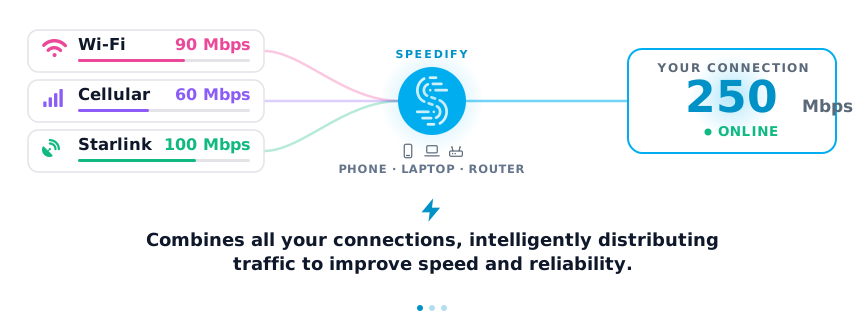
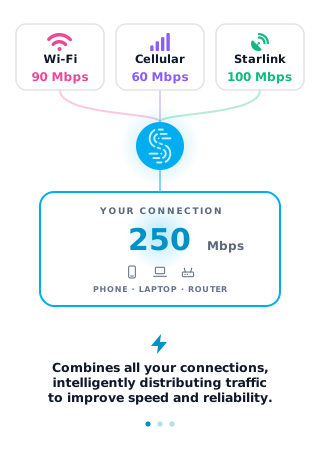
Speedify solves this by combining Wi-Fi and 4G/5G cellular simultaneously on a Windows PC using channel bonding technology. Both connections carry active traffic at the same time — so the PC gets the combined download and upload speeds of both, and automatic failover between them if either slows down or drops.
Speedify Combines Wi-Fi and 4G/5G Cellular Download and Upload Speeds: A Windows PC running Speedify with a 100 Mbps Wi-Fi connection and a 60 Mbps 4G/5G cellular hotspot active simultaneously gets close to 160 Mbps of combined throughput — faster downloads, faster uploads, and faster response times for every application on the PC. Wi-Fi and 4G/5G cellular are used together, not switched between.
Speedify Provides Automatic Failover When Wi-Fi Slows Down or Drops: When the Wi-Fi connection on a Windows PC slows during peak hours or drops during a router restart, Speedify’s automatic failover technology shifts all traffic to the 4G/5G cellular connection instantly — without dropping a Zoom call, interrupting a file upload, or pausing a download. No manual switching required.
Speedify Distributes Traffic Across Wi-Fi and 4G/5G Cellular in Real Time: Speedify continuously monitors the speed and latency of both the Wi-Fi and 4G/5G cellular connections and distributes traffic accordingly using Speedify’s proprietary protocol. When Wi-Fi is fast, Speedify uses more of it. When 4G/5G cellular is faster, Speedify shifts traffic there. The PC always uses the best available path for every packet.
Speedify Encrypts All Wi-Fi Traffic: Speedify is also a VPN that encrypts all traffic flowing across both the Wi-Fi and 4G/5G cellular connections simultaneously. Public Wi-Fi networks at airports, hotels, cafés, and co-working spaces are unencrypted by default — Speedify protects passwords, banking sessions, and sensitive data on every network the PC connects to.
How to Set Up Speedify to Make Wi-Fi on a Windows PC Faster
- Connect the PC to Wi-Fi as normal.
- Add a 4G/5G cellular connection — enable Personal Hotspot on an iPhone or Mobile Hotspot/USB Tethering on an Android phone and connect to the PC via USB tethering. USB tethering creates a separate network interface alongside Wi-Fi that Speedify can bond. Alternatively, use a USB cellular modem or a PC with a built-in 4G/5G modem.
- Download and install Speedify on the PC (available for Windows, macOS, iOS, Android, Linux, and OpenWrt).
- Open Speedify and connect. Speedify automatically detects the Wi-Fi connection and the 4G/5G cellular connection, and begins bonding both. Both connections appear in the Speedify dashboard with real-time download speed, upload speed, and latency data for each.
- Optionally, enable Streaming Mode in Speedify settings to optimize packet delivery for video calls and live streaming, or set per-connection data limits to manage cellular data usage.
Speedify vs. Windows Wi-Fi Fixes: What Each Approach Achieves
| Approach | Faster Downloads and Uploads? | Works When Wi-Fi Slows Down? | Automatic Failover? | Encrypted Traffic? | Requires Hardware Changes? |
|---|---|---|---|---|---|
| Speedify (Wi-Fi + 4G/5G Cellular Bonded) | ✅ Yes — combined throughput | ✅ Yes — shifts to 4G/5G cellular | ✅ Yes | ✅ Yes | ✅ No — software only |
| Switch to 5 GHz / 6 GHz band | ✅ Yes — within Wi-Fi range | ❌ No | ❌ No | ❌ No | ❌ No |
| Switch to Cloudflare DNS | ⚠️ Partial — page loads only | ❌ No | ❌ No | ❌ No | ❌ No |
| Change Wi-Fi channel | ✅ Yes — in congested environments | ❌ No | ❌ No | ❌ No | ❌ No |
| Move router / reposition PC | ✅ Yes — improves signal strength | ❌ No | ❌ No | ❌ No | ✅ Yes — physical move required |
| Other VPNs | ❌ No (often slower) | ❌ No | ❌ No | ✅ Yes | ❌ No |
Frequently Asked Questions About Making Wi-Fi on a Windows PC Faster
Why is Wi-Fi slow on a Windows PC but fast on other devices?
If Wi-Fi is slow on a Windows PC but fast on other devices connected to the same network, the issue is likely specific to the PC’s Wi-Fi adapter driver, a stale DHCP lease, or Windows connecting to the 2.4 GHz band instead of 5 GHz. Try updating the Wi-Fi adapter driver, releasing and renewing the IP address, and confirming the PC is connected to the 5 GHz band.
Does Speedify make Wi-Fi faster on a Windows PC without a second connection?
Speedify requires at least two active connections to bond. With only Wi-Fi active, Speedify still encrypts traffic and provides VPN protection, but channel bonding and speed improvements require a second connection such as a 4G/5G cellular hotspot.
Does using Speedify drain phone battery when tethering?
When a phone is connected to a Windows PC via USB tethering, the PC charges the phone while using the cellular connection. Battery drain is not an issue with USB tethering. Bluetooth tethering uses minimal power on both devices but delivers lower speeds than USB tethering.
Can Speedify bond Wi-Fi with Starlink or a second Wi-Fi network on a Windows PC?
Yes. Speedify bonds any combination of available connections on a Windows PC — Wi-Fi and 4G/5G cellular, Wi-Fi and Starlink, Wi-Fi and a second network via a USB to Ethernet adapter, or any other combination. The channel bonding technology works identically regardless of connection types.
Does Speedify work on all Windows versions?
Yes. Speedify runs on Windows 10 and Windows 11, on both 32-bit and 64-bit systems.
The Windows settings fixes in this guide improve Wi-Fi performance on a PC within the constraints of a single connection. Speedify removes those constraints entirely — combining Wi-Fi and 4G/5G cellular simultaneously for faster downloads, faster uploads, and a connection that keeps working even when Wi-Fi slows down or drops.
Download Speedify and make Wi-Fi on a Windows PC faster today.
Speedify
Get started with Speedify today.
Combine Wi-Fi, 4G/5G cellular, Ethernet, Starlink, and more into one faster, steadier connection. Free to try — no credit card required.
🚀 Speed
Faster uploads and downloads by bonding all your connections at once.
📶 Stability
Automatic failover in under a second when any connection drops.
🔒 Security
AES-256 encryption on every connection, on every network you join.


15M+ downloads worldwide. 75K+ five-star reviews on iOS and Android.