

Starlink’s Three Real Disadvantages, With Numbers
Starlink’s three measurable disadvantages are latency that varies from user to user, with one Starlink user in ten above 295 ms; about 46 minutes a day offline, 61 on RVs, boats and portable setups; and trouble that piles up on one Starlink dish in ten. The numbers come from the Speedify Starlink Index: 5,994 Starlink users and 4,273 Starlink dishes, 29 September to 12 October 2026.
Price and weather, the disadvantages people usually name first, are fair too, but the Speedify Starlink Index can’t put a number on either yet.
The short version: for a home without fast wired internet, the numbers still favor Starlink, and the measured weak spots have fixes: plug in with Ethernet, clear the dish’s view of the sky, and add a second internet connection for the dropouts that remain.
Speedify, an app that combines Starlink with other internet connections such as 4G/5G cellular, has a stake in Starlink’s weak spots. This article covers the three disadvantages the Speedify Starlink Index can measure, what Starlink does well on the same data, whether Starlink is worth it, and what the Speedify Starlink Index can’t measure yet. The free fixes come at the end.
The live Speedify Starlink Index updates every day, so today’s Speedify Starlink Index figures will differ from the numbers in this article.
Disadvantage One: Starlink Latency Varies From User to User
Counting each of 4,758 Starlink users once, one user in four had a typical latency of 45 ms or less, close to a cable internet connection. Half had 85 ms or more, three in four 185 ms or less, and one in ten more than 295 ms. Speedify’s support guide calls 100 ms or lower comfortable for real-time apps and 300 ms or more very noticeable.
The same Starlink network delivers cable-like latency to one user in four and more than 295 ms to one user in ten. What normal Starlink ping looks like has the details.
Disadvantage Two: 46 Minutes a Day Offline
Starlink users on Speedify had working two-way connectivity 96.77% of the time from 29 September to 12 October 2026, 46 minutes a day offline. Fixed Starlink dishes averaged 37 minutes; dishes on RVs, boats and portable setups averaged 61.
Treat the gap between fixed and mobile Starlink dishes with care: across three Speedify Starlink Index windows the gap has measured 2, 20 and 24 minutes, and the last two windows overlap. The daily total is steadier: in 31 days between 5 September and 11 October 2026, no day fell outside 38 to 53 minutes, and no day looked like a Starlink-wide outage. Is Starlink down, or is your dish down explains why.
Disadvantage Three: Trouble Piles Up on a Minority of Starlink Dishes
Of 3,510 Starlink dishes with enough data, half dropped no pings at all and two thirds dropped 0.1% or less. One dish in ten dropped more than 2.86%, and one in a hundred more than 34.28%. On obstruction, 8.7% of dishes had more than 10% of the sky blocked.
For an owner, the disadvantage is that a Starlink dish performs only as well as the spot the dish sits in, and the owner finds out after installation. How much sky Starlink dishes lose to obstructions shows where your dish stands.
Starlink’s Advantages on the Same Data
- Starlink’s latency claim holds at the dish. Fixed dishes read 22.9 ms to the ground station; Starlink publishes 25.7 ms for the US at peak hours.
- Starlink’s latency is steady while the internet connection works: jitter averaged 1.2 ms.
- Starlink-wide outages are rare: none in 31 days of data.
- Half of Starlink dishes dropped no pings at all; the trouble concentrates on one dish in ten.
Price, Weather and Speed: The Starlink Disadvantages the Index Can’t Measure
- Weather. Rain, snow and storms do affect Starlink, and the Speedify Starlink Index has no weather data to say by how much.
- Price and plans. Hardware cost, monthly fees and plan limits aren’t measurement questions.
- Speed. The Speedify Starlink Index has no speed number by design; Starlink publishes a US peak-hour median close to 200 Mbps.
- Who gets counted. The Speedify Starlink Index counts Speedify users, who install Speedify because the internet connection has to hold.
Starlink Is Worth It for Homes Without Fast Wired Internet
For a home without fast wired internet, the numbers favor Starlink: Starlink says users typically get 45 to 280 Mbps down, one Starlink user in four on Speedify sees cable-like latency, and 31 days of data show no Starlink-wide outage. The cost is about 46 minutes a day offline on average, which matters most for video calls and online games.
What Helps With Starlink’s Disadvantages, Starting With the Free Fixes
For latency, plug in with Ethernet and keep Wi-Fi out of the path. For dropouts, clear the sky first: raise or move the dish. For the dropouts that remain, add a second internet connection of a different kind, such as 4G/5G cellular. 71.8% of Starlink users on Speedify already run a second internet connection, and Speedify moves traffic to the second internet connection the moment Starlink stops answering. Speedify doesn’t remove Starlink’s disadvantages; Speedify gives your traffic somewhere to go when one of the disadvantages hits. How Speedify measures Starlink covers where these numbers come from.
Speedify
Get started with Speedify today.
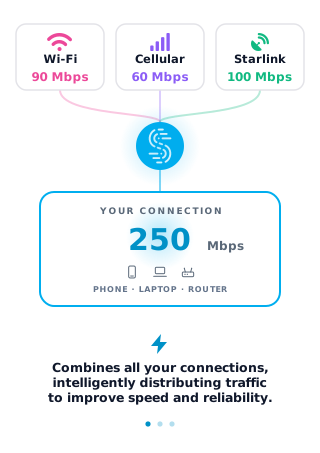
Combine Wi-Fi, 4G/5G cellular, Ethernet, Starlink, and more into one faster, steadier connection. Free to try — no credit card required.
🚀 Speed
Faster uploads and downloads by bonding all your connections at once.
📶 Stability
Automatic failover in under a second when any connection drops.
🔒 Security
AES-256 encryption on every connection, on every network you join.


15M+ downloads worldwide. 75K+ five-star reviews on iOS and Android.