

When Starlink Drops, the Cause Is Usually One Dish, Not the Starlink Network
Starlink rarely goes down across the whole network: the last worldwide outage, on 24 July 2025, lasted about two and a half hours, and in 31 days of Speedify Starlink Index data between 5 September and 11 October 2026, no day looked like one. The average Starlink user on Speedify was offline 38 to 53 minutes a day, every day, and most of those dropouts are local to one dish: one Starlink dish in ten dropped more than 2.86% of pings.
To check whether Starlink is down right now, open the Starlink app first. An outage map built from user reports can only tell you that other Starlink users are reporting problems too; checking whether Starlink is down covers the other ways.
Speedify measures thousands of Starlink internet connections all day, so a Starlink-wide outage would show up as one bad day for every Starlink user on Speedify at once: a 2-hour outage would push that day to about 166 minutes.
The short version: a Starlink-wide outage is rare, so when Starlink drops, start with your own dish, and add a second internet connection for the dropouts that remain.
This article shows how often Starlink goes down network-wide, why most dropouts are local, four checks that tell the two apart, and how a second internet connection keeps you online through a local dropout. Speedify is an app that combines Starlink with other internet connections, such as 4G/5G cellular, and measures every internet connection Speedify carries; the Speedify Starlink Index publishes those measurements.
The daily figures come from three Speedify Starlink Index windows saved between 5 September and 12 October 2026, leaving out the part days at the end of each window; the per-dish figures come from the window of 29 September to 12 October 2026. The live Speedify Starlink Index updates every day, so today’s Speedify Starlink Index figures will differ from the numbers in this article.
What a Starlink-Wide Outage Would Look Like on the Speedify Starlink Index
The Speedify Starlink Index measures working time: the share of time a Starlink internet connection had working two-way connectivity, from the device running Speedify to a Speedify server and back. From 29 September to 12 October 2026, working time across all Starlink users on Speedify was 96.77%, about 46 minutes a day offline. How Speedify measures Starlink covers the method.
Now picture the whole Starlink network failing for 2 hours. Every Starlink user on Speedify would lose the same 2 hours on the same day, and that day’s average would jump by 120 minutes, about 8.3 points of working time. The scenario isn’t made up: Starlink went down worldwide for about two and a half hours on 24 July 2025, after a software failure in Starlink’s core network.
In the 31 days of Speedify Starlink Index data, the worst day was 1 October 2026, at 53 minutes offline, and the best was 28 September, at 38 minutes. A spread of 15 minutes between the best and the worst day is normal day-to-day variation for an average over 5,500 to 6,000 Starlink users. Starlink-wide outages do happen, but rarely; on most days, a Starlink internet connection that stops working has stopped for a local reason: the dish, the Starlink router, the Wi-Fi network or the power.
Starlink Ping Drop Rates Across 3,510 Dishes on the Speedify Starlink Index
A Starlink dish pings Starlink’s point of presence (PoP), where the Starlink network meets the internet, and counts the pings that get no reply. The share of unanswered pings is the ping drop rate, and the Speedify Starlink Index collects the rate from every dish Speedify can reach. From 29 September to 12 October 2026, 3,510 dishes had enough data:
- Half of the dishes dropped no pings at all.
- Two thirds dropped 0.1% or less.
- One dish in ten dropped more than 2.86%.
- One dish in twenty dropped more than 8.46%.
- One dish in a hundred dropped more than 34.28%, more than one ping in three.
Figure 1. 3,510 Starlink dishes on Speedify, one dot for each hundredth of the dishes, sorted by the share of pings each dish dropped. Speedify Starlink Index, 29 September to 12 October 2026.
An average of 46 minutes a day hides that spread. The same Starlink network serves the dishes that drop nothing and the dishes that drop more than 2.86%, at the same time, so the cause sits at the dish, not in the network. The Speedify Starlink Index can’t see the cause for any single dish, but the common causes are obstructions from trees or a roof edge, a dish on a moving vehicle, a loose cable and a Starlink Mini lying flat.
How to Tell a Starlink Outage From a Problem With Your Own Dish
When a Starlink internet connection drops, four checks separate a Starlink-wide outage from a local outage:
- Open the Starlink app. The app shows outages and obstructions for your own dish, which an outage map can’t.
- Look at the obstruction map in the Starlink app. A dish with part of the sky blocked loses service each time a satellite passes behind the obstruction. Reading the obstruction map takes a minute. Comparing the obstruction percentage with 4,263 other Starlink dishes shows whether the number is high.
- Check a second internet connection, such as a phone on cellular. If the phone works on cellular while Starlink doesn’t, the trouble is on the Starlink side of the house: the dish, the Starlink router or the Wi-Fi. The Starlink app shows whether the dish is online.
- Watch the dish’s own numbers over a day. The Speedify Starlink Control Center shows the dish’s ping, obstruction and outages next to every other internet connection.
If the outage really is Starlink-wide, Starlink users across the area report problems at the same time, and checking whether Starlink is down becomes the right step. In 31 days of Speedify Starlink Index data, no day showed a Starlink-wide outage, so the evidence pointed at individual dishes.
What the Speedify Starlink Index Can’t Tell You About Starlink Outages
A regional outage barely moves a worldwide average. If Starlink failed across one region for an hour, the daily figure for all 5,994 users would move far less than in the 2-hour worldwide example. The Speedify Starlink Index doesn’t publish figures by region, so the 31 days of data rule out a Starlink-wide outage but not a regional outage.
The Speedify Starlink Index isn’t live. The figures update once a day, so the Speedify Starlink Index can’t tell you whether Starlink is down right now.
Weather. The Speedify Starlink Index has no weather data, so the figures here can’t show how often rain or snow takes a Starlink internet connection down.
A dropped ping isn’t the same as a disconnect. A dish that drops 3% of pings may never lose a call, and a dish that drops no pings can still sit behind a broken router. Dropped pings cover only the dish’s own link to the Starlink PoP.
The Speedify Starlink Index counts Speedify users. People install Speedify because the internet connection has to hold, so Starlink users on Speedify may run into more trouble than a typical Starlink owner.
Why a Second Internet Connection Covers How Starlink Fails
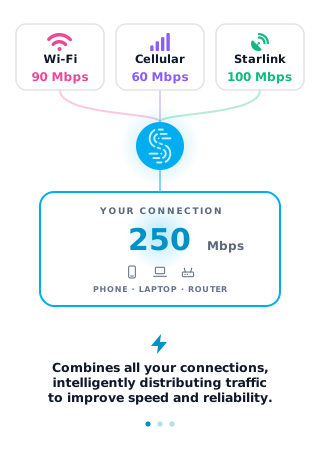
If most Starlink downtime is local, the fix that covers the most minutes is a second internet connection that doesn’t share the local cause. 71.8% of Starlink users on Speedify ran at least one other internet connection from 29 September to 12 October 2026, and 52.6% of those second internet connections were 4G/5G cellular. When Starlink stops answering, Speedify moves your traffic to the other internet connection and the video call or game carries on; when Starlink comes back, Speedify combines both internet connections again.
Speedify doesn’t fix the dish: an obstructed Starlink dish stays obstructed until someone moves the dish or clears the obstruction. A second Starlink dish shares the same Starlink network backend, so for a Starlink-wide outage like the July 2025 outage, Speedify’s own guidance is to pair Starlink with a different kind of internet connection, such as 4G/5G cellular or DSL. More fixes for a dish that keeps dropping are in why Starlink keeps disconnecting.
Speedify
Get started with Speedify today.
Combine Wi-Fi, 4G/5G cellular, Ethernet, Starlink, and more into one faster, steadier connection. Free to try — no credit card required.
🚀 Speed
Faster uploads and downloads by bonding all your connections at once.
📶 Stability
Automatic failover in under a second when any connection drops.
🔒 Security
AES-256 encryption on every connection, on every network you join.


15M+ downloads worldwide. 75K+ five-star reviews on iOS and Android.