Can I Use Two Starlink Dishes on a Mac? Yes, with Speedify

Speedify Lets You Use 2 Starlink Connections on a Mac for Faster Uploads and Downloads

Starlink has transformed internet access for remote workers, digital nomads, boaters, RV travelers, and anyone living beyond the reach of fiber or cable. But even Starlink has its limits: satellite congestion during peak hours, brief outages during dish obstructions or firmware updates, and upload speeds that don’t always match the promise. If you’ve found yourself wondering whether a Mac can use two Starlink connections at once — the answer is yes, with Speedify.

Combining two Starlink dishes on a Mac is not something macOS can do on its own. macOS routes all traffic through a single active network interface at a time. With Speedify installed, a Mac can bond two Starlink connections simultaneously using channel bonding technology — getting the combined download and upload speeds of both dishes, plus automatic failover if one goes offline.

Quick answer

Should you get a backup connection for Starlink?

Yes. Starlink goes down every day — an always-on dish averages about 34 minutes of downtime daily from routine satellite handoffs. A second connection keeps you online when Starlink drops.

What’s the best backup connection for Starlink?

A 4G/5G cellular hotspot or SIM is the most practical backup for most Starlink users — it works anywhere Starlink works, requires no installation, and uses a different network so outages rarely overlap. Cable or DSL broadband is a strong option if you have it at a fixed location. A second Starlink dish is also possible if you need maximum throughput.

How do you use two internet connections at once with Starlink?

Speedify combines Starlink with any other connection — cellular, cable, Wi-Fi, or a second dish — into one bonded connection. Speedify runs on your phone, laptop, or router. When Starlink drops, Speedify moves your traffic to the backup instantly, so calls don’t cut out and downloads don’t stall. Speedify is free to try.

71% of Speedify’s Starlink users already run a second connection. The data below shows why.

Try Speedify free →

Speedify Starlink Index — real-world performance from 6,209 Starlink users: 2.4% downtime, about 34 minutes a day for always-on connections

Speedify Starlink Index
May 28 – Jun 10, 2026 · 14-day window

Starlink goes down every day.
Here’s what that actually looks like.

Speedify passively monitors every connection it bonds. These figures come from 6,209 Starlink users over 14 days — compared in real time against the other connections on the same devices. No speed tests, no lab conditions.

Median latency

60 ms

p90 spikes to 257 ms

Avg packet loss

0.17%

vs 0.08% on T-Mobile

Jitter measures how much latency varies moment to moment — high jitter causes choppy calls and frozen video even when average latency looks fine.
Starlink28.1 ms
Comcast22.4 ms
T-Mobile15.9 ms
Verizon14.9 ms
AT&T11.3 ms
71%
of users

71% ran at least one other connection simultaneously — 4,381 of 6,209 users. Cellular is the most common backup.

Cellular 51% Cable / DSL 38% Corporate 11%
6,209 users · 144 countries · 1.26M records · passive measurement, aggregates only Full dataset →

Use Speedify to stay online during satellite handoffs every 15 seconds

Research confirms Starlink switches between satellites every 15 seconds on a fixed schedule.  Each satellite handoff is a potential dropout, and on a congested network or with any obstruction, those Starlink dropouts become real interruptions.

Speedify fixes Starlink connection drops by combining your Starlink internet connection with another satellite dish, Wi-Fi, 4G/5G cellular, or wired Ethernet at the same time. When Starlink drops, Speedify keeps your traffic moving on the backup internet connection instantly. 

ImageImage
ImageImage

Speedify alerts you about your Starlink dish status

Speedify software alerts you about your Starlink dish status as soon as your dish experiences an issue - e.g. when your actuator motor is stuck, the mast is not vertical or there's a thermal throttle. 

Speedify's Starlink Control Center helps you monitor all your Starlink dishes, read obstruction maps, and align multiple dishes all in the Speedify app. Get a real-time view of each dish's health and optimize the position of each Starlink dish, so you get the best possible performance out of your Starlink connections. 

Speedify

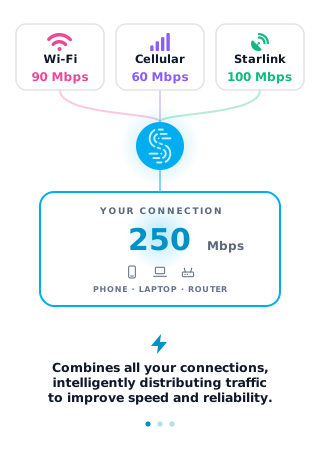
Speedify gives you faster, steadier internet by combining Wi-Fi, cellular, and Starlink

Speedify bonds Wi-Fi, 4G/5G cellular, Ethernet, and Starlink into one connection at the same time, giving you more speed, automatic failover when one drops, and AES-256 encryption on every link.

Download Speedify ›

More speed

Upload and download speeds combine across every active connection on your device.

🔄

Automatic failover

If a connection drops, Speedify moves your traffic to another in milliseconds. Calls stay connected.

🔒

Always encrypted

Every link runs through an encrypted tunnel, including public Wi-Fi, cellular, and Starlink.

Speedify Feature · Pair & Share

Speedify Pair & Share: share cellular between your devices, both ways

Most hotspots give. Speedify's Pair & Share gives and takes. Two devices running Speedify pair up and each uses the other's cellular connection simultaneously, so you both get faster uploads, faster downloads, and a steadier connection. No extra hardware, no new data plans, no setup beyond a tap.

Learn how Speedify's Pair & Share works ›

More speed

Every device you pair with adds its cellular to yours, and yours to theirs.

📱

Stays connected

If a paired device drops out, Speedify keeps you online on the remaining links.

🔒

Always private

Every shared connection runs through AES-256 encryption. Your traffic is yours.

🎉

No new gear

Runs on devices already running Speedify, over your local network. Pair once, reconnects automatically.

How do I use Wi-Fi and 4G/5G cellular at the same time with Speedify?

Pick your two internet connections and your device below and we'll take you to the step-by-step setup guide.

I want to combine

Use the selectors below to find the setup guide for your exact combination of connections.

Or view articles for

Get started with Speedify today

Free to try on every device. No credit card required.

15M+ downloads worldwide · 75K+ five-star reviews · 500TB+ bonded per week

Why macOS Cannot Use Two Starlink Connections at Once Natively

macOS supports multiple network interfaces — Ethernet, Wi-Fi, Thunderbolt Bridge — but the operating system only routes active traffic through one interface at a time. The network service order in System Settings → Network determines which connection macOS prefers, and the others sit idle as backups.

This means that even if two Starlink dishes are connected to a Mac — one via Ethernet and one via Wi-Fi from a second Starlink router — macOS will only use one. The second connection carries zero traffic until the first one fails. That is switching, not bonding. Switching leaves speed and redundancy on the table.

The following hardware-only approaches also fall short:

  • Starlink’s built-in bypass/passthrough mode: Passes a single connection through to another router but does not combine two dishes into one faster pipe.
  • Dual-WAN routers (e.g. Peplink, Firewalla): Can load-balance two Starlink connections across multiple devices on a network, but per-device bonding on a Mac requires additional software. These are also expensive hardware solutions.
  • macOS Network RAID / Link Aggregation: Only works with multiple Ethernet ports on the same switch — not applicable to two separate Starlink connections with different IP addresses.

How Speedify Bonds Two Starlink Connections on a Mac

Speedify uses channel bonding technology to combine two Starlink connections — or any combination of Starlink, Wi-Fi, 4G/5G cellular, and wired Ethernet — into a single faster and more reliable connection on a Mac. Speedify splits traffic intelligently across both connections at the packet level, so both dishes carry active data simultaneously.

Speedify Combines the Download and Upload Speeds of Both Starlink Dishes: Instead of being capped by one Starlink connection, a Mac running Speedify gets the combined throughput of both. Two Starlink Standard dishes averaging 150 Mbps down each can deliver close to 300 Mbps of usable download speed. Upload speeds — often the bottleneck for video calls, live streaming, and large file transfers — see the same improvement.

Speedify Provides Automatic Failover Between Two Starlink Connections: Starlink dishes lose connectivity briefly during satellite handoffs, firmware updates, or physical obstructions like trees, snow, or buildings. With two dishes bonded via Speedify, if one Starlink connection drops, Speedify’s automatic failover technology shifts all traffic to the second dish instantly — without dropping a video call, interrupting a live stream, or pausing a download. No manual intervention required.

Speedify Reduces the Impact of Starlink Latency Spikes: Starlink latency typically ranges from 20ms to 60ms but can spike during congestion or satellite transitions. When two Starlink connections are bonded, Speedify’s proprietary protocol routes packets across whichever connection has lower latency at that moment, reducing the frequency and severity of spikes — particularly important for video calls, online gaming, and real-time collaboration tools.

Speedify Encrypts All Traffic Across Both Starlink Connections: Speedify is also a VPN that encrypts all traffic flowing across both Starlink connections simultaneously. Satellite internet traffic is not inherently encrypted at the transport layer, so Speedify’s encryption adds a meaningful layer of security — particularly for professionals transmitting sensitive data from remote locations.

Real-World Download and Upload Speeds: What to Expect with Two Starlink Connections on a Mac

The speed improvement depends on the Starlink plan and local satellite congestion, but here are realistic scenarios:

Scenario Without Speedify With Speedify (Two Starlinks Bonded)
Two Starlink Standard dishes (150 Mbps down each) 150 Mbps max (one dish active) ~280–300 Mbps combined
Starlink Standard (20 Mbps up) + Starlink Standard (20 Mbps up) 20 Mbps upload max ~38–40 Mbps upload combined
One Starlink dish goes offline mid-video call Call drops or freezes Call continues on second dish — uninterrupted
Starlink + 4G/5G cellular hotspot bonded Starlink only (cellular idle) Starlink + cellular combined for maximum speed

How to Use Two Starlink Connections on a Mac with Speedify

Setting up Speedify to bond two Starlink connections on a Mac takes less than ten minutes:

  1. Connect the first Starlink dish to the Mac via Ethernet (using a USB-C to Ethernet adapter if needed) or via Wi-Fi from the Starlink router.
  2. Connect the second Starlink dish to the Mac via a different interface — for example, Ethernet for the first and Wi-Fi for the second, or two USB-C to Ethernet adapters on separate routers.
  3. Download and install Speedify on the Mac (available for macOS, Windows, iOS, Android, Linux, and OpenWrt).
  4. Open Speedify and connect. Speedify automatically detects both active network interfaces and begins bonding them. Both Starlink connections will appear in the Speedify dashboard with real-time speed and status data.
  5. Optionally, enable Streaming Mode in Speedify settings for optimized live video performance, or adjust per-connection data limits to manage Starlink data caps independently.

When to Use Two Starlink Connections Bonded on a Mac

Remote Workers and Digital Nomads: Starlink delivers reliable internet in locations where no other option exists — but a single dish can still let a remote worker down at the worst moment. Bonding two Starlink connections with Speedify on a Mac means Zoom, Teams, and Google Meet calls stay connected even during a dish obstruction or brief satellite handoff outage.

Live Streamers and Content Creators: Upload speed is the critical resource for live streaming and large file delivery. Two Starlink dishes bonded via Speedify nearly double the available upload bandwidth — enough to sustain high-bitrate 4K streams even when one connection experiences a temporary dip. Speedify’s Streaming Mode further optimizes packet delivery for live video.

Boaters and Marine Users: Starlink Maritime is widely used on vessels where connectivity is critical for navigation, safety communications, and crew welfare. Bonding two Starlink Maritime connections on a Mac running Speedify provides both the redundancy needed for safety-critical applications and the throughput needed for crew video calls and streaming.

RV and Overlanding Users: Starlink RV users frequently move between satellite coverage zones. Bonding a Starlink RV dish with a 4G/5G cellular hotspot — or a second Starlink dish — via Speedify ensures that a Mac stays connected as the vehicle moves through areas with varying satellite or cellular coverage.

Remote Offices and Field Teams: Field teams operating from remote command posts, construction sites, or disaster response locations increasingly rely on Starlink for connectivity. Bonding two Starlink connections on a Mac running Speedify gives field offices both the redundancy and speed needed to run cloud applications, video conferencing, and large data transfers reliably.

Speedify vs. Other Options for Using Two Starlink Connections on a Mac

Solution Bonds Two Starlink Connections? Works on Mac Natively? Automatic Failover? Faster Downloads and Uploads? Encrypted Traffic?
Speedify ✅ Yes ✅ Yes ✅ Yes ✅ Yes ✅ Yes
macOS Network Priority ❌ No (switches only) ✅ Yes ❌ No (manual) ❌ No ❌ No
Dual-WAN Router (Peplink, Firewalla) ❌ Per-device bonding requires software ❌ No (hardware only) ✅ Yes ✅ Network-level only ❌ No
Other VPNs ❌ No ✅ Yes ❌ No ❌ No (often slower) ✅ Yes

Frequently Asked Questions About Using Two Starlink Connections on a Mac

Can a Mac use two Starlink connections at the same time without Speedify?
No. macOS routes all traffic through a single active network interface at a time. Without Speedify, the second Starlink connection sits idle as a backup and carries no active traffic.

Does bonding two Starlink connections on a Mac require special hardware?
Two Starlink dishes and two routers are required. Connecting both to a Mac requires two separate network interfaces — for example, Wi-Fi for one Starlink router and a USB-C to Ethernet adapter for the other. No other special hardware is needed beyond Speedify software.

Can Speedify bond a Starlink connection with a 4G/5G cellular hotspot instead of a second Starlink?
Yes. Speedify bonds any combination of available connections on a Mac — two Starlink dishes, one Starlink and one 4G/5G hotspot, Starlink and wired Ethernet broadband, or any other combination. The channel bonding technology works the same regardless of connection types.

Does Speedify manage Starlink data caps separately for each dish?
Yes. Speedify allows per-connection data limits to be set independently, so each Starlink subscription’s data cap can be managed to avoid overage charges or deprioritization thresholds.

Does Speedify work on all Mac models?
Yes. Speedify runs on all Macs running macOS 12 Monterey or later, including MacBook Air, MacBook Pro, Mac mini, Mac Studio, and Mac Pro — on both Apple Silicon and Intel processors.

Two Starlink dishes represent a significant investment. Speedify ensures a Mac gets the full value from both — combined speed, unbreakable redundancy, and encrypted traffic — in a single lightweight app that runs quietly in the background.

Download Speedify and start using two Starlink connections on a Mac today.

Image

Get started with Speedify today!

With Speedify you can combine Wi-Fi, 4G / 5G cellular, Ethernet, Starlink and other satellites into one bonded super-connection to improve livestreaming, video calling, gaming, web browsing, and everything else you do online.

Download Speedify
Download Speedify on the Apple App StoreGet Speedify on the Google Play Store

Speed

Get faster uploads and downloads for everything you do online.

Stability

Avoid buffering and disconnects while streaming, gaming, and browsing.

Security

Keep your personal data safe from hackers, snoops and cyber criminals

Speedify engineers love talking tech on YouTube, Tiktok, and Instagram!

Alex Gizis and the Speedify engineers discuss and explain technology including Starlink satellites, Wi-Fi 7 routers, Apple networking features, fiber optics, broadband internet, 5G mobile networks, AI, networking protocols, and much more. Follow Speedify on YouTube, TikTok, Instagram, and LinkedIn!

Alex and the Speedify team are always exploring the latest in networking and security technology—like 5G, 6G, WiFi 7, laser and satellite internet—and sharing it in new discussion content across YouTube, TikTok, Instagram, and LinkedIn every week.

Got a tech question? Let's go deeper! Pop into Speedify Office Hours live every Wednesday at 10 AM Eastern. Speedify CEO Alex Gizis and our network engineers are standing by to break down your questions about networks, tech updates, and Speedify features.

Image