
A Bonding SDK Carriers and ISPs Can Embed in Their Own Products
A bonding SDK lets a carrier or ISP build the combining of internet connections into the hardware it already ships, rather than asking subscribers to install anything. Speedify’s engine for combining connections is available to embed in routers, modems and customer equipment through the Speedify SDK. The gains need two or more internet connections at the customer site; on one connection Speedify works as an encrypted VPN and cannot stop that connection from dropping.
This article covers how the Speedify SDK works, what integration options are available, and who it is designed for.
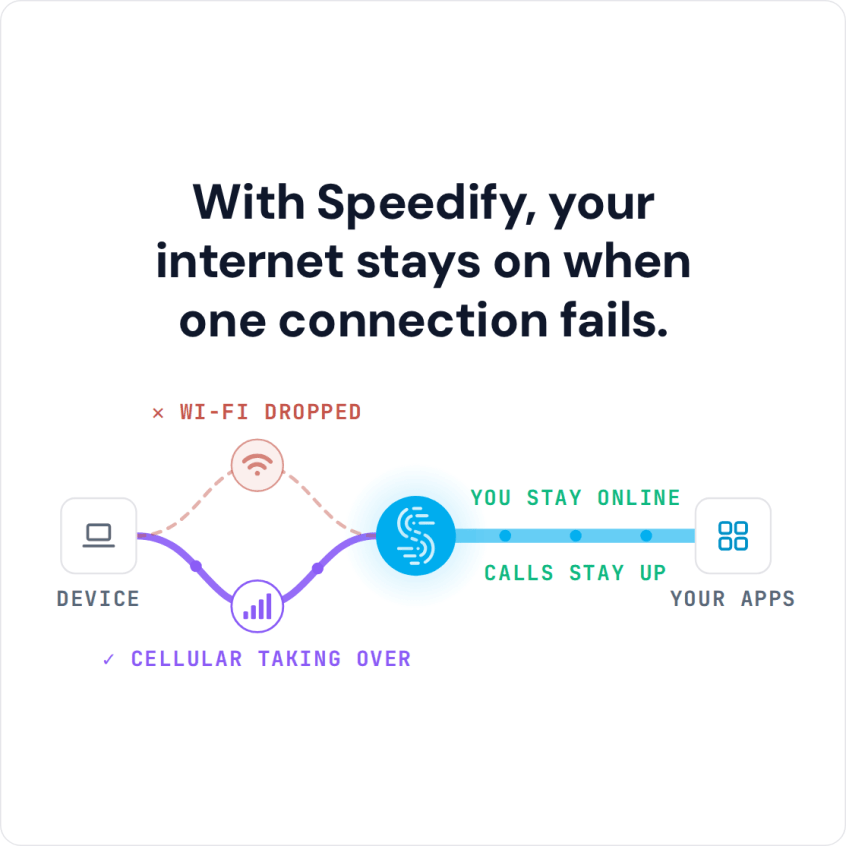
With Speedify, your internet stays on when one connection fails.
Watch now
How Speedify combines internet connections on any hardware
Get started with Speedify for your business
Speedify offers three commercial paths. They work together, and most enterprise customers use two or more.
01
Speedify Teams
Speedify on every supported OS for every team member
Centralized dashboard for billing, user provisioning, and usage analytics
CSV import/export and a RESTful management API
02
Speedify for Routers
License for supported OpenWrt routers
Powered by Speedify hardware lineup ready to deploy out of the box
Miri, GL.iNet and other partner models
Covers every device on the network, with no per-device install
03
Embed Speedify into your product
A · DIY
Build it yourself with the Speedify SDK.
Integrate Speedify into your iOS, Android, Windows, macOS, Linux or QNX product. Full developer documentation, sample code and supported integration paths. Your team owns the build, and the Speedify SDK handles combining the internet connections.
B · CUSTOM ENGINEERING
Have the Speedify team build it for you.
The Connectivity Problem Carriers and ISPs Face
Carriers, ISPs, and network providers face increasing pressure to deliver reliable connectivity across environments where a single connection (whether fiber optic, wired broadband, 4G/5G cellular, or Starlink and other satellite) is not sufficient on its own. Their customers are demanding more:
- Business customers need automatic failover when a primary wired broadband connection drops, without session interruption.
- Mobile customers in vehicles, on vessels, and in the field need their connection to stay up as they move through areas with variable cellular coverage across different carriers.
- Customers with multiple internet connections from the same or different providers want to use all of them simultaneously, not switch between them manually.
- ISPs competing in markets with reliable fiber optic broadband need differentiated value-added services to retain and grow their subscriber base beyond raw download speed.
Building technology that combines multiple connections from the ground up is a significant engineering investment. Speedify SDK gives carriers and ISPs access to Speedify’s technology for combining internet connections through a software development kit and integration pathway, so they can offer combined connections to their customers without building the underlying system themselves.
How Speedify SDK Works
Speedify’s technology for combining internet connections is built on a client-server architecture. The Speedify client runs on the end user’s device or on router hardware. The Speedify server handles the packet reassembly and internet routing. Through the Speedify SDK, network providers can:
- Embed Speedify in router and CPE hardware. Integrate the Speedify client directly into OpenWrt-compatible routers and customer premises equipment. Customers’ devices on the router’s network get the combined connection without needing any client software on individual devices.
- Integrate Speedify into mobile applications. Use Speedify’s SDK to add connection combining to carrier-branded or ISP-branded mobile apps on iOS and Android. The SDK gives the app the ability to combine the device’s Wi-Fi, 4G/5G cellular, and Ethernet connections simultaneously.
- Deploy Speedify on proprietary hardware. For carriers building custom hardware products (bonding routers, mobile hotspots, CPE units), the Speedify SDK provides access to Speedify’s client software and server infrastructure for white-label or co-branded deployment.
- Use Speedify Self-Hosted Servers for private infrastructure. Carriers and ISPs with data residency requirements or specific network architecture constraints can deploy Speedify Self-Hosted Servers on their own infrastructure. This allows the carrier to route all combined traffic through their own data centers rather than Speedify’s shared server network.
Speedify and Dedicated Hardware for Combining Connections, Compared for Carriers and ISPs
| Feature | Dedicated hardware vendors | Speedify |
|---|---|---|
| Architecture | A hardware device plus the vendor’s cloud | Cloud-native software, deployable on-premise or self-hosted |
| Servers | Vendor-operated and dedicated | Shared, Dedicated or Self-Hosted |
| Licensing model | Per-device licensing, tied to the vendor’s own hardware | Subscription and per-device licensing, plus SDK licensing |
| SDK for embedding in your own product | No | Yes |
| Platform support | Proprietary hardware only | Embedded Linux and OpenWrt; desktop Windows, macOS and Linux; mobile iOS and Android |
| Maximum combined connections | Model-dependent, commonly up to 12 | No built-in limit; set by the device’s hardware |
| Failover method | Automatic failover | Packet-level automatic failover |
| Central management | The vendor’s own dashboard | The Speedify Teams dashboard, per-device analytics and REST API provisioning |
Technical Details for Network Provider Integration
Speedify combines connections at the data packet level. The Speedify client on the end device (or router) splits internet traffic across all active connections and routes the split packets to a Speedify server.
The server reassembles the packets in order and forwards the complete request to the destination. Response traffic is split at the server and distributed back across the bonded connections to the client.
This architecture provides:
- Up to 95% of the combined upload and download throughput of all connections (Speedify’s published figure).
- Packet-level failover: when one connection drops or degrades, in-flight packets are rerouted across the remaining connections without resetting active internet sessions.
- Redundant Mode: each packet is sent simultaneously over all active connections for maximum session continuity in degraded conditions.
- DTLS 1.2 encryption with AES-256-GCM or ChaCha20-Poly1305 on all combined traffic.
- Protocol flexibility: Speedify’s client automatically selects TCP, UDP, or HTTPS as the tunnel protocol depending on network conditions and firewall restrictions.
Speedify’s server infrastructure spans 50+ locations across 6 continents. Carriers that need servers in a specific location for latency or data residency can run Speedify Self-Hosted Servers there.
The Speedify SDK supports integration on Windows, macOS, Linux, iOS, and Android, as well as OpenWrt-compatible router hardware. Speedify’s engineering team provides custom integration support for carriers and hardware manufacturers.
Use Cases for Carrier and ISP Integration
- 4G/5G carrier bonding routers. Carriers offering home broadband over 4G/5G cellular can integrate Speedify into their CPE routers to combine multiple cellular connections (from the same carrier or from multiple carriers), giving customers faster upload and download speeds and automatic failover at the router level.
- Wired broadband plus cellular failover services. ISPs offering wired broadband can add a 4G/5G cellular failover tier through the Speedify SDK. When the wired connection drops, Speedify fails over to cellular at the packet level, keeping the customer’s sessions running on the same public IP address.
- Satellite internet augmentation. Satellite ISPs can integrate Speedify to combine Starlink or VSAT with 4G/5G cellular, improving reliability during satellite outages and increasing available upload and download speeds when both connections are active. See how ISPs and carriers can use Starlink.
- Mobile carrier value-added services. Mobile carriers can integrate Speedify’s SDK into carrier apps to offer subscribers a connection that combines their 4G/5G cellular with available Wi-Fi connections for faster uploads and downloads and improved reliability on the go.
Carriers and ISPs Already Working with Speedify
Speedify has established SDK partnerships with major network providers and technology companies. Speedify’s technology for combining connections has been integrated into products deployed by Xfinity, Cox, Comcast, and OmniAccess, among others. These partnerships demonstrate that Speedify’s SDK and integration pathway are production-ready and scalable to large subscriber deployments.
Learn more about the Speedify enterprise and partner programs or read about how Speedify’s technology for combining connections works.
Speedify Is Used on Millions of Devices Worldwide
Speedify has made internet connections faster and more reliable for businesses and individuals since 2014.
15M+
Speedify downloads worldwide75K+
5-star reviews for Speedify on iOS and Android82
Speedify server points of presence in 50+ cities on 6 continents500TB+
Of internet traffic carried by Speedify every weekSpeedify Partners
Speedify works with these companies to bring faster, more reliable internet and networking technology to their customers and employees.


How to Get Started with Speedify SDK
The Speedify SDK is available to network providers, carriers, ISPs, and hardware manufacturers. Speedify’s engineering team can provide custom integration support, help design a scalable deployment architecture, and assist with SDK integration on supported platforms.
To discuss your use case and get technical details on the integration pathway, contact the Speedify team directly through the Speedify enterprise contact page.
Speedify Business Solutions
Speedify Teams
Speedify for Routers

Speedify Embedded Solutions and Integrations
Add Speedify to your own app or hardware with the Speedify SDK. Your product then combines internet connections, fails over automatically when one drops, and encrypts the traffic, using the same technology as the Speedify app.