
Network Traffic Management Solutions Allow Cellular Operators to Improve Connectivity and Security
Traffic management decides which subscribers get a good experience when a cell is busy, and every option is a trade-off between throttling someone and buying capacity.
Speedify is software that adds a third option to carrier network management: combining more than one connection for each subscriber, so the busy cell carries less of the load. That needs a second connection for the subscriber, such as Wi-Fi; on a single connection Speedify works as an encrypted VPN and cannot stop that connection from dropping.
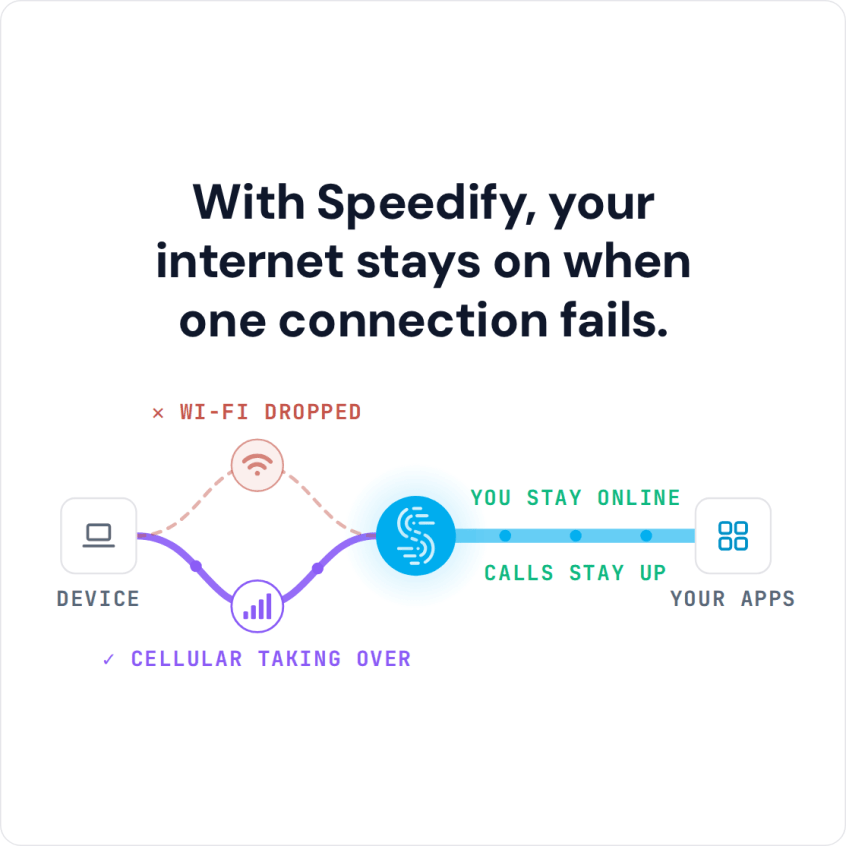
With Speedify, your internet stays on when one connection fails.
This post covers what carriers are dealing with today, and why combining connections is the long-term answer to infrastructure and cost pressure.
Watch now
How Speedify combines internet connections on any hardware
Get started with Speedify for your business
Speedify offers three commercial paths. They work together, and most enterprise customers use two or more.
01
Speedify Teams
Speedify on every supported OS for every team member
Centralized dashboard for billing, user provisioning, and usage analytics
CSV import/export and a RESTful management API
02
Speedify for Routers
License for supported OpenWrt routers
Powered by Speedify hardware lineup ready to deploy out of the box
Miri, GL.iNet and other partner models
Covers every device on the network, with no per-device install
03
Embed Speedify into your product
A · DIY
Build it yourself with the Speedify SDK.
Integrate Speedify into your iOS, Android, Windows, macOS, Linux or QNX product. Full developer documentation, sample code and supported integration paths. Your team owns the build, and the Speedify SDK handles combining the internet connections.
B · CUSTOM ENGINEERING
Have the Speedify team build it for you.
Mobile Data Traffic Keeps Growing
Mobile data traffic is on an exponential rise, with a predicted tripling in the following years, according to Statista: “In 2022, the average data used per smartphone per month worldwide amounted to 15 GB. The source forecasts that this will increase to around 46 GB per smartphone per month globally in 2028”. Ericsson’s June 2024 Mobility Report has a similar figure when it comes to mobile data traffic per smartphone. But when looking at total mobile network traffic, they forecast a CAGR of 23% between 2023 and 2029, reaching an impressive 466 EB (exabyte)/month.
The main drivers for this growth are the rapid deployment of 5G networks globally and the rising consumption of video streaming services, social media and other real-time communication applications. The numbers differ from region to region, but the overall trends are the same.
Professional Mobile Data Network Providers, MVNOs and Cellular Carriers’ Current Problems
Customer satisfaction is immediately affected when the network infrastructure on which businesses have grown to rely fails to meet demand. For many enterprises, the ability to transport high capacity data quickly over these networks is essential. Impacts include slow or crowded networks, devices connecting to unmanaged, subpar Wi-Fi, inadequate or outdated coverage in rural regions, and infrastructure failures. When it comes to offering a quick and dependable service, a contemporary and flexible network service is essential.
Cost is the other pressure. MVNOs see it first hand: because they do not own the cellular infrastructure, the cost of traffic on the mobile network makes it hard to compete. Wi-Fi infrastructure helps where it exists, but it does not reach as far as cellular coverage.
Online traffic security matters too. Most companies now use VPNs for their remote workers, as they are aware of the dangers that reside with both public Wi-Fi and cellular data traffic. As stated in the 2024 GSMA security threat landscape report, implemented security defenses include a secure by design architecture and multi-layered defenses, where the usage of VPN encryption can help organizations.
These are even more important when your main market is a competitive one, such as North America, most of Europe and Asia. Your existing clients and potential ones will just choose the best available alternative.
Network Traffic Management for Carriers: The Main Tools
Carrier network traffic management covers the tools an operator uses to keep a busy network usable: traffic shaping and prioritization (voice and real-time traffic go first), throttling heavy users or video, offloading traffic onto Wi-Fi, and adding capacity with new spectrum or more cells. Shaping and throttling ration the capacity a cell already has. Offloading and new capacity add to it.
Speedify adds an option on the subscriber side. When a subscriber has a second connection such as Wi-Fi, Speedify spreads that subscriber’s traffic across both, so the busy cell carries only part of it, and nobody has to be throttled to make room.
Traffic Shaping and Throttling: Why They Fall Short
In order to address issues related to infrastructure and costs, many network operators from North America especially have started to employ traffic shaping techniques. These are essentially some bandwidth management methods that prioritize certain types of network packets to ensure higher network performance for higher priority applications.
Data throttling is one technique widely used: it slows down specific types of traffic, usually streaming and gaming, to fit more users onto the same capacity.
Limiting bandwidth or charging heavily for extra mobile data does not make customers happier. A better answer is to give each subscriber more capacity by combining the connections a device or home already has.
Introducing Speedify: Network Traffic Management for Speed, Stability and Security
Mobile network operators and providers of professional mobile data services are looking for new revenue. Security-as-a-service or specialized content channels on their own tend to see slow adoption. Connectivity and security services that improve every connection a customer makes are easier to sell, and Speedify gives service providers a network traffic management suite they can offer to customers right away while lowering service costs.
Speedify offers service providers three building blocks:
- A white labeled carrier-grade mobile application, ideal for creating a customer facing value-added subscription service.
- An SDK for including in-home CPE (customer premises equipment) to provide standard Hybrid Access Gateway functions and ensure a 4G/5G cellular failover path for fixed line customers.
- An offload and traffic routing service which can lower the operational cost of a mobile service provider whilst increasing the value of analytics and other value added services deployed in the network.
All of this runs on Speedify’s encrypted VPN service for combining internet connections, so customers get security that holds up through network interruptions and handovers. Using more than one network at a time avoids performance problems at the network edge and improves reliability.
Speedify Is Used on Millions of Devices Worldwide
Speedify has made internet connections faster and more reliable for businesses and individuals since 2014.
15M+
Speedify downloads worldwide75K+
5-star reviews for Speedify on iOS and Android82
Speedify server points of presence in 50+ cities on 6 continents500TB+
Of internet traffic carried by Speedify every weekSpeedify Partners
Speedify works with these companies to bring faster, more reliable internet and networking technology to their customers and employees.


Why Network Operators Use Speedify for Network Traffic Management
As explained above, the main benefit for mobile network operators and professional mobile data service providers is lower operational cost alongside higher service value. Speedify’s SDK partners include organizations like Xfinity, CUJO AI, OmniAccess, Cox and Comcast.
The table below explains how Speedify can help with connectivity and security hassles:
|
Service |
Customer Proposition |
Speedify Value |
|
Hybrid Access CPE |
Combine fixed and mobile services at the home to satisfy targeted quality, busy hour speed and uptime. |
Intelligently adds the mobile network to supplement the fixed line in the most efficient way, only using the mobile network when the fixed line performance is below acceptable limits. |
|
Increase customer insights |
Bring data back to the mobile core, even when the device is on another network, to gain the benefit of increased analytics |
As the VPN improves performance with little battery impact, customers are more likely to keep it active, and data which would otherwise be off your network is brought back to the core to benefit from your services and analytics |
|
Increase value of other core services |
Family filters, Media services, etc are applied more of the time as the device is connected to your core network more of the time |
|
|
Mobile Data Offload |
Use public Wi-Fi securely and safely with the added peace of mind that a minimum service quality will be provided regardless of the Wi-Fi quality |
Intelligently move only the traffic which can be supported by the Wi-Fi network (if any), combine Wi-Fi and cellular to provide a minimum performance and optionally bring all the data back to the mobile core |
|
Protect congested networks |
Use alternative networks when one is congested, without the user noticing |
Intelligently decide whether to combine networks for increased speed or replicate data for optimal performance and reliability |
|
Wi-Fi Data Offloading |
Use mobile data network securely and safely with the added peace of mind that a minimum service quality will be provided regardless of the cellular coverage |
Intelligently move only the traffic which can be supported by the mobile data network, combine Wi-Fi and cellular to provide a minimum performance and optionally bring all the data back to the mobile core. |
Contact the Speedify team to see how Speedify fits your network traffic management plans.
Speedify Business Solutions
Speedify Teams
Speedify for Routers

Speedify Embedded Solutions and Integrations
Add Speedify to your own app or hardware with the Speedify SDK. Your product then combines internet connections, fails over automatically when one drops, and encrypts the traffic, using the same technology as the Speedify app.