

What Is MPTCP, and How Does Internet Bonding Actually Work?
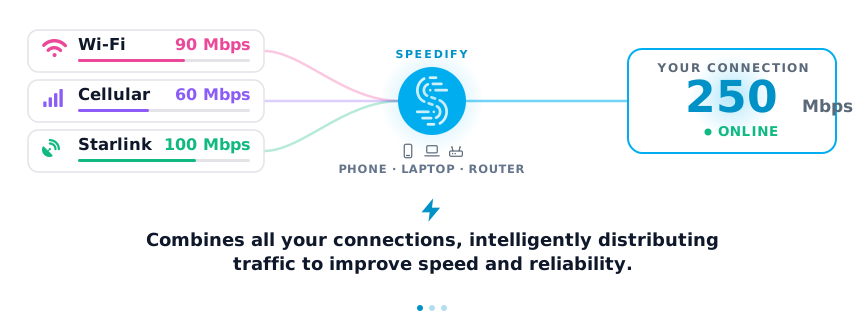
MPTCP (Multipath TCP) is a networking standard that lets a single connection use several internet paths at once, so a session keeps running even when one path drops. Internet bonding does the same job in practice – combining Wi-Fi, cellular, Ethernet and satellite into one stream.
Speedify is an app that bonds every available connection into one encrypted link for faster upload and download speeds and automatic failover if a connection fails. Here is how MPTCP works and how Speedify’s bonding compares.
Speedify combines every connection you have into one faster, steadier one
How do I use WiFi and 4G/5G cellular at the same time with Speedify?
Pick your two internet connections and your device below and we'll take you to the step-by-step setup guide.


The Problem MPTCP Solves: One Session, Many Links
A standard internet connection ties a session to a single path from start to finish. If that path drops, the session drops with it, even if a second connection sat available the entire time. Multipath TCP addresses this at the protocol level, letting a single TCP connection use multiple network paths simultaneously so a session can survive one path failing. The idea solved a real gap: modern devices carry multiple radios and interfaces, but most networking software was never built to use more than one at a time.
How Multipath Approaches Split and Reassemble Traffic
Any multipath approach has to solve the same core problem: breaking traffic into pieces, sending those pieces across different paths, and reassembling them correctly on the other end in the right order. Differences between approaches come down to where that splitting happens, how much of the traffic each path carries, and what happens when one path performs worse than another. A poorly built implementation reassembles slowly or wastes the faster path waiting on the slower one; a well built one uses each path close to its actual capacity in real time.
How Speedify’s Bonding Compares to MPTCP and Why Encryption Matters
Speedify’s enterprise channel bonding builds on the same multipath principle as MPTCP but works at the application layer as a VPN-style tunnel, bonding connections without depending on server-side MPTCP support that most websites and services still don’t offer. Every packet traveling through that tunnel is encrypted under a strict no-logs policy, so bonding multiple connections together does not mean exposing traffic across whichever network happens to carry it, a public Wi-Fi hotspot included.
Real-World Gains: Speed, Reliability, Seamless Failover
In practice, bonding delivers three things at once. Combined throughput uses up to 95% of the total capacity across connections, so two mediocre connections add up to one solid one. Reliability improves because traffic has somewhere to go the moment one path degrades. Failover happens in under a second, fast enough that video calls and streams continue without a visible reconnect. Bonding Starlink and 5G for business shows these gains applied to a real pairing of connection types rather than in the abstract.
Where Bonding Is Deployed Today, and Getting Started Without Special Hardware
Bonding shows up today in broadcast vans combining cellular carriers, branch offices combining wired and cellular lines, remote workers combining home internet with a phone hotspot, and vehicles combining Starlink with cellular. None of these deployments require proprietary hardware, Speedify installs as software on existing laptops, phones, and routers.
Getting started takes a short sequence:
- Confirm at least two connections are available, such as Wi-Fi and a phone hotspot.
- Install Speedify on the device that needs bonded connectivity.
- Add each connection to the bonded pool.
- Choose a mode, standard bonding for throughput or redundant mode for zero data loss on critical sessions.
Bonding needs at least two working paths to function at all, and cannot create bandwidth beyond what those paths actually deliver. A device with only one connection gets encryption but no bonding benefit, the gains described here all depend on having a genuine second path to combine.
Speedify Is Used on Millions of Devices Worldwide
Speedify has powered stronger Internet for millions of consumers since 2014
15M
Millions of Speedify downloads worldwide, and growing every day5⭐️
More than 75,000 5-star reviews for Speedify in the iOS and Android app stores82
Points of Speedify presence in datacenters around the globe500TB
Hundreds of terabytes of fast, secure data streamed every week via SpeedifySpeedify Partners
Speedify partners with these amazing organizations to deliver better internet and next-generation networking technology to their customers and employees.


MPTCP vs. Speeidfy and Internet Bonding: FAQ
Is Speedify the same thing as MPTCP?
Speedify uses multipath principles similar to MPTCP but implements bonding at the application layer through an encrypted tunnel, avoiding the need for server-side MPTCP support.
Does internet bonding require special hardware?
Speedify runs as software on existing laptops, phones, and routers, so bonding multiple connections does not require dedicated bonding appliances.
How fast does Speedify fail over when a connection drops?
Speedify fails over to a remaining healthy connection in under a second, keeping active sessions like calls and streams running without a visible interruption.
Can internet bonding work with just one internet connection?
Speedify needs at least two working connections to bond traffic, a single connection can still be encrypted but gains none of the throughput or failover benefits of bonding.
Speedify Business Solutions
Speedify Teams
Speedify for Routers

Speedify Embedded Solutions and Integrations
Embed Speedify software into your app or hardware products and leverage the core channel bonding technology of Speedify in new and interesting ways.