


Speedify Secures Your Internet and Gets You Faster Uploads and Downloads
The concept of VPN tunneling represents far more than just basic encryption that helps you with your online privacy; it's a sophisticated technology that can either enhance or hinder your internet experience depending on implementation.
A VPN tunnel wraps each packet in an encrypted envelope, routing it through a trusted intermediary. It’s not a physical tunnel, but a secure layer of cryptographic protection imposed on top of standard routing protocols.
There are many VPN providers out there, but there's only one that doesn't slow down or break your connection while delivering fast and more reliable Internet: Speedify.
Why Speedify VPN is unbreakable vs. other VPNs
Most VPNs stop working the moment one of your internet connections has a problem. If your Wi-Fi glitches, or your device briefly switches between 4G / 5G and Starlink, you can suddenly lose your VPN connection.
Speedify is built to prevent that. Instead of relying on just one connection, Speedify can use all your available internet connections at the same time: Wi-Fi, Ethernet, 4G / 5G cellular, even Starlink or other satellite. If one connection slows down or drops, Speedify instantly moves your traffic to another internet source so your VPN stays connected and your online activity isn’t interrupted.
In this video, you’ll see how Speedify keeps your internet connection secure, smooth, and reliable by intelligently spreading your encrypted data across the available connections. The result: an unbreakable VPN tunnel.
Combining multiple internet sources like Wi-Fi, 4G, 5G, Starlink and wired broadband together makes Speedify VPN unbreakable
Speedify combines Wi-Fi, 4G, 5G, Starlink and wired broadband for secure and unbreakable VPN tunnels
No matter how secure your VPN is, if you experience a drop in your Internet connection, either your VPN tunnel will break leaving you unprotected, or you’ll be stuck offline. Speedify is the only VPN that seamlessly combines all of your connections, including Wi-Fi, 4G, 5G, Ethernet, and Starlink, into one unbreakable connection to keep you online and secure.
Speedify will automatically detect any available Internet connections on your device, encrypting and intelligently distributing your online traffic between them for optimal performance. If you need help we have quick start guides available for most common set ups.
Combine personal hotspots for unbreakable and secure uploads and downloads
Speedify's Pair & Share feature enables you to connect to multiple personal hotspots at the same time and wirelessly share LTE, 4G, and 5G cellular connections back and forth between multiple Speedify users on the same local network to create a faster, more reliable connection for everyone.
With Speedify, all of your available internet sources - even shared personal hotspots - are combined inside the secure VPN tunnel with your encrypted traffic intelligently distributed between them, while split tunneling allows blocked sites to bypass. So, if any connection slows down or drops out, the VPN tunnel stays active and the other connections will automatically take over to keep you securely, seamlessly connected.
Use Speedify to combine...
Combine these connections on:
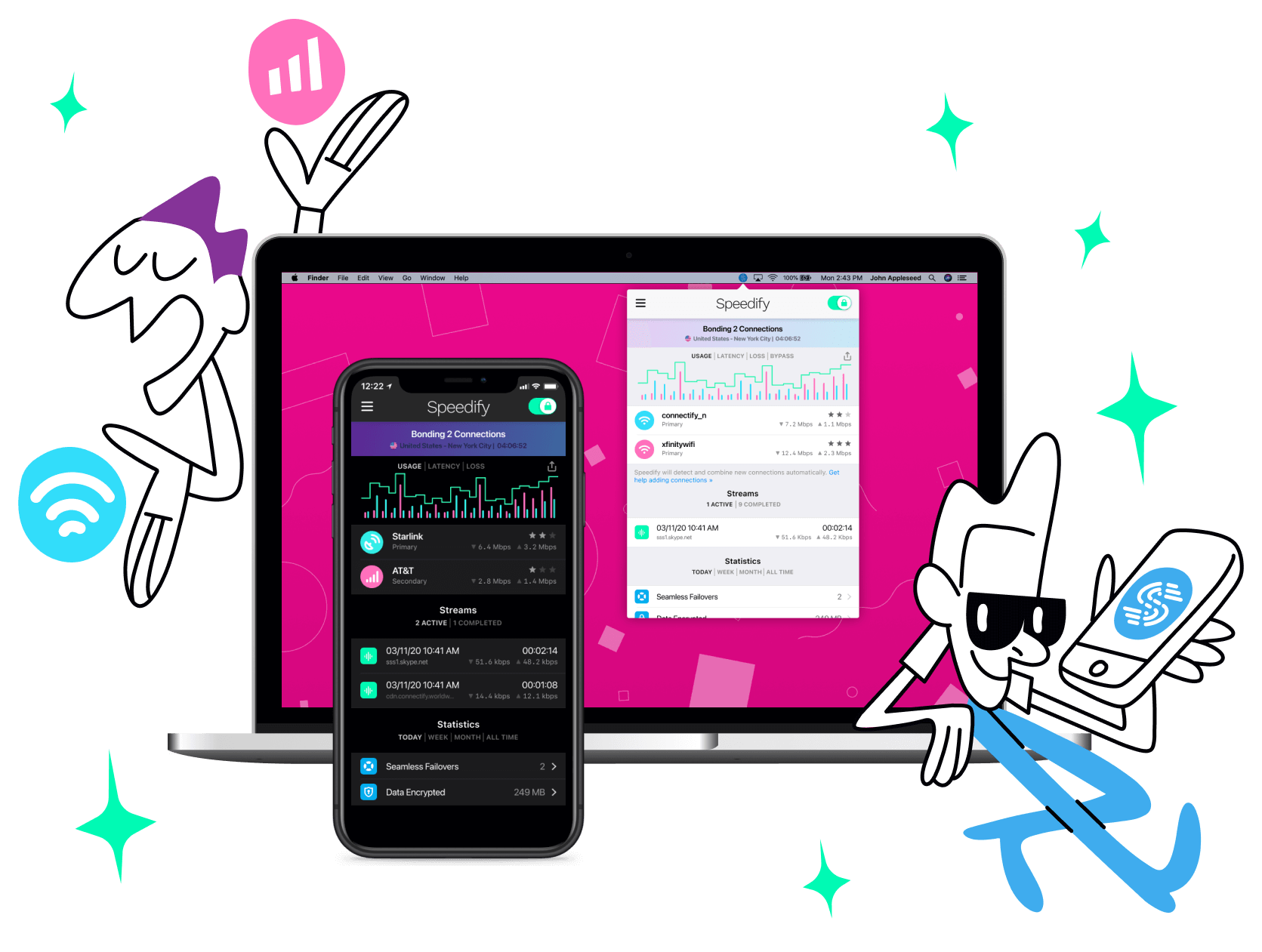


Understanding VPN Tunnel Architecture
A VPN tunnel is essentially an encrypted data pathway established between your device and a VPN server, creating a secure route through which all your internet traffic flows. This tunnel operates at the network layer, encapsulating your original data packets within additional headers and encryption protocols before transmission across public networks.
The tunneling process involves several critical components working in tandem. When you initiate a connection, your device and the VPN server perform a cryptographic handshake using protocols like SSL/TLS to establish secure communication parameters. The data transmitted through the tunnel is encrypted using a specific protocol, transforming the information into a coded format known as "ciphertext."
This encapsulation process creates multiple layers of protection, similar to placing a sealed envelope inside another sealed envelope. Your original IP packet becomes the payload, wrapped in encryption, then further encapsulated with VPN protocol headers, and finally transmitted using the underlying network protocol.
Modern VPN Protocols: Performance vs. Security Trade-offs
The choice of VPN protocol significantly impacts both security and performance characteristics of your tunnel. Wireguard, OpenVPN, and IKEv2/IPsec are the most popular VPN protocols around and the go-to choices to stay safe online. Things are more complex when we bring in network speed.

OpenVPN remains the gold standard for cross-platform compatibility and security. It uses almost the exact same cryptography as OpenVPN — both authenticate connections using SSL/TLS, and both rely on AES-256 to encrypt the data itself. However, its flexibility comes at the cost of computational overhead, particularly impacting performance on resource-constrained devices.
WireGuard represents the next generation of VPN protocols, designed with modern cryptographic principles. By default, WireGuard utilizes the Curve25519 protocol for key exchange and ChaCha20-Poly1305 for encryption and message authentication, offering superior performance through its streamlined codebase and efficient implementation.

IKEv2/IPsec excels in mobile environments due to its robust reconnection capabilities and native support across operating systems. Its ability to seamlessly handle network transitions makes it ideal for users frequently switching between Wi-Fi and cellular networks.
Although these protocols keep you safe online, they usually slow down your Internet connection - keep reading to see the most common reasons why that happens.
VPN Performance Paradox: Why Most VPNs Slow You Down
Traditional VPN implementations inherently introduce latency and reduce bandwidth through several mechanisms:
Encryption Overhead: Every packet requires computational resources for encryption and decryption, creating processing delays proportional to your CPU capabilities and the chosen cipher strength.
Routing Inefficiencies: Traffic must traverse additional network hops to reach the VPN server before being forwarded to its final destination, often resulting in suboptimal routing paths.
Single Connection Limitations: Most VPNs rely on a single encrypted tunnel, creating a bottleneck that cannot exceed the capacity of your primary internet connection.
Protocol Overhead: VPN protocols add header information to each packet, reducing the effective payload size and requiring additional transmissions for the same amount of data.
Channel Bonding for Unbreakable VPN Tunnels
While traditional VPNs are constrained by single-connection limitations, innovative technologies like channel bonding make things better in terms of internet speed and reliability.
Speedify's unique channel bonding technology and VPN protocol allows you to combine multiple internet sources like Starlink, Wi-Fi, 4G / 5G cellular, DSL and other connections into a single faster, more reliable super-connection.
This approach addresses the fundamental performance limitations by:
Aggregating Bandwidth: Instead of being limited to a single connection's capacity, bonded channels can theoretically achieve the combined throughput of all available connections.
Providing Redundancy: If one connection experiences packet loss or latency spikes, traffic can be dynamically redistributed across remaining channels without interrupting the session.
Optimizing Path Selection: Different types of connections (fiber, cable, cellular) may have varying performance characteristics for different types of traffic, allowing intelligent routing decisions.
Speedify VPN for Faster Upload and Download Speeds
Speedify implements sophisticated channel bonding alongside traditional VPN security features. Using its own VPN protocol, Speedify allows one device to use multiple different internet connections. This can be Wi-Fi, 4G / 5G cellular data and any further supported connection, from DSL to Starlink.
The technology works by intelligently distributing packet flows across available connections while maintaining session continuity. Speedify's channel bonding technology aims to boost internet speeds and create a reliable connection by merging various connection types together. This creates scenarios where users can actually experience faster internet speeds than their primary connection alone would provide.
Speedify VPN Real World Applications
- Live Streaming: Bonded connections provide the bandwidth headroom and redundancy critical for uninterrupted broadcasts
- Video Conferencing: Multiple channels ensure call quality remains stable even if one connection degrades
- Large File Transfers: Parallel streams across bonded channels can dramatically reduce download times
- Gaming: Reduced latency spikes and improved packet delivery consistency
Technical Details for Speedify VPN
Speedify goes beyond simple load balancing. It dynamically spreads individual packets amongst your available internet connections to improve reliability and speed for any Internet activities, including live streaming or torrenting.
First of all - TCP (Transmission Control Protocol) is one of the transport protocols used in network and Internet communications. It basically divides the information being sent and received into chunks, adds a TCP header and creates a TCP segment. Then, that TCP segment is being sent over the network, following a path of “hops” until it reaches the destination.
The way Speedify used to work is it opened one TCP socket over each Internet connection it used - e.g. one TCP socket over Wi-Fi / cellular / wired Ethernet / etc. With the new protocol, Speedify opens up multiple sockets over each connection (for example 8) - 8 over Wi-Fi / cellular / wired Ethernet / etc.
If there’s packet loss on one of the TCP sockets, only the network packets being sent over that socket are delayed, as the TCP protocol will keep trying to send those, while the other sockets can continue sending other packets. This will minimize the negative effects of high latency and packet loss on connection performance, including the cases when you use Speedify with a single Internet connection.
In plain words
If each connection that Speedify uses were to be represented by a one lane road (e.g. Wi-Fi, cellular, Ethernet, etc.) which cars (network packets) use to get to the destination, the Speedify VPN protocol adds extra lanes, so that cars are distributed over all the lanes available.
When there’s a traffic event on one of the lanes, the cars on the other lanes will keep going without being dependent on the lane that’s stuck. If that lane remains stuck, the cars that have already been sent on it will be rerouted through the other lanes.
Speedify Advanced Features for Faster Upload and Download Speeds
Modern bonding VPNs offer more advanced features that extend beyond basic encryption or connection aggregation.
Peer to Peer Cellular Sharing: With Speedify's Pair & Share feature you can easily share cellular connections between multiple Speedify users, enabling collaborative bandwidth sharing in team environments.
Intelligent Failover: Seamless transition between connections without application-level disruption, critical for maintaining productivity during network instability.

Traffic Prioritization: Speedify automatically prioritizes streams and video calls over other network traffic to fix stuttering, buffering, ensuring critical applications receive optimal performance.
Bypass: In the past you had to disconnect from your VPN to watch Netflix, Disney Plus and other streaming services. With Speedify's Bypass enabled, your online privacy is protected by the VPN tunnel while the streaming traffic can go around the VPN tunnel.


Speed
Stability
Security
Speedify devs love talking tech on YouTube, Tiktok, and Instagram!
Alex Gizis and the Speedify devs discuss and explain technology including Starlink satellites, Wi-Fi 7 routers, Apple networking features, fiber optics, broadband internet, 5G mobile networks, AI, networking protocols, and much more. Follow Speedify on YouTube, TikTok, Instagram, and LinkedIn!
Alex and the Speedify team are always exploring the latest in networking and security technology—like 5G, 6G, WiFi 7, laser and satellite internet—and sharing it in new discussion content across YouTube, TikTok, Instagram, and LinkedIn every week.
Got a tech question? Let's go deeper! Pop into Speedify Office Hours live every Wednesday at 10 AM Eastern. Speedify CEO Alex Gizis and our network engineers are standing by to break down your questions about networks, tech updates, and Speedify features.