

Fix Zoom Meeting Issues on Mac: Combine Starlink, 4G / 5G Cellular, Wi-Fi and Other Connections with Speedify
Zoom freezing on a Mac and then jumping forward a few seconds is what brief gaps in arriving data look like – your MacBook is still online, but the picture and sound stall while it waits. A weak Wi-Fi signal at the far end of the house is a common reason.
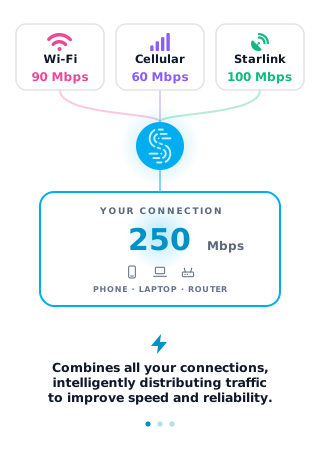
Speedify is an app for macOS that draws on Wi-Fi, 4G/5G cellular data, wired Ethernet, Starlink and other internet connections at once. The sections that follow look at why leaning on a single internet connection lets Zoom stumble on a Mac, and what using Speedify does for your Zoom picture and sound.
Speedify keeps your call running when the connection under it fails.
Zoom, Teams, and Meet all end the call when the connection goes, and rejoining costs you the thread of the meeting. Speedify bonds your Wi-Fi with any second connection, often 4G/5G cellular, and hands the call over mid-session. Nobody has to rejoin.
Advanced macOS Network Optimization with Intelligent Bonding
Technical Mac users require more than basic connectivity fixes. Professional network management demands intelligent traffic distribution across multiple upstream providers, automatic failover mechanisms, and transport-layer optimization that maintains throughput under load.
Our implementation covers multi-WAN aggregation on macOS, including cellular backhaul (5G/LTE-A), satellite integration (Starlink), fiber optic connections, and Wi-Fi 6E—unified through bonding algorithms optimized for Apple’s network stack.
Expert Solution: Multi-Connection Architecture
Multi-ISP aggregation for bandwidth-critical applications
Speedify provides macOS-native connection aggregation across Wi-Fi 6E, 5G mmWave, Ethernet backhaul, and Starlink LEO satellite into a unified high-availability interface optimized for Apple’s networking frameworks.
The system automatically detects available network interfaces with intelligent traffic distribution algorithms that analyze latency, jitter, and packet loss metrics in real-time. Load balancing dynamically adjusts based on application QoS requirements and connection quality. Configuration guides support complex deployments including dual-WAN setups and cellular failover.
Multi-device cellular aggregation with failover
Speedify’s Pair & Share enables sophisticated cellular aggregation scenarios for Mac users managing distributed Apple ecosystems. Dynamic sharing of 5G/LTE connections across macOS, iOS, and iPadOS devices creates high-availability cellular mesh networks with automatic load balancing.
Implementation supports carrier aggregation across multiple providers, enabling combination of Verizon 5G mmWave, AT&T 5G+, and T-Mobile 5G UC for unprecedented mobile bandwidth. The system maintains session persistence across connection transitions for uninterrupted operation.
Root Cause Analysis: macOS Network Stack Limitations
Primary vectors for zoom meeting issues mac users encounter involve network stack limitations in single-connection scenarios. When operating with insufficient bandwidth allocation or connection instability, Zoom’s RTP cannot maintain QoS requirements. Power users often remain unaware of underlying connectivity degradation until application failure during critical sessions.
Zoom’s codec requirements demand sustained bandwidth, particularly for 4K streams and multi-participant conferences. The application maintains complex bi-directional data streams with strict latency requirements. macOS devices simultaneously encode outbound video/audio while decoding multiple inbound feeds—highly sensitive to network inconsistencies.
Network topology challenges arise when Wi-Fi connections experience momentary packet drops or cellular encounters tower handoffs. Transport-layer interruptions require multiple RTTs for congestion control recovery, resulting in observable quality degradation.
These limitations manifest as audio dropouts, video frame freezing, and A/V synchronization drift—symptoms familiar to Mac users managing professional video conferencing requirements.
Technical Implementation: Intelligent Network Aggregation
Professional resolution of zoom meeting issues mac systems face requires transport-layer optimization through intelligent connection bonding. Speedify’s networking engine continuously monitors connection quality metrics across interfaces, implementing sophisticated Wi-Fi and cellular aggregation optimized for macOS frameworks.
The system creates a virtual network interface that aggregates multiple physical connections into a single high-availability channel. This dramatically improves effective bandwidth while providing automatic failover that maintains session continuity during individual connection failures.
Traffic engineering ensures optimal performance for real-time applications. When connections degrade—such as congested Wi-Fi access points or cellular capacity limitations—the system automatically redistributes traffic across healthy connections without session interruption. Failover operates below application awareness for seamless user experience.
Compatibility spans Apple’s Mac lineup including MacBook Pro (M-series/Intel), MacBook Air, iMac, Mac Studio, Mac Mini, and Mac Pro. Supports macOS 10.12+ with optimizations for Apple Silicon and Intel architectures. Current requirements available on the download page.
Enterprise-Grade Security with Performance Enhancement
Beyond connectivity optimization, Speedify implements enterprise security through its bonding VPN architecture with DTLS 1.2 security protocol. All traffic receives AES 256 encryption or ChaCha20 Poly 1305ChaCha20-Poly1305 encryption, providing authenticated encryption without legacy VPN performance penalties.
Security implementation protects against sophisticated threats including MITM attacks on public networks and corporate espionage targeting video conferencing. This operates transparently with no application-specific configuration while maintaining Zoom enterprise security compatibility.
Unlike traditional VPNs that introduce latency and throughput penalties, Speedify’s bonding architecture improves performance through parallel path utilization. Advanced cryptographic acceleration optimized for Apple Silicon ensures encryption overhead doesn’t compromise real-time application performance.
Mac power users gain comprehensive elimination of zoom meeting issues mac systems experience, plus enterprise security and improved network performance for 4K streaming, large transfers, and real-time collaboration.
Advanced multi-connection deployment architecture
Speedify enables sophisticated aggregation combining fiber, 5G cellular, Starlink satellite, and Wi-Fi 6E into unified high-availability networking optimized for professional video conferencing, content creation, and mission-critical applications.
Speedify
Get started with Speedify today.
Combine Wi-Fi, 4G/5G cellular, Ethernet, Starlink, and more into one faster, steadier connection. Free to try — no credit card required.
🚀 Speed
Faster uploads and downloads by bonding all your connections at once.
📶 Stability
Automatic failover in under a second when any connection drops.
🔒 Security
AES-256 encryption on every connection, on every network you join.


15M+ downloads worldwide. 75K+ five-star reviews on iOS and Android.