
Internet Connectivity - Biggest Challenge for Remote Learning
Remote learning has got a whole new and broader meaning in the recent years. This type of learning was purely optional before and would usually apply to online courses for post-graduates. Nowadays we see children and adults of all ages doing this from kindergarten and primary school.
Whether it's school, college, post-graduate studies or online courses, remote learning is here to stay. And since it relies on the Internet to work, you have to think about how good is your Internet connection for distance learning.
This article explains how you, as a teacher or student, can avoid any remote learning challenges related to your Internet connection in the first place. Speedify combines multiple internet connections (Wi-Fi, 4G, 5G, Ethernet, Starlink, Satellite, and more) to improve the stability, speed, and security of your remote learning experience. This way, you can focus on teaching, not on making sure you are seen or heard.
Quick answer
Should you have a backup 4G, 5G, Starlink, or cable internet connection?
Yes — every internet connection goes down, including Starlink, which drops for ~34 minutes a day on average. A backup connection from a different provider means one outage never takes you fully offline. The most common options are a 4G/5G cellular hotspot, a cable or DSL line, or a second satellite dish.
4G/5G cellular
Works anywhere. Just a SIM or hotspot — no installation needed.
Learn more →Cable / DSL
Best for fixed locations. Different network, so outages rarely overlap.
Learn more →Second Starlink
Adds redundancy and throughput for remote sites or heavy usage.
Learn more →Speedify bonds any two connections into one — automatic failover, more speed, no dropped calls.
Try free →Speedify
Speedify gives you faster, steadier internet by combining Wi-Fi, cellular, and Starlink
Speedify bonds Wi-Fi, 4G/5G cellular, Ethernet, and Starlink into one connection at the same time, giving you more speed, automatic failover when one drops, and AES-256 encryption on every link.
Download Speedify ›More speed
Upload and download speeds combine across every active connection on your device.
Automatic failover
If a connection drops, Speedify moves your traffic to another in milliseconds. Calls stay connected.
Always encrypted
Every link runs through an encrypted tunnel, including public Wi-Fi, cellular, and Starlink.
Speedify Feature · Pair & Share
Speedify Pair & Share: share cellular between your devices, both ways
Most hotspots give. Speedify's Pair & Share gives and takes. Two devices running Speedify pair up and each uses the other's cellular connection simultaneously, so you both get faster uploads, faster downloads, and a steadier connection. No extra hardware, no new data plans, no setup beyond a tap.
Learn how Speedify's Pair & Share works ›More speed
Every device you pair with adds its cellular to yours, and yours to theirs.
Stays connected
If a paired device drops out, Speedify keeps you online on the remaining links.
Always private
Every shared connection runs through AES-256 encryption. Your traffic is yours.
No new gear
Runs on devices already running Speedify, over your local network. Pair once, reconnects automatically.


#1 Remote Learning Challenge: Slow and Unreliable Internet Connectivity
We've all been there, at least in our spare time: seeing that buffering wheel all too often on videos, being disconnected from video calls or not being able to understand what others are saying due to choppy audio and video. This reflects in your daily activities now, since the Internet connection is the same one it was a few months ago. So that's not good.
Count the times you or somebody in your online class says "can you hear me?" or "I can't understand what you're saying". If those phrases come too often in the conversation, then you've got a hardware, software or an Internet problem you need to address.
Plus - think also of the opportunities online learning offers you. If you'd have no technical challenges, you could go beyond video by making your class interactive, as a teacher. You could use online collaboration tools for brainstorming, quizzes and other creative activities.
Troubleshooting Internet Connection Challenges of Remote Learning
Disclaimer: we won't focus here on whether your webcam and microphone are set up correctly. Or if the settings are right for your Zoom / Google Classroom / other remote learning tool you're using. We'll just assume those are all good.
The real remote learning challenge is that troubleshooting Internet connection issues takes time. It's like taking a second job as your own IT support person. You have to at least follow these steps:
- Restart your modem / router.
- If possible, use a wired connection to your computer. Or at least move closer to the Wi-Fi router.
- Close non-essential teaching apps that might be hogging the bandwidth. Also ask your family to restrain from streaming videos or getting on video calls while you're teaching remotely.
- Test your Internet speed to make sure you're getting the speed you're paying for.
- Call your Internet Service Provider and wait until they solve the issue... that's days, usually.
In certain situations there's the possibility of recording your class and making them available for download for students. But in most cases, you have to do synchronous teaching.
So, the essence of making the most out of online learning is a solid Internet connection that's fast, stable and also secure - we've all heard of those Zoom bombings. Meet Speedify, your solution to avoid remote learning challenges.
Speedify Helps You Avoid One of the Disadvantages of Remote Learning: Poor Connectivity
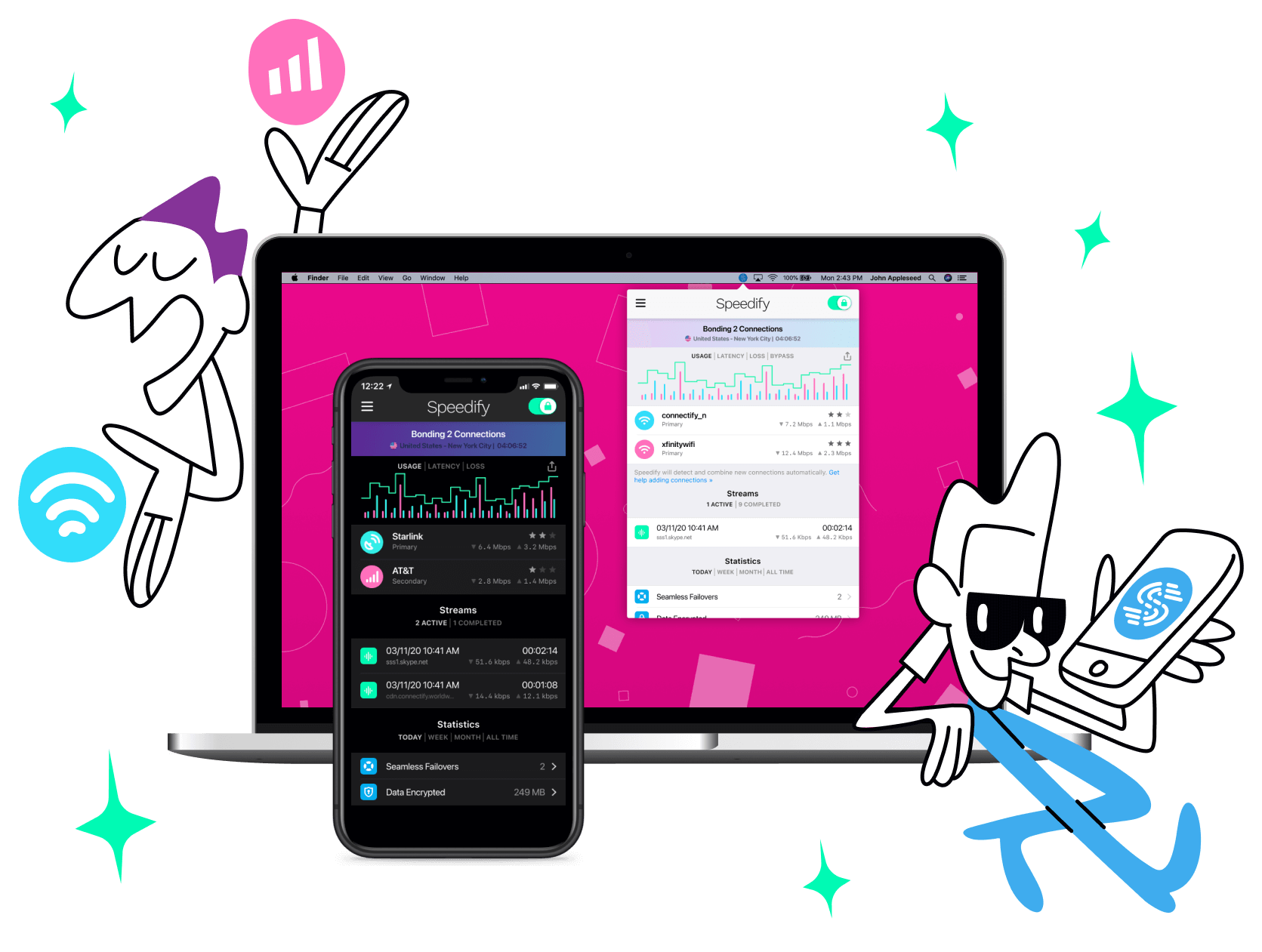
Speedify is an app you can install on the device you're using to teach online - computer, tablet, smartphone. It is a bonding VPN service that allows you to use all of your Internet connections at once, whether you have a Starlink, Wi-Fi, 4G / 5G cellular, DSL or any other type of connection. By doing this, you will get a "super-pipe" with faster speed and increased reliability, as well as being protected from online snoops that are after your data.
The increased Internet speed is achieved through a technology called channel bonding, which Speedify uses. That also allows you to remain connected online even if one of your connections drops.
How do you get a second Internet connection to use at the same time, you ask? It's simple: you probably have a smartphone - you can just tether that to your computer and use its cellular data. It's even simpler if you use a tablet or the smartphone to teach - just enable the cellular connection. Don't worry about paying more - with Speedify you can specify how much cellular data it should use, so you don't go over your plan.
Get started with Speedify today!
With Speedify you can combine Wi-Fi, 4G / 5G cellular, Ethernet, Starlink and other satellites into one bonded super-connection to improve livestreaming, video calling, gaming, web browsing, and everything else you do online.




Speed
Stability
Security
Speedify engineers love talking tech on YouTube, Tiktok, and Instagram!
Alex Gizis and the Speedify engineers discuss and explain technology including Starlink satellites, Wi-Fi 7 routers, Apple networking features, fiber optics, broadband internet, 5G mobile networks, AI, networking protocols, and much more. Follow Speedify on YouTube, TikTok, Instagram, and LinkedIn!
Alex and the Speedify team are always exploring the latest in networking and security technology—like 5G, 6G, WiFi 7, laser and satellite internet—and sharing it in new discussion content across YouTube, TikTok, Instagram, and LinkedIn every week.
Got a tech question? Let's go deeper! Pop into Speedify Office Hours live every Wednesday at 10 AM Eastern. Speedify CEO Alex Gizis and our network engineers are standing by to break down your questions about networks, tech updates, and Speedify features.