

Run Speedify on an OpenWrt Router for Whole-Network Bonding
OpenWrt turns a router into a fully programmable Linux device, and Speedify installs right on top of it. Once Speedify runs on the router, every device on the network gets faster, more reliable, and more secure internet, with no app to install on each phone, laptop, or smart device.
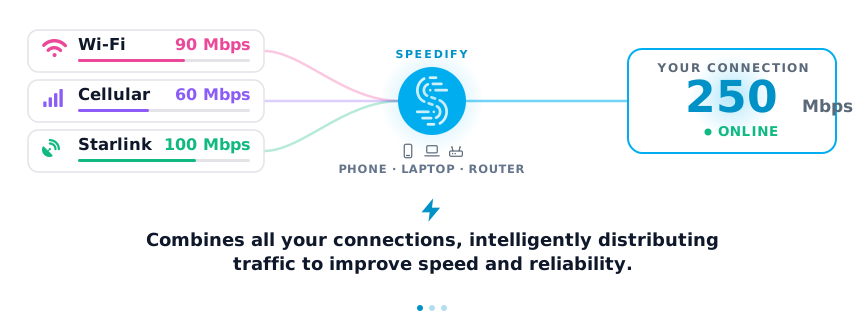
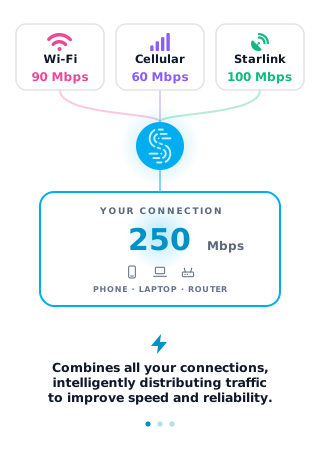
Speedify combines Wi-Fi, 4G/5G cellular, Ethernet, Starlink and satellite internet connections into one connection for the whole LAN. Speedify’s technology for combining internet connections sends traffic over all of them at once for faster downloads and uploads, and if one connection drops, traffic moves to the others without dropping calls or streams. This guide covers installing Speedify on any supported OpenWrt router, not just one brand.
Speedify runs on the router and bonds the connections for everything behind it
How do I use WiFi and 4G/5G cellular at the same time with Speedify?
Pick your two internet connections and your device below and we'll take you to the step-by-step setup guide.


What Your OpenWrt Router Needs to Run Speedify
Speedify on a router has clear hardware requirements. Confirm these before you start.
- A Speedify Router License. Running Speedify on a router uses a dedicated Router License, separate from a personal subscription.
- A supported CPU and OpenWrt version. Speedify runs on x86_64 (Intel or AMD) or aarch64 (Cortex A53 or A72) processors, on OpenWrt 23.05 or newer. Speedify does not support MIPS processors or DD-WRT. Confirm your device in Speedify’s supported routers article.
- An active internet connection on the router so it can download Speedify during setup.
If your device runs a stock vendor firmware, you can flash mainline OpenWrt from the OpenWrt firmware selector first, then install Speedify. Supported boards include the Raspberry Pi 4 and Banana Pi R3, along with many x86 mini-PCs and GL.iNet routers.
How to Install Speedify on an OpenWrt Router
- Activate your Speedify Router License on the account you will sign in with.
- Connect to the router over SSH as root. The router’s address is usually 192.168.1.1.
- Run the official install script. Speedify provides a one-line script that installs the Speedify package and the LuCI plugin together. Use the exact, current command from Speedify’s OpenWrt setup guide. If you prefer to install each package by hand, follow Speedify’s manual OpenWrt install guide.
- Open the LuCI web panel. A new Speedify tab appears in the top navigation after installation. Log out and back in if you do not see it.
- Sign in to Speedify from the Speedify tab to activate the connection.
Speedify is now active, and every device on the router’s network gets the combined, encrypted connection automatically.
Combine Two or More Internet Connections on OpenWrt with Speedify
To combine more than one internet connection, the router needs at least two WAN interfaces, for example a wired uplink plus a 4G/5G cellular connection. OpenWrt bridges WANs into a single interface by default, but Speedify needs each connection to be individually addressable to combine it, so the WANs have to be reconfigured. Spare LAN or USB ports can be turned into WAN ports, and a USB-tethered Android phone or iPhone can serve as an extra WAN.
The exact interface steps are in Speedify’s guide to combining connections on OpenWrt. Once the WANs are configured, they appear in the Speedify interface and Speedify starts combining them. For the hardware background, see Speedify’s guide to what a router is and how it works, and for a single-board build, see building your own Raspberry Pi router that combines connections.
Speedify on an OpenWrt Router vs. Dedicated Hardware Appliances
Dedicated hardware appliances for combining connections do one job and cost accordingly. A Speedify-powered OpenWrt router combines multiple WANs and fails over in software, on hardware you choose, and it doubles as your normal router. Speedify protects every connection with encryption, prioritizes real-time traffic like video calls and live streams, and keeps the network online when one connection fails.
One Thing to Remember After OpenWrt Updates
Upgrading the OpenWrt operating system itself usually wipes manually installed packages, so you will need to reinstall Speedify after a full firmware update. The reinstall uses the same one-line script.
Speedify on OpenWrt: FAQ
Which OpenWrt routers can run Speedify?
Any router with an x86_64 or aarch64 CPU running OpenWrt 23.05 or newer. MIPS processors and DD-WRT are not supported. Check the current supported routers list before buying.
Do I need a separate license for the router?
Yes. Speedify on a router uses a Speedify Router License, which is separate from a personal subscription. Each Router License is priced by monthly data and includes a complimentary Speedify for Individuals account for up to 5 other devices. The free tier is not available on routers.
Can Speedify combine a wired connection with cellular on OpenWrt?
Yes. Once each connection is set up as its own WAN interface, Speedify combines them and sends traffic over both at once.
Does every device on the network benefit?
Yes. With Speedify on the router, every connected device gets the combined, encrypted connection, including devices that cannot run the Speedify app themselves.
Speedify
Get started with Speedify today.
Combine Wi-Fi, 4G/5G cellular, Ethernet, Starlink, and more into one faster, steadier connection. Free to try — no credit card required.
🚀 Speed
Faster uploads and downloads by bonding all your connections at once.
📶 Stability
Automatic failover in under a second when any connection drops.
🔒 Security
AES-256 encryption on every connection, on every network you join.


15M+ downloads worldwide. 75K+ five-star reviews on iOS and Android.