

Run Speedify Headless on a Linux Server with the CLI
A Linux server rarely has a screen, a mouse, or a desktop, and it does not need any of them to run Speedify. Speedify runs fully headless, controlled entirely through the command-line interface, so a server can bond multiple internet connections and stay online through a dropped link with nothing but an SSH session.
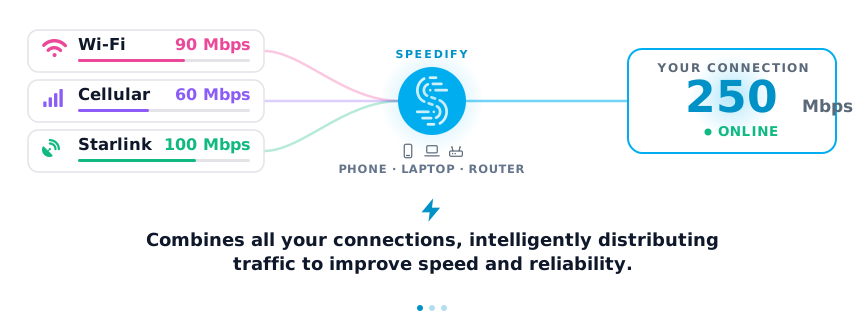
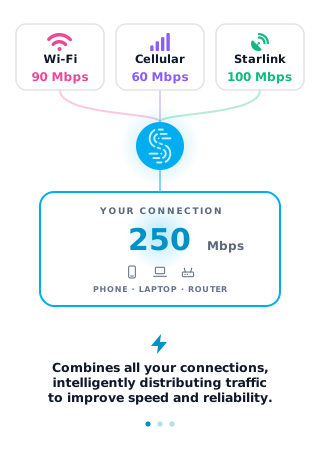
Speedify combines Wi-Fi, 4G/5G cellular, Ethernet, Starlink and other satellite into one connection, and on a server that usually means bonding two or more wired or cellular uplinks for redundancy and speed. Speedify’s channel bonding technology uses up to 95% of the combined capacity and fails over in under a second, all while encrypting every connection.
Speedify runs on the router and bonds the connections for everything behind it
How do I use WiFi and 4G/5G cellular at the same time with Speedify?
Pick your two internet connections and your device below and we'll take you to the step-by-step setup guide.


Desktop UI vs Headless CLI
| Setup | Speedify desktop UI | Speedify headless CLI |
|---|---|---|
| Needs a display | Yes | No, runs over SSH |
| Package to install | speedify plus speedifyui | speedify only |
| How you control it | Graphical interface | speedify_cli commands |
| Best for | Laptops and desktops | Servers, containers, and embedded devices |
| Scriptable and automatable | Limited | Yes, including a Python API |
How to Install Speedify on a Headless Linux Server
- Install Speedify from the terminal. Run the install command from Speedify’s Linux installation guide. On a headless system you only need the core Speedify package, not the user-interface package. On a minimal system with only root access and no sudo, you can follow the manual install steps in the same guide.
- Confirm the background service is running. Speedify runs as a background service after installation, which is what the CLI talks to.
- Locate the CLI. On Linux the command-line tool lives at /usr/share/speedify/speedify_cli. See Speedify’s Linux CLI guide for details.
Sign In and Connect from the Command Line
With no interface, sign-in happens through the CLI. Running the login command returns an activation URL that you open in a browser on any device to finish signing in, after which the server stays signed in. Once authenticated, a single connect command brings Speedify online, and a status check confirms the account and connection. The complete command reference, including how to connect to a specific server, set adapter priorities, and read connection stats, is in Speedify’s CLI usage guide.
Bond Connections on a Server
A server bonds whatever uplinks it has: two Ethernet ports, a wired link plus a tethered cellular modem, or a primary line plus a backup. Each connection is managed through the CLI, where you can mark a metered link as backup so it only carries traffic when the primary cannot keep up. Speedify then spreads traffic across the active connections at the packet level and reroutes instantly if one fails.
For a single-board example of the same idea, see Speedify’s guide to building a Raspberry Pi bonding router.
Automate Speedify with the Python API
Headless setups often want automation, and Speedify ships an official Python API for exactly that. Scripts can change settings, run speed tests, log connection stats, and react to connects and disconnects.
The package is on Speedify’s GitHub at github.com/speedify/speedify-py. For teams that need more control over where traffic exits, Speedify also offers dedicated and self-hosted servers.
Headless Speedify on Linux: FAQ
Can Speedify run without a desktop?
Yes. Speedify runs fully headless on Linux, controlled through the speedify_cli command-line tool over SSH. No display or desktop environment is required.
How do I sign in with no user interface?
The CLI login command returns an activation URL. Open it in a browser on any device to complete sign-in, and the server stays signed in.
Can I automate Speedify on a server?
Yes. Speedify offers an official Python API so scripts can control settings, run speed tests, and respond to connection events.
Does headless mode still bond connections and fail over?
Yes. Headless mode has the full bonding engine. It uses up to 95% of combined capacity and fails over in under a second, just without a graphical interface.
Speedify
Get started with Speedify today.
Combine Wi-Fi, 4G/5G cellular, Ethernet, Starlink, and more into one faster, steadier connection. Free to try — no credit card required.
🚀 Speed
Faster uploads and downloads by bonding all your connections at once.
📶 Stability
Automatic failover in under a second when any connection drops.
🔒 Security
AES-256 encryption on every connection, on every network you join.


15M+ downloads worldwide. 75K+ five-star reviews on iOS and Android.