

Speedify Combines Two or More Starlink Dishes into One Faster, More Reliable Internet Connection
This guide covers whether you can actually run two Starlink dishes, how Speedify combines their speeds, the people already doing it, and what you need to set it up.
Starlink disconnects all the time for ALL Starlink users. The Speedify Starlink Index report found that Starlink connections are down for an average of ~33 min per day. Plus, all Starlink dishes experience small drops and packet loss every 15 seconds, when the moving Starlink satellites hand off the connection to the next satellite overhead.
The best way to fix Starlink's connection drops is to combine your Starlink connection with another internet connection, such as 4G/5G cellular, cable, fiber, DSL, or another Starlink connection. Speedify makes this possible with channel bonding.
Most Starlink users already run a second connection.
From a sample of 6,228 Starlink users on Speedify, 71% ran at least one other internet connection while using Starlink. Cellular is the most common choice of backup connection.
What they pair with
Should you get a backup connection for Starlink?
Yes. Starlink goes down every day — an always-on dish averages about 34 minutes of downtime daily from routine satellite handoffs. A second connection keeps you online when Starlink drops.
What’s the best backup connection for Starlink?
A 4G/5G cellular hotspot or SIM is the most practical backup for most Starlink users — it works anywhere Starlink works, requires no installation, and uses a different network so outages rarely overlap. Cable or DSL broadband is a strong option if you have it at a fixed location. A second Starlink dish is also possible if you need maximum throughput.
How do you use two internet connections at once with Starlink?
Speedify combines Starlink with any other connection — cellular, cable, Wi-Fi, or a second dish — into one bonded connection. Speedify runs on your phone, laptop, or router. When Starlink drops, Speedify moves your traffic to the backup instantly, so calls don’t cut out and downloads don’t stall. Speedify is free to try.
71% of Speedify’s Starlink users already run a second connection. Speedify’s Starlink Index tracks real-world Starlink performance data from thousands of dishes.
See the full dataset →Use Speedify to stay online during Starlink satellite handoffs every 15 seconds
Research confirms Starlink switches between satellites every 15 seconds on a fixed schedule. Each satellite handoff is a potential dropout, and on a congested network or with any obstruction, those Starlink dropouts become real interruptions.
Speedify fixes Starlink connection drops by combining your Starlink internet connection with another satellite dish, Wi-Fi, 4G/5G cellular, or wired Ethernet at the same time. When Starlink drops, Speedify keeps your traffic moving on the backup internet connection instantly.

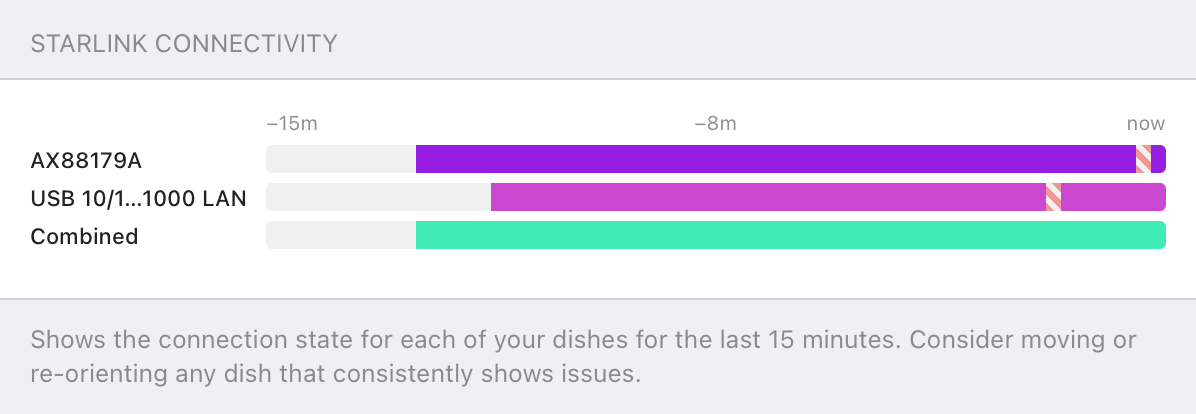
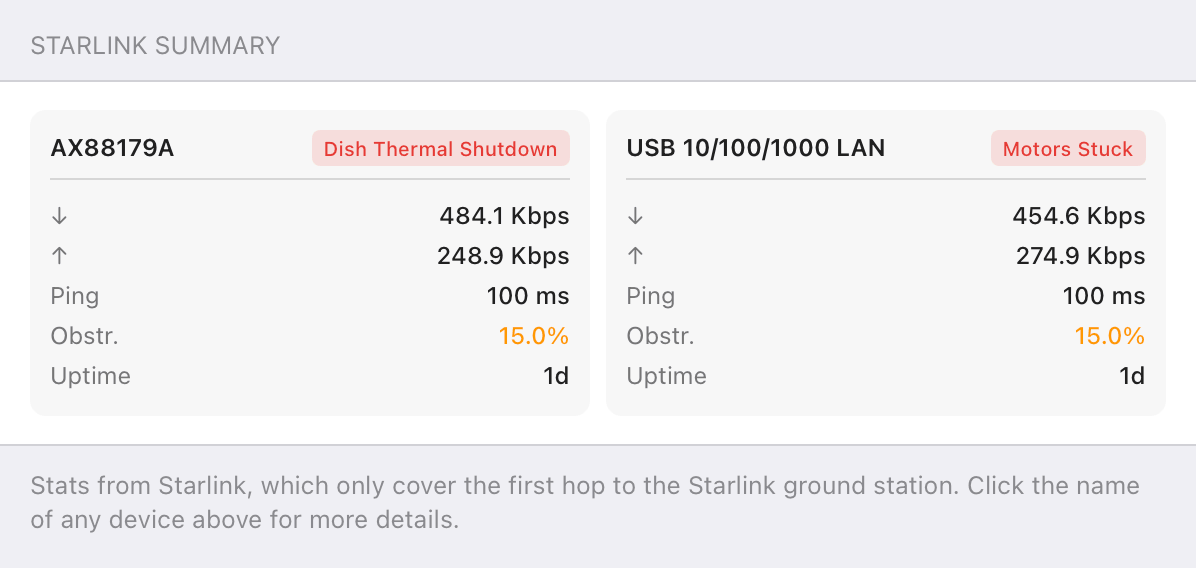
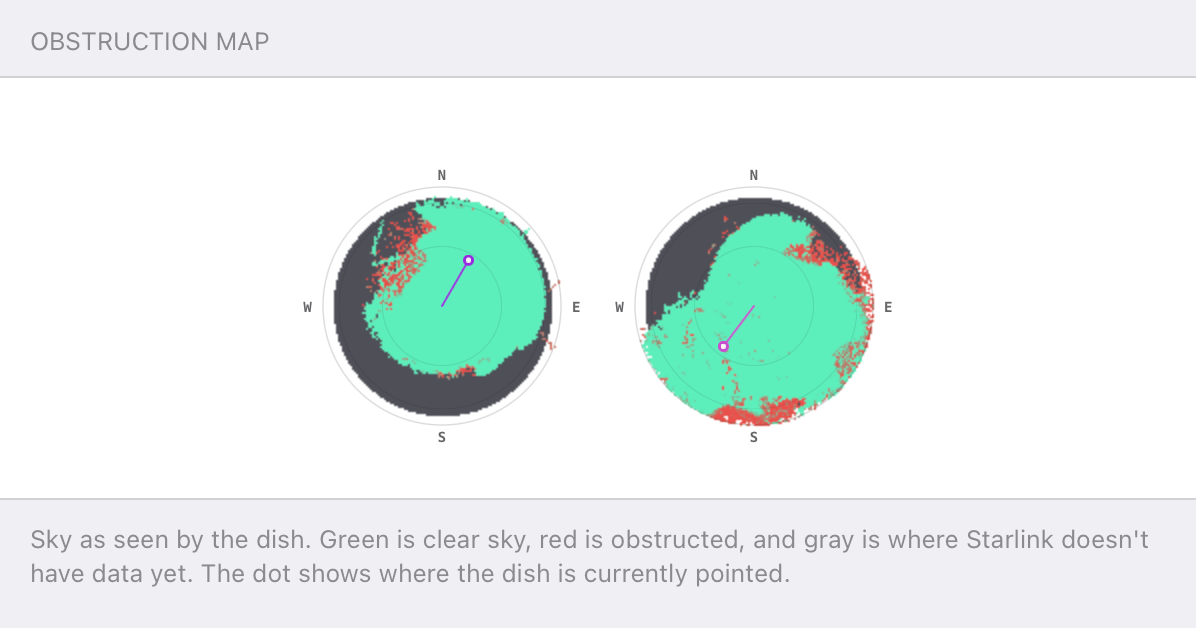
Speedify alerts you about your Starlink dish status
Speedify software alerts you about your Starlink dish status as soon as your dish experiences an issue - e.g. when your actuator motor is stuck, the mast is not vertical or there's a thermal throttle.
Speedify's Starlink Control Center helps you monitor all your Starlink dishes, read obstruction maps, and align multiple dishes all in the Speedify app. Get a real-time view of each dish's health and optimize the position of each Starlink dish, so you get the best possible performance out of your Starlink connections.
Can You Really Run Two Starlink Dishes at the Same Time?
Nothing stops you from installing two Starlink dishes at one location. Each dish needs its own Starlink subscription and account, and a Starlink account can hold multiple service addresses and dishes under one login. The limitation isn’t the hardware. It’s that both Starlink dishes answer to the same 192.168.100.1 address, so the Starlink app and a typical router can only see one dish at a time.
Speedify gets past the single-IP limit by talking to each Starlink dish in parallel. Both dishes show up at once, and Speedify uses both instead of treating the second as a spare. For a closer look at the IP conflict and how Speedify resolves it, see how to manage two Starlink dishes at once with Speedify.
How Speedify Bonds Two Starlink Connections
Speedify’s channel bonding technology splits your internet traffic across both Starlink connections at the packet level. Each packet routes over whichever dish is performing better at that moment, so the two dishes act as one connection. When both Starlink dishes are healthy, Speedify delivers up to 95% of their combined upload and download throughput.
This is not load balancing that pins each app to one link. Speedify uses both Starlink dishes for the same transfer at the same time. If one dish gets obstructed or drops out, Speedify’s automatic failover moves all traffic to the other dish without interrupting active video calls, uploads, or VPN sessions.
Who Already Runs Two Starlink Dishes
Two-dish Starlink setups used to be rare. They aren’t anymore. Three examples show why people in very different situations combine dishes with Speedify:
The rural remote worker. Someone working from a property with no cable or fiber depends on Starlink for every video call. A single satellite handoff or a passing rain cell can freeze a call at the wrong moment. A second Starlink dish bonded with Speedify keeps the call running when one dish stutters, because Speedify is already carrying traffic on both.
The IRL livestreamer. A creator broadcasting live from a remote location can’t pause to reconnect. A dropped frame is a dropped stream. Two Starlink dishes bonded with Speedify give the upload headroom that live video needs and a second path that holds the broadcast together if one dish loses the satellite.
The remote construction site. A construction company running a job trailer miles from the nearest tower has no wired option and often weak cellular. One Starlink dish covers the site until the hardware fails or the weather turns, and then the whole site goes dark. Two Starlink dishes bonded with Speedify keep payroll, design files, and site cameras online through a single dish outage.
What You Need to Use Two Starlink Dishes with Speedify
- Two Starlink subscriptions. Each Starlink dish needs its own account and subscription, both manageable under Starlink’s account system.
- A device that can reach both dishes. A laptop or desktop with two network interfaces works, or a Speedify-compatible router with multiple WAN ports for whole-network coverage.
- Speedify installed on that device. Speedify runs on Windows, macOS, iOS, Android, Linux, and OpenWrt routers.
Connect both Starlink dishes, open Speedify, set both connections to Always mode, and Speedify begins distributing traffic across both dishes right away.
Two Starlink Dishes Work Better Together with Speedify
A second Starlink dish on its own is a spare you switch to after something breaks. Bonded with Speedify, two Starlink dishes become one connection that runs on both at the same time, adds their speeds together, and survives a single dish failure without dropping you offline. Speedify makes your Starlink setup faster, more reliable, and more secure, whether you run one dish or several.
Get started with Speedify today!
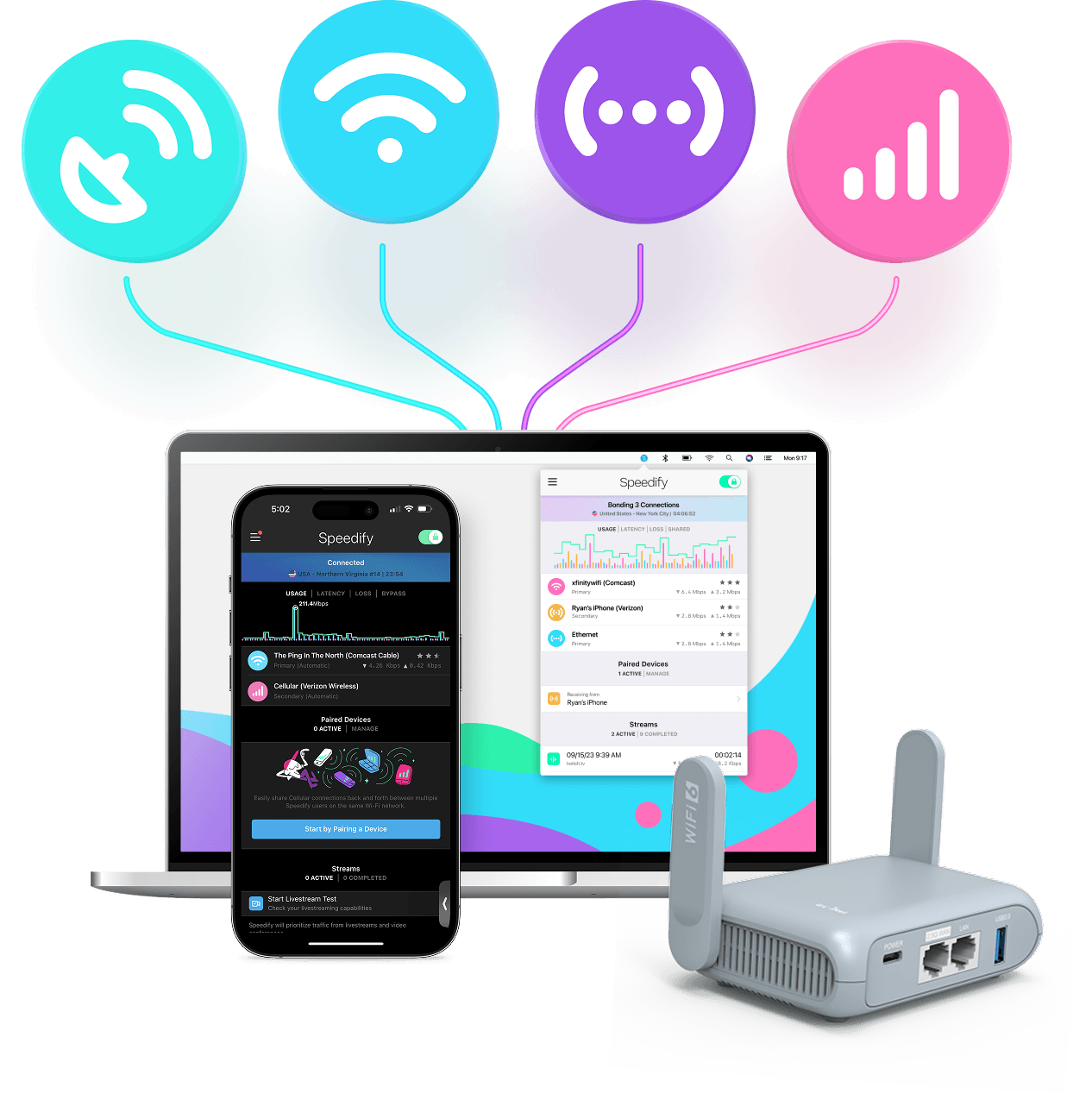
With Speedify you can combine Wi-Fi, 4G / 5G cellular, Ethernet, Starlink and other satellites into one bonded super-connection to improve livestreaming, video calling, gaming, web browsing, and everything else you do online.




Speed
Stability
Security
Speedify engineers love talking tech on YouTube, Tiktok, and Instagram!
Alex Gizis and the Speedify engineers discuss and explain technology including Starlink satellites, Wi-Fi 7 routers, Apple networking features, fiber optics, broadband internet, 5G mobile networks, AI, networking protocols, and much more. Follow Speedify on YouTube, TikTok, Instagram, and LinkedIn!
Alex and the Speedify team are always exploring the latest in networking and security technology—like 5G, 6G, WiFi 7, laser and satellite internet—and sharing it in new discussion content across YouTube, TikTok, Instagram, and LinkedIn every week.
Got a tech question? Let's go deeper! Pop into Speedify Office Hours live every Wednesday at 10 AM Eastern. Speedify CEO Alex Gizis and our network engineers are standing by to break down your questions about networks, tech updates, and Speedify features.