

Starlink Direct-to-Cell Brings Satellite Connectivity to Your Smartphone
Use the Speedify software app to avoid Starlink internet dropouts
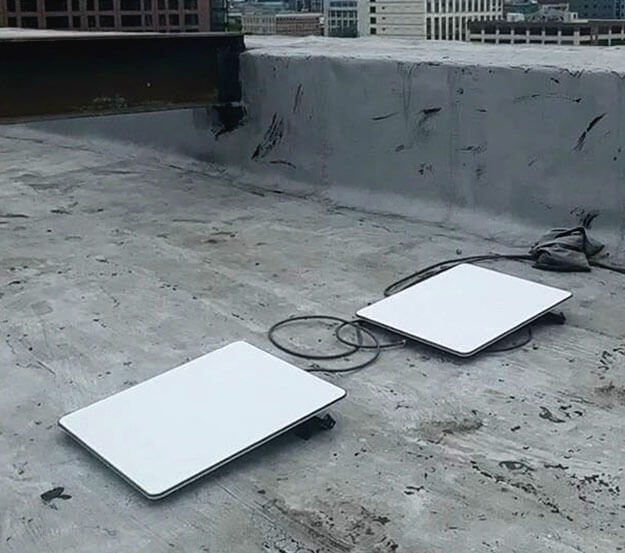
Speedify alerts you about your Starlink dish status

Use Speedify to Increase Your Upload and Download Speeds: Combine Wi-Fi, 4G / 5G Cellular, Ethernet, Starlink and Other Satellites

Speedify combines Wi-Fi, 4G / 5G cellular, Ethernet, Starlink, and other satellites for faster internet uploads and downloads
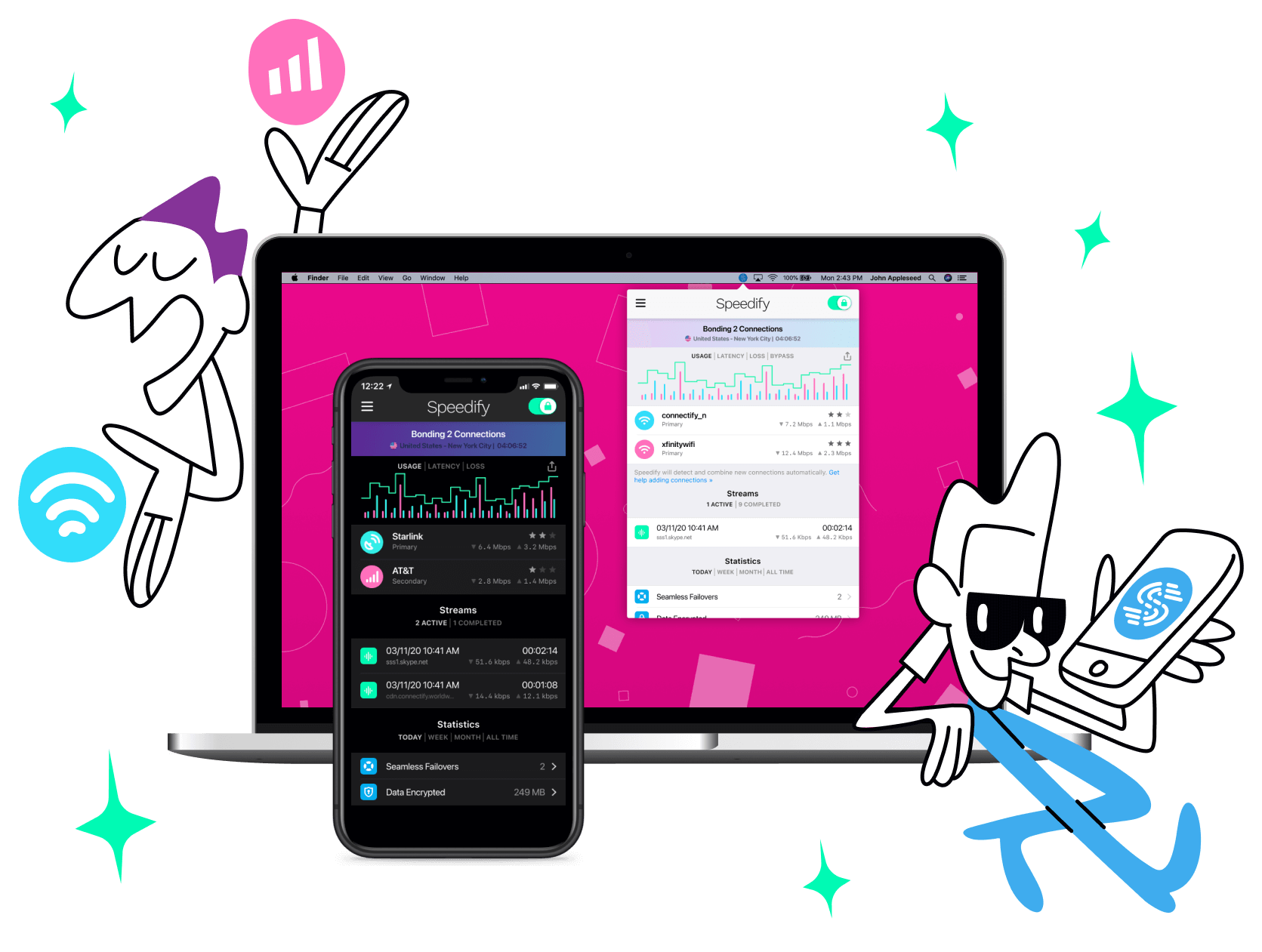
Speedify is the only software app that combines Wi-Fi, 4G / 5G cellular, Ethernet, Starlink and other satellites at once for secure, faster, and more reliable internet uploads and downloads so you stay online without interruptions.
Speedify will automatically detect and start using any available Internet connections on your device while intelligently distributing your online traffic between them for optimal performance. If you need help we have quick start guides available for most common set ups.

Speedify combines multiple personal hotspots for faster internet upload and download speeds
Speedify's Pair & Share feature enables you to connect to multiple hotspots at the same time for faster upload and download speeds and more reliable internet for everyone. Speedify's Pair & Share feature allows you to wirelessly share 4G / 5G cellular connections back and forth between multiple Speedify users on the same local network when live streaming from an event, calling from the commute or sharing from the field.
Speedify is the only app that allows you to share 4G / 5G cellular data between PCs, Macs, iPhones and Androids. Use multiple iPhones and Android phones as hotspots for internet access and get faster upload and download speeds and mobile failover for all paired devices.
Use Speedify to combine...
Combine these connections on:

How Starlink Direct-to-Cell Works
Ryan: You might be able to access Starlink on your phone right now without needing to buy a dish, but it's a little bit different from regular Starlink. Alex, what is Starlink Direct-to-Cell?
Alex Gizis: They are putting cell tower radios on the satellites in space. So you can have a totally ordinary phone, and if you're outside with a view of the sky, you can, instead of connecting to a tower on the ground, connect to a tower in space. And get text and phone calls on the Internet that way.
Ryan: How is it different from regular Starlink?
Alex Gizis: So the regular Starlink Internet service uses special dishes, using a proprietary protocol up at something like 12 GHz, which lets it go really, really fast. But everything about it is designed specifically for SpaceX to deliver Internet.
This is about making those things up in space act just like cell phone towers. So, existing phones that don't know anything about space or SpaceX, when they join the tower with the strongest signal, they could be joining something up in space.
Starlink Direct-to-Cell Capabilities and Limitations
Ryan: How does it reach that far if it's a regular LTE signal?
Alex Gizis: Step one, you have to have a view of the sky. It is not powerful enough. to punch through the roof of your house and then make it all the way to space. You have to be able to see the satellite. And then even there, SpaceX is in discussions with the FCC asking for permissions to have those towers in space broadcast at higher power than regular towers, which makes sense. But the FCC is still considering the quest.
Ryan: How powerful are we talking? What kind of speeds?
Alex Gizis: So at this point, all they've really demonstrated, at least in, in the tests around the hurricane, was texting phones will be next with Internet. They were talking about having a few Mbps spread across all the phones in a not small area.
So right now, they have about 6,000 satellites in space, which, for the record, is more than half of all the satellites in space. But about 330 of them have the extra hardware of acting as cell phone towers. Now, they went to the FCC and asked for permission to launch 22,000 more satellites. They're looking to make it up to 30,000 satellites in space, of which about 7,500 will be the cell phone towers.
They're looking for real coverage, but each one only can manage to get about 17 Mbps of bandwidth down to the ground. So if you imagine the world, chopped up into a grid of 7,500 pieces. And each piece is only sharing 17 Mbps across itself, you realize this isn't high speed stuff. This isn't a threat to AT&T and Verizon.
Starlink Direct-to-Cell Usage Scenarios: Emergency Services and Remote Applications
Alex Gizis: It really is coverage where you can't get any coverage. You're on the top of a mountain. You're playing crashes in the Andes. You're stranded on a desert island. You're in the middle of the Sahara and you can still get a message out. "I'm here. Come and get me." I think that's much more the goal. I mean, the bandwidth numbers don't add up to the point that they could be a real competitor to any of the existing services.
It's much more an emergency service.
Ryan: So are they going to be a new carrier?
Alex Gizis: No actually, in each country, they're trying to pick one carrier they'll work with. So in the United States, it's T-Mobile. If you go look at their website, they've announced partnerships all over the world, but they're really going with T-Mobile first.
They're broadcasting at 1.9 GHz. Which is, a pair of bands, the G block, that T-Mobile is using today. So this should just work on basically any phone that works on T-Mobile today. It'll just start spotting some of the towers that are very far away but somehow still work.
Ryan: And how far away are we talking?
Alex Gizis: 300 miles up. It's 550 kilometers.
Starlink Direct-to-Cell Compared to Apple's Satellite Service
Ryan: So I heard Apple is launching their own satellite service as well. How does this compare to Starlink Direct to Solar?
Alex Gizis: So Apple has hooked up with and invested in GlobalStar, which is a competing low Earth orbit system.
They're a little bit higher. They're 870 miles up as opposed to 217. So their satellites cover a bigger area. But of course the signals spread out more, which is necessary because Globalstar at this point only has 31 satellites. Starlink has 10 times as many. So Apple has really limited it. It really is only for emergency texts.
It makes a big deal of asking are you in trouble before you send it and it attaches your location. They're not pretending. It's for anything casual. It's an emergency service for when you and your iPhone are stuck on a mountain top or whatever. The Apple stuff works on any iPhone 14 or later and it works no matter what carrier you have.
The idea of the iPhone system is if it can't find any carrier to connect to, it gives up and tries the special Apple carrier. So whether you're on T-Mobile, Verizon, whoever, it ought to work if there's no towers left. But it is really just for emergencies. You're not texting your friends. You're not making calls.
You're just reaching out saying, "I have an emergency. Here's my location."
Ryan: So hypothetically, if you had a T-Mobile iPhone 14, could you use both of these services?
Alex Gizis: Yes. My understanding is it'll try the regular T-Mobile towers. And if they don't work, then it'll try the Starlink space ones. Then if even that doesn't work, it finally falls back to the Apple one. The Apple is the last resort.
Ryan: For now, Starlink Direct to Sell and Apple Satellite are both texts, but that's going to change in the future?
Alex Gizis: It should. So Starlink is certainly talking about adding phone in the very near future. In fact, I think T-Mobile's letting you sign up for a beta test. I don't think anyone's got it yet, but they've started taking signups.
And eventually they're talking about Internet, but with the warnings that'll be slow. Apple just put, another billion dollars into Globalstar to let them boost their infrastructure, put up some more satellites and stuff. So I think there's an implication that they'll Add more services, but they need to make sure it's actually going to work, that they have enough bandwidth, enough satellites.
Another use for these things, particularly the Starlink one, is IoT, Internet of Things. There is a lot of stuff that's sort of outside of the city, a little further away than cell phone towers reach, that needs to be able to call home, but doesn't have that much to say. Weather gathering equipment that needs to send back the temperature. Farming equipment for refrigerators.
I need to report back that they're still working, they're still cool, or they've stopped working. "Somebody better come out and service me before I warm up." There's just lots and lots of that stuff, and they just don't need much bandwidth. The total bandwidth they need is a couple hundred bytes a day.
Packaging that up into a couple texts is plenty good. And that's actually a pretty big market. And one of the neat things about this, of course, is that you can use any existing thing that has cellular modem, right? It's regular LTE. If it can connect to LTE at 1.9 GHz, which pretty much everything with a cellular modem can, you can take anything that works. It connects to T-Mobile, then it'll connect to the satellites.
Can You Use Starlink Direct-to-Cell with Speedify?
Ryan: So can you use either of these satellite cell services with Speedify?
Alex Gizis: You can use Speedify with anything that shows up as an Internet connection, and it'll use it and combine it with whatever Internet connections you have.
Right now, both these things are just texts. They're not Internet connections. I don't know that Apple has any plans to do that. To turn their global star thing into Internet connections, Starlink is saying they will, right? They're saying, it'll be slow and all of that, right? 17 Mbps, but it will be data.
So at that point, yes, Speedify will work over it and work with it.
Ryan: And of course, Speedify works right now with regular Starlink.
Alex Gizis: Sure. And regular T-Mobile, right? Anything that shows up as an Internet connection, all sorts of satellite links, all sorts of Wi-Fi, all sorts of cellular, Ethernet. If it gets you to the Internet, then you can run Speedify on your router, on your phone, on your computer, and it'll use it and combine it, and it'll be great.
How to Use Starlink Direct-to-Cell
Ryan: So what are the conditions for picking up this Starlink Direct-to-Cell signal? Hypothetically, could you use it with Wi-Fi, even with regular Starlink?
Alex Gizis: I don't think there's any special rules. I think it's just LTE. Which means the phone's doing that and at the same time it's doing whatever it does with Wi-Fi. So it's entirely possible that, yeah, your Wi-Fi can be coming from a SpaceX dish, and your LTE is coming off the satellite as well. You kind of wouldn't know, they're just sort of unattached to machines doing their thing to keep you online.
Ryan: Right. So it'd be a really weak backup connection, basically.

Connectivity Tech Discussions
Our Connectivity Tech Discussions Between Two Palms video series shines the spotlight on Alex and technical guests, diving deep into caonversations about the latest Internet technology, including Starlink satellite, WiFi 7, Apple, fiber optics, new routers, remote connectivity, and networking protocols.
Join us and let's talk tech!