
WiFi Login Screen Won’t Show Up at Starbucks? Use the Speedify Software App to Stay Always Connected to the Internet While You Connect to the Starbucks WiFi Login Page
Starbucks Wi-Fi needs you to accept its terms on a sign-in page, and when that page does not open you are connected to the network with no way onto the internet.
Speedify is an app that combines Wi-Fi with your phone’s 4G/5G cellular, so you keep working over cellular while you deal with the portal, and it detects the sign-in page and shows a notification that opens it. On the Starbucks Wi-Fi alone, Speedify works as an encrypted VPN and cannot keep you online before you sign in.
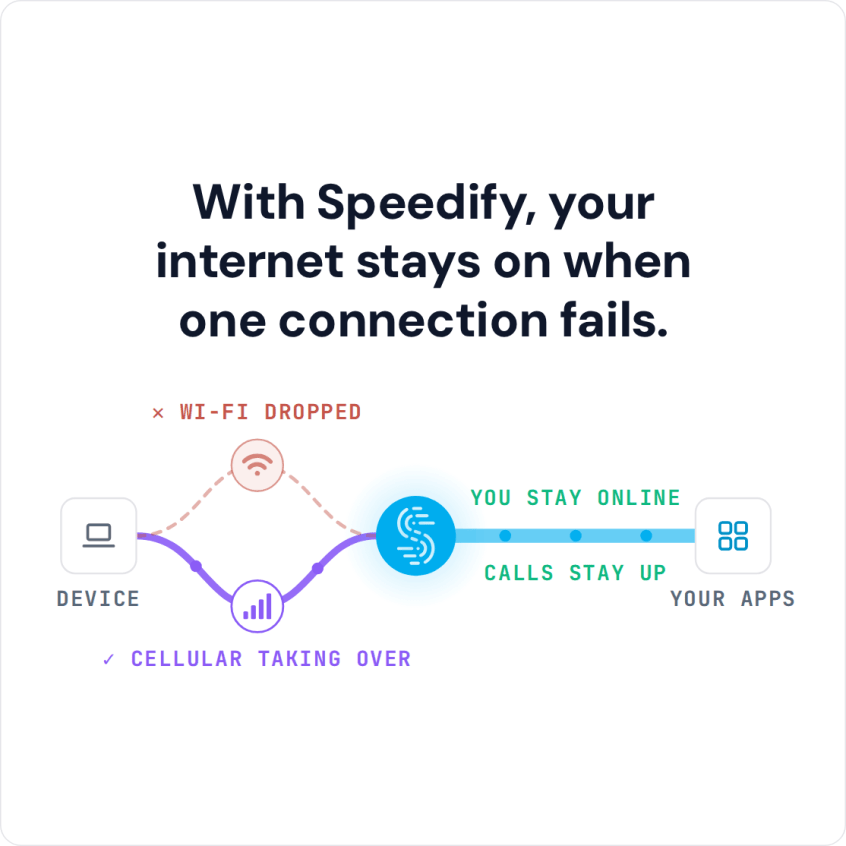
With Speedify, your internet stays on when one connection fails.
This guide covers what the Starbucks sign-in page is, how to troubleshoot it, and what to do when a VPN is what is blocking it.
Starbucks Wi-Fi Login Page: What It Is and How to Troubleshoot
To understand why the Starbucks Wi-Fi login screen won’t pop up, it helps to know what a captive portal is.
A captive portal is a web page that usually shows up when you connect to a public WiFi hotspot. You have to either accept some terms of service and/or login with a username and password before actually getting online.
So why won’t the Starbucks captive portal display on your device sometimes? It’s hard to know unless you are the network admin running the captive portal. Sometimes there are faults within the system. In other cases having your computer or mobile device set to use a custom DNS server can cause problems with a captive portal. In most cases the problem is related to the network itself and you as a user can’t do anything about it. If you are using a VPN, chances are the VPN is causing the issue.
Here’s what you can try to fix the Starbucks Wi-Fi login screen issues:
- Change your DNS servers. If you don’t know where to change your DNS settings, you’re probably fine, your device by default picks up a DNS server from the WiFi router, which is what the public WiFi expects you to use. And that’s good, at least with public WiFi. If you change your DNS settings you should try reverting them and the WiFi login page should appear. If you forgot where the DNS setting is, this article from HowToGeek should refresh your memory.
- If the first step didn’t solve the issue, the problem could be that your browser cache is still trying to use the DNS info it knows to access sites instead of loading the WiFi login page. You can try to break this cycle by visiting something new. You could clear your browser cache or better yet, open an incognito window in your browser and try visiting a non-HTTPS site. You may be wondering why a non-HTTPS site: if you try to visit a secure site and your network tries to redirect your browser to a login screen, your browser will prevent to keep your data secure. Make sure to use an incognito window!
- And the last step, which should be first, restart all elements involved.
- Turn the WiFi on your device off and then back on.
- Restart the device (laptop, smartphone, tablet).
- Restart the router if you can, or ask the barista to do it.
How to Fix: Starbucks WiFi Won’t Pop Up When Using a VPN
If you are even a little concerned about your online security and privacy, chances are you are already using a VPN. And if you’re not, you should be, especially if you often connect to public WiFi hotspots. A VPN will encrypt your data and prevent any hackers from stealing your personal and sensitive information like social media passwords, credit card details etc.
However, you may have noticed that Starbucks WiFi won’t pop up if you are connected to the VPN. You will need to disconnect the VPN in order to connect to the WiFi, which leaves you exposed.
This happens because the captive portal network setup has specific rules about IP address ranges that are acceptable to log in. These are assigned by the hotspot / router at Starbucks when you join the Wi-Fi hotspot. And since you are using a VPN to mask your IP address, the login page will see a completely different IP than the one it’s expecting. So, you won’t be able to connect to the Internet at all.
Luckily, not all VPNs are the same. And Speedify is one of the exceptions that allows you to connect to Starbucks WiFi without sacrificing your online security.
How Speedify Handles the Starbucks Wi-Fi Login Screen
When you join the Starbucks WiFi that uses a login page, Speedify will:
- Show you a notification asking you if you want to login.
- Keep you connected over 4G/5G cellular, so your other online activities (like Teams or Slack calls, streaming, gaming) keep running over the cellular connection, encrypted by Speedify, while you sign in.
- If you click the notification prompting you to connect to the Starbucks WiFi hotspot, Speedify will pop up the login screen in a window.
- Once you log in, Speedify starts using the Starbucks Wi-Fi connection alongside cellular, without stopping anything you are doing online.
Under the hood, Speedify’s Captive Portal Assist feature handles Wi-Fi sign-in pages like this:
- when it detects a captive portal, it automatically moves the traffic to and from the captive portal login page outside of the encrypted VPN tunnel
- once you successfully log onto the network, Speedify moves that direct traffic back to the VPN tunnel
- you can also use the split tunneling feature (Bypass) for specific services, which sends their traffic outside the encrypted VPN tunnel.
Speedify’s core technology lets you combine multiple internet connections at once. In the example above, that means the Wi-Fi and the cellular connection on your smartphone or laptop.
With Speedify, you can use the Starbucks Wi-Fi and other public hotspots with your traffic encrypted.
Speedify
Get started with Speedify today.
Speedify combines Wi-Fi, 4G/5G cellular, Ethernet, Starlink and satellite into one faster, more reliable internet connection. Free to try: 5 GB a month with a free account. No credit card required.
🚀 Speed
Faster uploads and downloads, because Speedify uses all your internet connections at once.
📶 Stability
If one internet connection drops, Speedify moves your traffic to the others in milliseconds.
🔒 Security
AES-256 encryption on every internet connection, on any network you join.



15M+ downloads worldwide. 75K+ five-star reviews on iOS and Android.