

Unbreakable VPN Connection to Support Net Neutrality by Combining Starlink, Wi-Fi, 4G, 5G, and DSL with Speedify
As first expressed in 2003 at Columbia University, net neutrality is the principle that Internet service providers must treat all data on the Internet the same, and not discriminate or charge differently by user, content, website, platform, application, type of attached equipment, or method of communication.
There have been a lot of discussions about net neutrality in the last couple of years in the context of big online players wanting to favor their own services over others and doing stuff like throttling a series of online services like P2P transfers, streaming videos, etc.
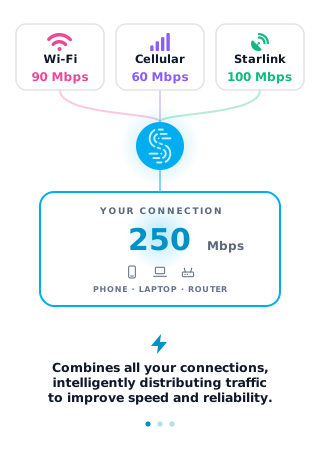
Speedify delivers an unbreakable VPN connection by intelligently bonding multiple internet sources, ensuring continuous uptime and encrypted protection.
Should you have a backup 4G, 5G, Starlink, or cable internet connection?
Yes — every internet connection goes down, including Starlink, which drops for ~34 minutes a day on average. A backup connection from a different provider means one outage never takes you fully offline. The most common options are a 4G/5G cellular hotspot, a cable or DSL line, or a second satellite dish.
4G/5G cellular
Works anywhere. Just a SIM or hotspot — no installation needed.
Learn more →Cable / DSL
Best for fixed locations. Different network, so outages rarely overlap.
Learn more →Second Starlink
Adds redundancy and throughput for remote sites or heavy usage.
Learn more →Speedify bonds any two connections into one — automatic failover, more speed, no dropped calls.
Try Speedify free →How Did FCC Regulate Net Neutrality so Far in the US?
While not being officially involved till then, FCC started investigating net neutrality related issues in 2008 – the Comcast traffic policy and Bittorrent traffic. FCC created a first set of Open Internet Rules in late 2010, while continuing to investigate large companies policies for interconnecting and traffic throttling. It all culminated in 2015, when the FCC earned a reputation as the defenders of an Open Internet when they voted to enact stronger rules about net neutrality – Title II regulations.
In April 2017, the new FCC chairman announced the plan to reverse those Title II regulations, with the final vote being carried on December 14. Throughout 2017, many companies and websites have protested against this initiative.
So – briefly put – with the 2015 regulations, the FCC has designated the Internet as a telecommunications service, where ISPs are considered operators / carriers and cannot favor one company over another. With the repeal and classification of ISPs as content providers, this will open up more options for them when it comes to providing Internet services.
FCC Net Neutrality Repeal: Pro Arguments
The main advantage of repealing the net neutrality rules, according to the FCC commissioner, is that broadband investments would increase as a result of having less regulations. This would mean better and faster online access across the US.
The 210-page FCC proposal‘s arguments on repealing the net neutrality regulations adopted in 2015 are mainly related to free-market economics. According to this, competitions eliminates the need for regulation, so if one ISP messes with your free access to the Internet, you can just go to another.
This sound good, but it depends on the competition actually existing and on situations where one ISP is way more powerful than others in a certain area. According to this article, the data collected by the FCC from ISPs in December 2016 has a lot of discrepancies and can be interpreted in multiple ways – e.g. 51.1% to 79.7% of Americans have 2 or more choices of broadband providers, so there’s not actually a clear view of the broadband competitive landscape.
Also, during the meeting on December 14, commissioners supporting of the repeal repeatedly mentioned that the market will be able to regulate itself as it did before 2015 and that the FTC has the necessary tools and experience to watch over this, should there be any issues.
How FCC Net Neutrality Repeal Could Affect the Average Internet User
Most online opinions about this planned repeal are actually against it. We at Speedify stand behind Net Neutrality regulations. Here are the main arguments why the repeal shouldn’t happen:
- Consumers could start paying more for their Internet services. ISPs could start to “bundle” services and charge more depending on what you want to access. An example of this is already happening in Portugal, a country without net neutrality rules.
- ISPs could throttle Internet access for certain services – especially the bandwidth-intensive ones such as live video streaming, online gaming, etc. They could ask for more money from the consumer if they want to access that specific service with full speed.
- ISPs could block certain services if companies don’t reach an agreement with them or if they belong to a competitor. How would you feel is Verizon would not allow you to connect to Netflix? Best case scenario – you’d have to pay something extra for that.
- With the desire to get more money from their subscribers indirectly through advertising, ISPs could restrict access to services that anonymize the Internet traffic, such as VPN services.
Even though these potential effects could apply only to online users connecting from the US, it could set an example for other countries across the globe as well.
VPNs Are the Best Bet You Have to Circumvent the FCC Net Neutrality Repeal
Technically speaking, it’s easy for an ISP to determine if someone is connecting repeatedly to one server and restrict that connection. But it’s not only individuals that are using VPNs; most of the companies have such solutions in place for their remote workers. So, unless an ISP has a clear plan to get every penny they can from selling the browsing data of their users to marketing companies, they will not restrict VPN services.
So, you’ll always have a way to use the Internet on your own terms, without being spied on by your ISP, various companies or even the government. All you have to do is carefully choose the right VPN for you: one that you can trust, that is fast and reliable.
How to Choose the Right VPN and NOT Be Affected by the FCC Net Neutrality Repeal
Aside from keeping your private data safe, a modern VPN for 2018 has to handle bandwidth-intensive apps without slowing down your connection or disconnecting, like most traditional VPN services do.
Speedify is different in a good way: it is the only true mobile VPN available for consumers on iPhones, Android, Windows and macoS. Speedify can combine multiple Internet connections into one super-link, giving you extra bandwidth, lower latency and increased reliability.
Speedify also has an automatic Internet failover mechanism, so it’ll seamlessly switch between Internet connections so you won’t skip a beat in your live streaming video when one of your connection is bad or drops.
Are you a supporter of net neutrality and want to use the Internet on your own terms, without being restricted on any services? Get started with Speedify today for FREE – no strings attached!
Alex and the Speedify team are always exploring the latest in networking and security technology—like 5G, 6G, WiFi 7, laser and satellite internet—and sharing it in new discussion content across YouTube, TikTok, Instagram, and LinkedIn every week.
Got a tech question? Let's go deeper! Pop into Speedify Office Hours live every Wednesday at 10 AM Eastern. Speedify CEO Alex Gizis and our network engineers are standing by to break down your questions about networks, tech updates, and Speedify features.

Speedify
Get started with Speedify today.
Combine Wi-Fi, 4G/5G cellular, Ethernet, Starlink, and more into one faster, steadier connection. Free to try — no credit card required.
🚀 Speed
Faster uploads and downloads by bonding all your connections at once.
📶 Stability
Automatic failover in under a second when any connection drops.
🔒 Security
AES-256 encryption on every connection, on every network you join.


15M+ downloads worldwide. 75K+ five-star reviews on iOS and Android.