

Speedify Switches to Your Other Internet Connection Right Away, So Starlink Dropouts Don’t Cut You Off
When Starlink keeps disconnecting, the cause is usually one of a few things: something partly blocking the Starlink dish’s view of the sky, a Starlink dish overheating in direct sun, a loose cable, a software update restarting the Starlink dish, or a Starlink router problem. It happens on standard Starlink dishes and on the Starlink Mini.
Starlink Internet Connection Drops Happen to Everyone
Speedify measures thousands of Starlink users in more than 140 countries. In September 2026, fixed Starlink dishes went offline for about 38 minutes a day on average, and Starlink dishes on RVs and boats for about 46 minutes a day.
All Starlink dishes also see short dropouts roughly every 15 seconds as the Starlink internet connection switches from one moving satellite to the next. Even a perfectly installed Starlink dish goes offline, and about 7 in 10 Starlink users on Speedify use Starlink together with a second internet connection, like 4G/5G cellular.
Speedify keeps you online through Starlink outages and bad weather
Step 1: Find Out Why Your Starlink Keeps Disconnecting in the Starlink App
Open Statistics in the Starlink app and look at the outage log. The Starlink app records each drop and gives it a reason, for example “obstructed”, “no signal received” or “searching”. Match the timing to the reason:
- The Starlink app reports a service outage: the problem is on Starlink’s side, and there is nothing to fix at home. See what each Starlink status means.
- Short, repeating “obstructed” drops: something is blocking the view of the sky. Go to Step 2.
- Drops on hot afternoons: the Starlink dish is overheating. Go to Step 3.
- A short drop at the same time every night: usually a software update. See Step 5.
- The Starlink dish shows online, but your devices keep losing the internet: go to Step 6.
Step 2: Clear Obstructions Blocking Your Starlink Dish’s View of the Sky
A tree branch or roofline that blocks part of the Starlink dish’s view causes short dropouts that repeat on a regular cycle. The obstruction map in the Starlink app shows the blocked direction. Trim the branch, or move the Starlink dish to a spot with a clear view.
Step 3: Keep Your Starlink Dish from Overheating
Starlink dishes work normally while the outside air is below 50°C (122°F). Hotter than that, or in direct sun on a hot day, a Starlink dish slows down or shuts off until it cools. Give it shade and space for air to move around it. More in how to stop a Starlink dish from overheating.
Step 4: Check the Cable Between Your Starlink Dish and Router
A plug that has worked loose, or a cable that is pinched or chewed, drops the Starlink internet connection on and off. Unplug and replug the cable at both ends, and replace it if it is damaged.
Step 5: Check Whether a Starlink Software Update Caused the Drop
Starlink installs software updates that briefly restart the Starlink dish, usually overnight. A short drop at the same time each night is often an update, not a fault.
Step 6: Check Your Starlink Router and Wi-Fi
If the Starlink dish shows online but your devices keep losing the internet, the Starlink router or Wi-Fi is the more likely cause. Restart the Starlink router. Then check whether a device right next to the Starlink router stays online: if it does and devices in other rooms don’t, the Wi-Fi isn’t reaching far enough into your home.
Step 7: Restart Your Starlink Dish
Unplug the Starlink power supply, wait 30 seconds, and plug it back in. The restart clears a stuck Starlink dish, and it takes a few minutes to find the strongest satellites again.
If short drops continue after all of that, some of them are the moments when your Starlink dish switches from one satellite to the next, about every 15 seconds (why Starlink drops every 15 seconds). Those come with satellite internet, and the answer is a second internet connection that covers them.
Who Is Hit Hardest When Starlink Keeps Disconnecting
- People on video calls: a drop of a second or two can freeze a call or cut you out of it, even if the Starlink internet connection comes right back.
- Gamers and live streamers: one short drop at the wrong moment disconnects you from the game or the stream.
- RV and boat users, and Starlink Mini users on the move: a Starlink dish on the move keeps passing trees, buildings and hills that block its view, so drops come more often than on a fixed roof.
Stay Online When Starlink Keeps Disconnecting, with Speedify
You can clear obstructions and tighten cables, but the short drops that come with satellite internet stay. Speedify covers them.
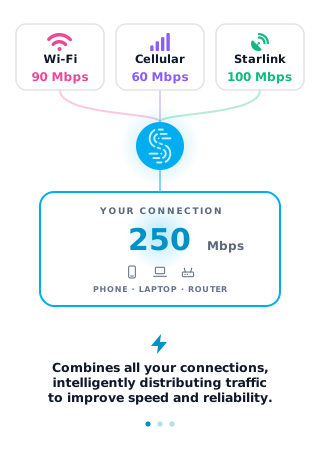
Speedify combines Starlink with 4G/5G cellular, wired Ethernet, Wi-Fi or a second satellite dish into one reliable internet connection. The moment the Starlink dish drops, Speedify moves your calls, streams and games to your other internet connections, so they keep going. Speedify needs that second internet connection to switch to: if both are down at the same time, you are offline either way.
Read more on how to monitor Starlink outages and uptime with Speedify, or see how Speedify combines internet connections.
Speedify
Get started with Speedify today.
Combine Wi-Fi, 4G/5G cellular, Ethernet, Starlink, and more into one faster, steadier connection. Free to try — no credit card required.
🚀 Speed
Faster uploads and downloads by bonding all your connections at once.
📶 Stability
Automatic failover in under a second when any connection drops.
🔒 Security
AES-256 encryption on every connection, on every network you join.


15M+ downloads worldwide. 75K+ five-star reviews on iOS and Android.