

Run Speedify on a GL.iNet Router to Bond Every Connection
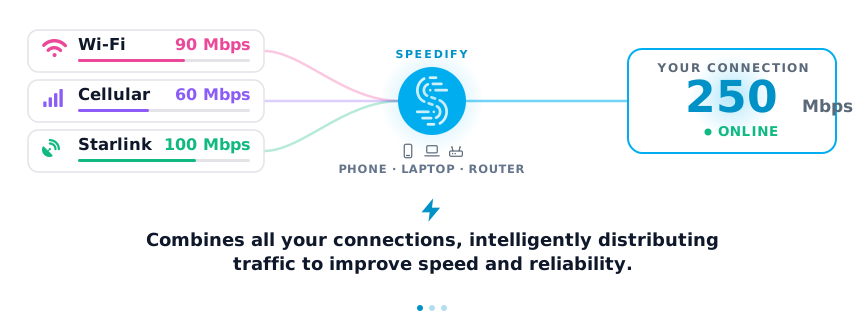
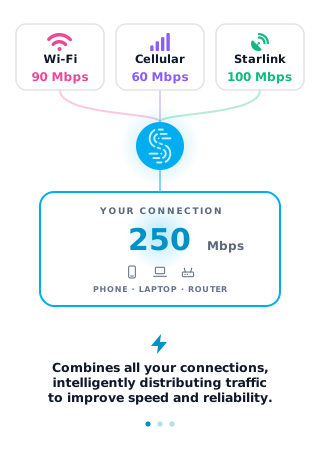
Once Speedify is on the router, Speedify combines Wi-Fi, 4G/5G cellular, Ethernet, Starlink and other satellite into one connection for the entire LAN. Speedify’s channel bonding technology uses up to 95% of the combined capacity across every connection you give it, and fails over in under a second if one drops.
With Speedify, your internet stays on when one connection fails.
When one of your connections drops, Speedify automatically routes your traffic to your remaining connections — so calls don't cut out and downloads don't stall.
Should you have a backup 4G, 5G, Starlink, or cable internet connection?
Yes — every internet connection goes down, including Starlink, which drops for ~34 minutes a day on average. A backup connection from a different provider means one outage never takes you fully offline. The most common options are a 4G/5G cellular hotspot, a cable or DSL line, or a second satellite dish.
4G/5G cellular
Works anywhere. Just a SIM or hotspot — no installation needed.
Learn more →Cable / DSL
Best for fixed locations. Different network, so outages rarely overlap.
Learn more →Second Starlink
Adds redundancy and throughput for remote sites or heavy usage.
Learn more →Speedify bonds any two connections into one — automatic failover, more speed, no dropped calls.
Try Speedify free →How do I use WiFi and 4G/5G cellular at the same time with Speedify?
Pick your two internet connections and your device below and we'll take you to the step-by-step setup guide.


What You Need Before You Start
Speedify on a router has a few requirements. Confirm these first so the install goes smoothly.
- A Speedify Router License. Running Speedify on a router uses a dedicated Router License, separate from a personal subscription.
- A supported router. The router needs to run OpenWrt 23.05 or newer, or GL.iNet firmware, on an x86_64 (Intel or AMD) or aarch64 (Cortex A53 or A72) CPU. Check the current list in Speedify’s supported routers article.
- An active internet connection on the router so it can download Speedify during setup.
Many GL.iNet models qualify out of the box. One exception: Speedify does not support GL.iNet firmware on older mipsel devices such as the Beryl MT1300. On those, you can flash mainline OpenWrt from the OpenWrt firmware selector and run Speedify on top of that.
Why Install Speedify on the Router Instead of Each Device
A router-level install means the bonding and failover happen once, for everything on the network. A smart TV or a games console cannot run the Speedify app on its own, but behind a Speedify-powered router it still gets the bonded, encrypted connection. If you want the background on the hardware itself, see Speedify’s guide to what a router is and how it works.
How to Install Speedify on a GL.iNet Router
- Activate your Speedify Router License on the Speedify account you will sign in with.
- Connect to the router over SSH. The default gateway is usually 192.168.1.1, logging in as the router’s admin user.
- Run the official install script. Speedify provides a one-line script that installs both the Speedify package and the LuCI plugin. Use the exact, current command from Speedify’s OpenWrt and GL.iNet setup guide rather than copying it from anywhere else, since the command is updated over time.
- Open the LuCI web panel. After the install, a new Speedify tab appears. On OpenWrt it sits in the top navigation; on GL.iNet it sits on the left, under the VPN section. Log out and back in if you do not see it.
- Sign in to Speedify. Click the Speedify tab and sign in with your Speedify account to activate the connection.
Speedify is now active, and every device on the router’s network gets bonding and protection automatically.
Set Up Internet Connection Bonding on a GL.iNet Router with Speedify
To combine more than one internet connection, the router needs at least two WAN interfaces, for example a wired uplink plus a 4G/5G cellular connection. OpenWrt usually bridges WANs by default and GL.iNet does not, so each connection has to be individually addressable for Speedify to bond it.
A USB-tethered Android phone or iPhone can serve as an extra WAN. The exact interface configuration is covered in Speedify’s bonding setup guide for OpenWrt. Once the WANs are configured, they appear in the Speedify interface and bonding begins.
For a do-it-yourself take on the same idea using a single-board computer, see Speedify’s guide to building your own Raspberry Pi bonding router.
Two GL.iNet Gotchas Worth Knowing
Two honest notes. First, GL.iNet’s Network Acceleration feature can conflict with Speedify’s Performance Enhancing Proxy and cause connection issues; if you see problems, that setting is the first thing to check.
Second, upgrading the router’s OpenWrt operating system usually wipes manually installed packages, so you will need to reinstall Speedify after a firmware update.
GL.iNet and Speedify: FAQ
Which GL.iNet routers can run Speedify?
GL.iNet routers with an x86_64 or aarch64 CPU running OpenWrt 23.05 or newer, or GL.iNet firmware, are supported. Older mipsel devices are not supported on GL.iNet firmware, but can run Speedify after flashing mainline OpenWrt. Always check the current supported routers list.
Do I need a special license for a router?
Yes. Speedify on a router uses a Speedify Router License, which is separate from a personal Speedify subscription.
Does every device on the network get bonding?
Yes. Once Speedify runs on the router, every connected device gets the bonded, encrypted connection, including devices that cannot run the Speedify app themselves.
Can the router still work normally if Speedify is off?
Yes. With Speedify disconnected, the router uses its connections as usual. With Speedify connected, those connections are bonded into one.
Alex and the Speedify team are always exploring the latest in networking and security technology—like 5G, 6G, WiFi 7, laser and satellite internet—and sharing it in new discussion content across YouTube, TikTok, Instagram, and LinkedIn every week.
Got a tech question? Let's go deeper! Pop into Speedify Office Hours live every Wednesday at 10 AM Eastern. Speedify CEO Alex Gizis and our network engineers are standing by to break down your questions about networks, tech updates, and Speedify features.

Speedify
Get started with Speedify today.
Combine Wi-Fi, 4G/5G cellular, Ethernet, Starlink, and more into one faster, steadier connection. Free to try — no credit card required.
🚀 Speed
Faster uploads and downloads by bonding all your connections at once.
📶 Stability
Automatic failover in under a second when any connection drops.
🔒 Security
AES-256 encryption on every connection, on every network you join.


15M+ downloads worldwide. 75K+ five-star reviews on iOS and Android.