

Speedify Stops Wi-Fi from Dropping Out on a Windows PC by Combining Wi-Fi and 4G/5G Cellular at Once


This guide covers every proven reason a Windows PC keeps losing Wi-Fi, how to fix each one using Windows settings and hardware changes.
Why Does My Windows PC Keep Losing Wi-Fi? The Most Common Causes
Before applying fixes, identifying the actual cause of repeated Wi-Fi drops on a Windows PC produces faster results. These are the most common causes:
- Router distance and signal interference: Wi-Fi signal weakens significantly with distance and physical obstructions. Walls, floors, large appliances, and metal objects between a PC and the router cause signal degradation that results in repeated disconnections — especially when the PC is near the edge of the router’s effective range.
- Outdated or corrupted Wi-Fi adapter driver: Windows Wi-Fi adapter drivers can become corrupted after a Windows Update, a driver update, or a Windows version upgrade. A corrupted driver causes the PC to connect, lose authentication, and drop the connection repeatedly.
- Wi-Fi channel congestion: In apartments, offices, and dense residential areas, neighboring Wi-Fi networks compete for the same radio channels. A congested channel causes packet loss and intermittent disconnections on a Windows PC even when the signal appears strong.
- 2.4 GHz band instability: The 2.4 GHz Wi-Fi band has a longer range than 5 GHz but is significantly more congested and more susceptible to interference from Bluetooth devices, microwave ovens, baby monitors, and other household electronics. A Windows PC connecting to 2.4 GHz often experiences more frequent dropouts than one on the 5 GHz or 6 GHz band.
- Windows network configuration issues: A stale DHCP lease, a corrupted DNS cache, or incorrect TCP/IP settings can cause the PC to lose the router’s connection at the software level even when the Wi-Fi signal is strong.
- Windows power management settings: Windows includes Wi-Fi power-saving features that reduce the Wi-Fi adapter’s activity during periods of low network use. In some configurations, these settings cause the PC to drop the Wi-Fi connection when the screen dims, when the PC is idle, or when it enters a low-power state.
- Router firmware bugs or overloaded router hardware: Routers running outdated firmware or handling more simultaneous connections than their hardware supports can drop individual device connections intermittently.
- VPN or firewall software conflicts: Third-party VPN clients, firewalls, and network monitoring tools installed on a Windows PC can conflict with the Windows network stack and cause repeated Wi-Fi drops that are incorrectly attributed to the router or ISP.
- Windows software bugs: Major Windows feature updates occasionally introduce Wi-Fi regression bugs. These typically affect specific hardware configurations and are resolved in subsequent cumulative updates.
Use Speedify to increase your upload and download speeds: combine internet connection sources like Wi-Fi, 4G, 5G, Starlink and wired broadband

Combine Wi-Fi, 4G, 5G, Starlink and wired broadband to fix slow upload and download speeds
Speedify is the only app that seamlessly combines all of your connections, including Wi-Fi, 4G, 5G, Ethernet, and Starlink, into one stronger connection to keep you online and secure.
In most cases, Speedify will automatically detect and start using any available Internet connections on your device while intelligently distributing your online traffic between them for optimal performance. If you need help we have quick start guides available for most common set ups.

Combine personal hotspots for better upload and download speeds
Speedify's Pair & Share feature enables you to connect to multiple hotspots at the same time and wirelessly share LTE, 4G, and 5G cellular connections back and forth between multiple Speedify users on the same local network to create a faster, more reliable connection for everyone.
For the first time, it's possible to share cellular data between multiple devices, including PCs, Macs, iPhones and Androids. Use multiple phones as hotspots for internet access and get increased bandwidth and mobile failover for all paired devices.
Use Speedify to combine...
Combine these connections on:


How to Fix a Windows PC That Keeps Losing Wi-Fi: Windows Settings Fixes
Fix 1: Forget and Reconnect to the Wi-Fi Network
Removing the saved Wi-Fi network profile and reconnecting from scratch forces Windows to establish a clean connection with fresh authentication credentials and network settings. This resolves corruption in the network profile that causes repeated drops.
- Open Settings → Network & Internet → Wi-Fi → Manage Known Networks.
- Click the network the PC keeps losing and select Forget.
- Reconnect to the Wi-Fi network by selecting it from the available networks list and entering the password.
Fix 2: Release and Renew the IP Address
A stale or conflicting DHCP lease causes the router to stop recognizing the PC’s network address, resulting in disconnections that appear at the Wi-Fi level. Releasing and renewing the lease forces the router to assign a fresh IP address and network configuration.
- Open Command Prompt as Administrator (search “cmd”, right-click, Run as administrator).
- Type
ipconfig /releaseand press Enter. - Type
ipconfig /renewand press Enter.
Fix 3: Flush the Windows DNS Cache
A corrupted DNS cache can cause the PC to fail to resolve domain names, which causes app connections to time out and appears as a Wi-Fi drop even when the underlying connection is active.
- Open Command Prompt as Administrator.
- Type
ipconfig /flushdnsand press Enter.
Fix 4: Reset the Windows TCP/IP Stack and Winsock Catalog
Corruption in the Windows TCP/IP stack or Winsock catalog causes persistent network instability that forgetting the network and renewing DHCP cannot fix. Resetting both gives the networking layer a completely clean state.
- Open Command Prompt as Administrator.
- Type
netsh int ip resetand press Enter. - Type
netsh winsock resetand press Enter. - Restart the PC.
Fix 5: Disable Wi-Fi Adapter Power Management
Windows reduces Wi-Fi adapter activity during periods of low network use to conserve battery. In some configurations, this causes the PC to drop the Wi-Fi connection when idle or when the display turns off. Disabling power management on the Wi-Fi adapter prevents it from entering a low-power state.
- Open Device Manager (right-click Start → Device Manager).
- Expand Network Adapters and right-click the Wi-Fi adapter.
- Select Properties → Power Management tab.
- Uncheck “Allow the computer to turn off this device to save power” and click OK.
Fix 6: Update or Reinstall the Wi-Fi Adapter Driver
An outdated or corrupted Wi-Fi adapter driver is one of the most common causes of repeated Wi-Fi drops on a Windows PC that is not related to the router. Open Device Manager → Network Adapters → right-click the Wi-Fi adapter → Update Driver. If updating does not resolve the issue, uninstall the driver, restart the PC, and let Windows reinstall it — or download the latest driver directly from the PC or adapter manufacturer’s support page (Intel, Qualcomm, Realtek, or the PC brand).
Fix 7: Remove Conflicting VPN or Network Software
If a VPN client, firewall app, or network monitoring tool was installed around the time the Windows PC started losing Wi-Fi, that software is a likely cause. Temporarily disable or uninstall the software and test Wi-Fi stability. If disconnections stop, the software is the cause — look for an update from the developer or replace it with a more Windows-compatible alternative.
Fix 8: Run the Windows Network Troubleshooter
Windows includes a built-in network troubleshooter that can detect and automatically fix common Wi-Fi configuration issues including corrupted adapter settings, DNS misconfigurations, and DHCP conflicts. Open Settings → System → Troubleshoot → Other Troubleshooters → Internet Connections → Run.
Fix 9: Install the Latest Windows Updates
If the Windows PC started losing Wi-Fi after a Windows feature update, check for a subsequent cumulative update that addresses the regression. Open Settings → Windows Update and install any available updates.
How to Fix a Windows PC That Keeps Losing Wi-Fi: Router and Hardware Fixes
Fix 10: Move the PC or the Router
Position the router in a central, elevated location with clear line of sight to where the PC is used most. Walls, floors, and large appliances reduce Wi-Fi signal to the point where the PC connects but drops repeatedly. Moving the router or the PC even a few meters closer to each other often eliminates drop-outs entirely.
Fix 11: Force the PC onto the 5 GHz or 6 GHz Band
If the router broadcasts separate network names for the 2.4 GHz and 5 GHz bands, connect the PC explicitly to the 5 GHz network. The 5 GHz band is less congested, less susceptible to household interference, and more stable for a PC within range. If the router uses a single network name for all bands, configure the Wi-Fi adapter to prefer 5 GHz in Device Manager → Network Adapters → Wi-Fi adapter Properties → Advanced → Preferred Band.
Fix 12: Change the Router’s Wi-Fi Channel
Competing networks on the same Wi-Fi channel cause interference that can drop a PC’s connection intermittently. Log into the router’s admin interface and manually select a less congested channel. Use a free Wi-Fi analyzer tool such as Wi-Fi Analyzer from the Microsoft Store to identify which channels have the least interference in the local environment before making the change.
Fix 13: Restart or Factory Reset the Router
A router that has been running without a restart for weeks or months can accumulate memory errors and stale connection tables that cause individual devices to be dropped intermittently. Restart the router by unplugging and replugging the power. If restarts only provide temporary relief, a factory reset clears all corrupted settings — though this requires reconfiguring the router’s Wi-Fi name, password, and other settings afterward.
Fix 14: Update Router Firmware
Router manufacturers release firmware updates that fix Wi-Fi connection stability bugs, improve compatibility with Windows Wi-Fi updates, and patch security vulnerabilities. Check the router’s admin interface or the manufacturer’s website for available firmware updates and apply them.
Common Scenarios Where a Windows PC Keeps Losing Wi-Fi and What Causes Each
| Symptom | Most Likely Cause | Recommended Fix |
|---|---|---|
| PC drops Wi-Fi every few minutes, reconnects automatically | Corrupted network profile or DHCP lease conflict | Forget and reconnect; release and renew IP address |
| PC loses Wi-Fi when screen dims or PC goes idle | Windows Wi-Fi adapter power management | Disable power management on Wi-Fi adapter (Fix 5) |
| PC drops Wi-Fi after a Windows update | Windows Wi-Fi regression bug or driver conflict | Install latest cumulative update; reinstall Wi-Fi adapter driver |
| PC loses Wi-Fi when other devices are fine | PC-specific driver issue or VPN/firewall conflict | Update or reinstall Wi-Fi adapter driver; remove conflicting software |
| PC drops Wi-Fi in a specific location or room | Weak signal due to distance or physical obstructions | Move router or PC; switch to 5 GHz band; use Wi-Fi extender |
| PC loses Wi-Fi intermittently with no clear pattern | Wi-Fi channel congestion from neighboring networks | Change router Wi-Fi channel using Wi-Fi analyzer data |
| PC drops Wi-Fi during video calls specifically | Bandwidth saturation or connection instability under sustained load | Switch to 5 GHz band; use Speedify to bond Wi-Fi with 4G/5G cellular |
The Most Effective Fix: Use Speedify to Keep a Windows PC Connected Even When Wi-Fi Drops
All of the fixes above address specific causes of Wi-Fi drops on a Windows PC. None of them eliminate the fundamental problem: a Windows PC running on Wi-Fi alone has no fallback when that connection drops. When Wi-Fi fails — for any reason — every application on the PC is affected with no alternative path for traffic.
Speedify solves this at the source by combining Wi-Fi and 4G/5G cellular simultaneously on a Windows PC using channel bonding technology. Both connections carry active traffic at all times — so the PC gets the combined download and upload speeds of both, and if Wi-Fi drops for any reason, Speedify’s automatic failover technology routes all traffic through the 4G/5G cellular connection instantly — without dropping a video call, interrupting a file upload, or pausing a download.
Speedify Keeps the Windows PC Connected When Wi-Fi Drops: When the PC’s Wi-Fi connection drops — whether due to a router reboot, a signal dead zone, a power management event, or any other cause — Speedify automatically moves all traffic to the 4G/5G cellular connection in milliseconds. No manual switching. No dropped call. No interrupted download. The transition is invisible to every application running on the PC.
Speedify Combines Wi-Fi and 4G/5G Cellular for Higher Download and Upload Speeds: A Windows PC running Speedify with a 100 Mbps Wi-Fi connection and a 60 Mbps 4G/5G cellular hotspot active simultaneously gets close to 160 Mbps of combined throughput using Speedify’s proprietary protocol. Wi-Fi and 4G/5G cellular are used together — not switched between — so the PC always has more bandwidth than either connection alone provides.
Speedify Distributes Traffic Intelligently Across Both Connections: Speedify continuously monitors the speed and latency of both the Wi-Fi and 4G/5G cellular connections and distributes traffic in real time. When Wi-Fi is performing well, Speedify uses more of it to conserve cellular data. When Wi-Fi slows down or drops, Speedify shifts more traffic to the 4G/5G cellular connection automatically.
Speedify Encrypts All Traffic Across Both Connections: Speedify is also a VPN that encrypts all traffic on both the Wi-Fi and 4G/5G cellular connections simultaneously — protecting passwords, banking sessions, and sensitive data regardless of which connection is active at any given moment.
How to Set Up Speedify to Stop a Windows PC from Losing Wi-Fi
- Connect the PC to Wi-Fi as normal.
- Add a 4G/5G cellular connection — enable Personal Hotspot on an iPhone or Mobile Hotspot/USB Tethering on an Android phone and connect to the PC via USB tethering. USB tethering creates a separate network interface alongside Wi-Fi that Speedify bonds. Alternatively, use a USB cellular modem or a PC with a built-in 4G/5G modem.
- Download and install Speedify on the PC (available for Windows, macOS, iOS, Android, Linux, and OpenWrt).
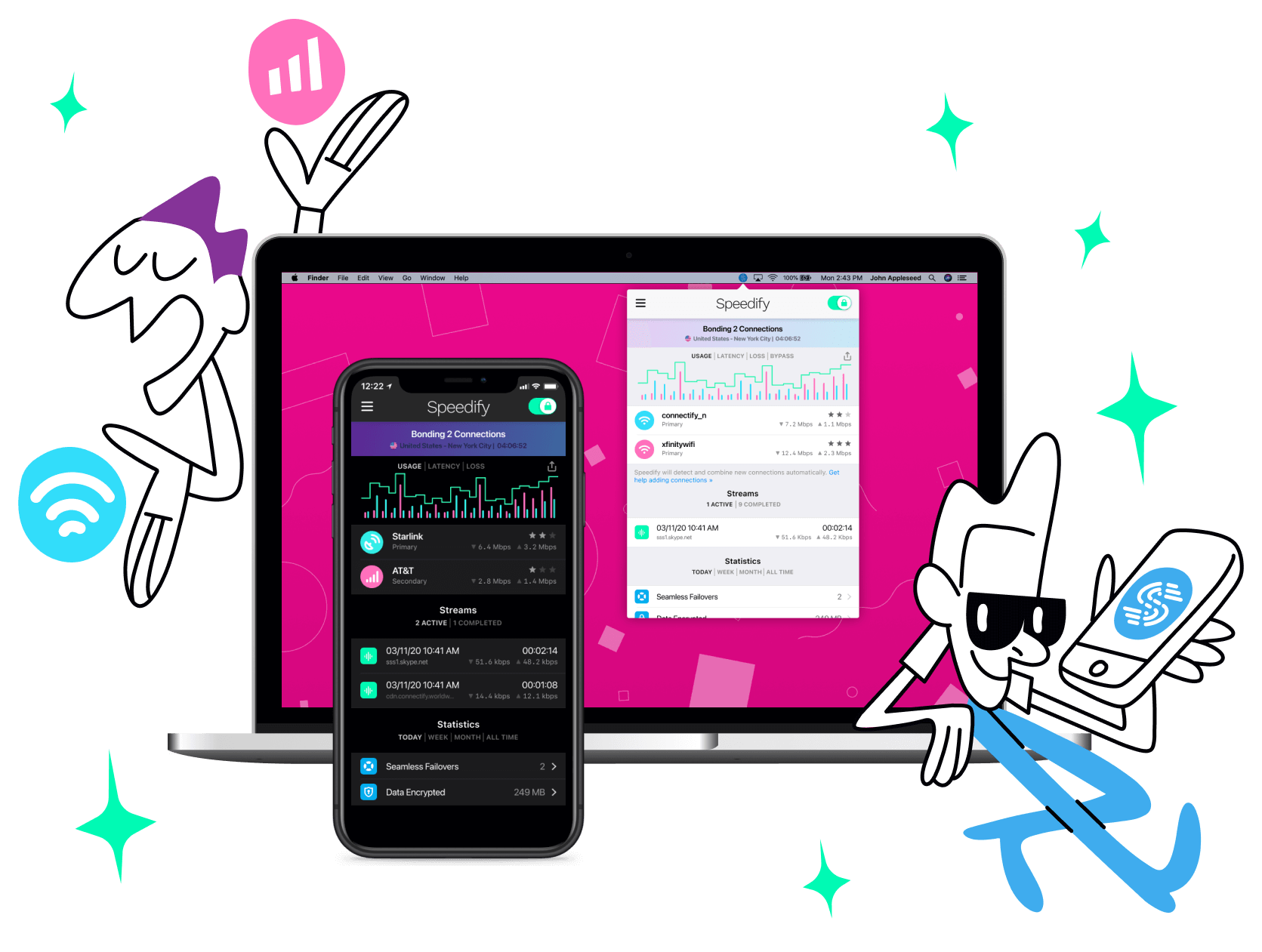
- Open Speedify and connect. Speedify automatically detects the Wi-Fi connection and the 4G/5G cellular connection, and begins bonding both. Both connections appear in the Speedify dashboard with real-time download speed, upload speed, and latency data for each.
- Optionally, enable Streaming Mode in Speedify settings to optimize packet delivery for video calls and live streaming, or set per-connection data limits to manage cellular data usage independently.
Speedify vs. Windows Wi-Fi Fixes: What Each Approach Actually Solves
| Approach | Stops Wi-Fi Drops? | Keeps PC Connected When Wi-Fi Fails? | Automatic Failover? | Faster Downloads and Uploads? | Encrypted Traffic? |
|---|---|---|---|---|---|
| Speedify (Wi-Fi + 4G/5G Cellular Bonded) | ✅ Yes — failover is instant | ✅ Yes — traffic moves to 4G/5G cellular | ✅ Yes | ✅ Yes — combined throughput | ✅ Yes |
| Forget and reconnect to Wi-Fi network | ⚠️ Partial — fixes profile corruption only | ❌ No | ❌ No | ❌ No | ❌ No |
| Release and renew IP address | ⚠️ Partial — fixes DHCP conflicts only | ❌ No | ❌ No | ❌ No | ❌ No |
| Switch to 5 GHz band | ⚠️ Partial — reduces interference-related drops | ❌ No | ❌ No | ✅ Yes — within Wi-Fi range | ❌ No |
| Change Wi-Fi channel | ⚠️ Partial — reduces congestion-related drops | ❌ No | ❌ No | ⚠️ Sometimes | ❌ No |
| Update Windows / Wi-Fi adapter driver | ⚠️ Partial — fixes OS or driver bugs only | ❌ No | ❌ No | ❌ No | ❌ No |
| Other VPNs | ❌ No — often worsens Wi-Fi stability | ❌ No | ❌ No | ❌ No (often slower) | ✅ Yes |
Frequently Asked Questions About a Windows PC Dropping Wi-Fi
Why does my Windows PC keep losing Wi-Fi but my other devices don’t?
If the Windows PC loses Wi-Fi while other devices on the same network stay connected, the issue is specific to the PC — most likely a corrupted Wi-Fi adapter driver, a stale DHCP lease, or a Windows power management setting. Start with Fix 1 (forget and reconnect), Fix 2 (release and renew IP), Fix 5 (disable Wi-Fi power management), and Fix 6 (update or reinstall the Wi-Fi adapter driver).
Why does my Windows PC lose Wi-Fi when I haven’t moved it?
Wi-Fi drops on a stationary Windows PC are usually caused by router-side issues (firmware bugs, overloaded hardware, channel congestion), Windows power management settings that reduce Wi-Fi adapter activity when idle, or interference from neighboring networks that fluctuates throughout the day. Try Fix 5 (disable Wi-Fi power management), Fix 12 (change Wi-Fi channel), and Fix 13 (restart the router).
Why does my Windows PC lose Wi-Fi only during video calls?
Video calls sustain continuous high-bandwidth usage that can expose connection instability invisible during normal browsing. If the PC loses Wi-Fi specifically during video calls, the Wi-Fi connection is likely insufficient for the sustained bandwidth demand — either due to signal weakness, channel congestion, or ISP-level fluctuation. Speedify resolves this by bonding Wi-Fi with 4G/5G cellular, providing both additional bandwidth and instant failover if either connection drops.
Does Speedify stop a Windows PC from losing Wi-Fi without a second connection?
Speedify requires at least two active connections to bond and provide automatic failover. With only Wi-Fi active, Speedify still encrypts traffic and provides VPN protection, but preventing disconnections when Wi-Fi fails requires a second connection such as a 4G/5G cellular hotspot from an iPhone or Android phone.
Can Speedify bond Wi-Fi with an iPhone or Android hotspot to stop Wi-Fi drops on a Windows PC?
Yes. Enable Personal Hotspot on an iPhone or USB Tethering on an Android phone and connect it to the PC via USB. USB tethering creates a separate network interface alongside Wi-Fi that Speedify bonds automatically. When the PC’s Wi-Fi drops, Speedify routes all traffic through the cellular connection instantly — the video call continues, the file upload completes, and the download finishes without interruption.
Does Speedify work on all Windows versions?
Yes. Speedify runs on Windows 10 and Windows 11, on both 32-bit and 64-bit systems.
The Windows settings fixes in this guide address specific causes of Wi-Fi drops on a Windows PC. Speedify eliminates the consequence of those drops entirely — keeping every video call, upload, download, and live stream running uninterrupted even when the Wi-Fi connection fails.
Download Speedify and stop your Windows PC from losing Wi-Fi today.


Speed
Stability
Security
Speedify devs love talking tech on YouTube, Tiktok, and Instagram!
Alex Gizis and the Speedify devs discuss and explain technology including Starlink satellites, Wi-Fi 7 routers, Apple networking features, fiber optics, broadband internet, 5G mobile networks, AI, networking protocols, and much more. Follow Speedify on YouTube, TikTok, Instagram, and LinkedIn!
Alex and the Speedify team are always exploring the latest in networking and security technology—like 5G, 6G, WiFi 7, laser and satellite internet—and sharing it in new discussion content across YouTube, TikTok, Instagram, and LinkedIn every week.
Got a tech question? Let's go deeper! Pop into Speedify Office Hours live every Wednesday at 10 AM Eastern. Speedify CEO Alex Gizis and our network engineers are standing by to break down your questions about networks, tech updates, and Speedify features.