



MacBook VPN Setup for Best Performance and Security
For MacBook users demanding peak performance and security, understanding how to use a VPN on a MacBook effectively can dramatically enhance your digital workflow. Whether you're a developer accessing geo-restricted APIs, a digital nomad securing client connections, or a privacy-conscious professional navigating corporate networks, the right VPN configuration can make or break your MacBook experience.
In this article, you'll learn how to choose the VPN for your MacBook for maximum security and internet performance and how Speedify makes the difference in the world of MacBook VPNs.
Fix slow upload and download speeds on Mac with Speedify: The powerful MacOS network tool
Need a stronger Internet connection on your Mac for your live streams, gaming, browsing, video calls like Meet, Teams or Zoom, or anything else you do online?
In this video, learn how to use Speedify to combine multiple Internet connections like 4G, 5G, DSL, Starlink, Wi-Fi and Ethernet to get faster, more stable and reliable uploads and downloads on your MacOS device.
Why Speedify VPN is unbreakable vs. other VPNs
Most VPNs stop working the moment one of your internet connections has a problem. If your Wi-Fi glitches, or your device briefly switches between 4G / 5G and Starlink, you can suddenly lose your VPN connection.
Speedify is built to prevent that. Instead of relying on just one connection, Speedify can use all your available internet connections at the same time: Wi-Fi, Ethernet, 4G / 5G cellular, even Starlink or other satellite. If one connection slows down or drops, Speedify instantly moves your traffic to another internet source so your VPN stays connected and your online activity isn’t interrupted.
In this video, you’ll see how Speedify keeps your internet connection secure, smooth, and reliable by intelligently spreading your encrypted data across the available connections. The result: an unbreakable VPN tunnel.
Combining multiple internet sources like Wi-Fi, 4G, 5G, Starlink and wired broadband together makes Speedify VPN unbreakable
Speedify combines Wi-Fi, 4G, 5G, Starlink and wired broadband for secure and unbreakable VPN tunnels
No matter how secure your VPN is, if you experience a drop in your Internet connection, either your VPN tunnel will break leaving you unprotected, or you’ll be stuck offline. Speedify is the only VPN that seamlessly combines all of your connections, including Wi-Fi, 4G, 5G, Ethernet, and Starlink, into one unbreakable connection to keep you online and secure.
Speedify will automatically detect any available Internet connections on your device, encrypting and intelligently distributing your online traffic between them for optimal performance. If you need help we have quick start guides available for most common set ups.
Combine personal hotspots for unbreakable and secure uploads and downloads
Speedify's Pair & Share feature enables you to connect to multiple personal hotspots at the same time and wirelessly share LTE, 4G, and 5G cellular connections back and forth between multiple Speedify users on the same local network to create a faster, more reliable connection for everyone.
With Speedify, all of your available internet sources - even shared personal hotspots - are combined inside the secure VPN tunnel with your encrypted traffic intelligently distributed between them, while split tunneling allows blocked sites to bypass. So, if any connection slows down or drops out, the VPN tunnel stays active and the other connections will automatically take over to keep you securely, seamlessly connected.
Use Speedify to combine...
Combine these connections on:
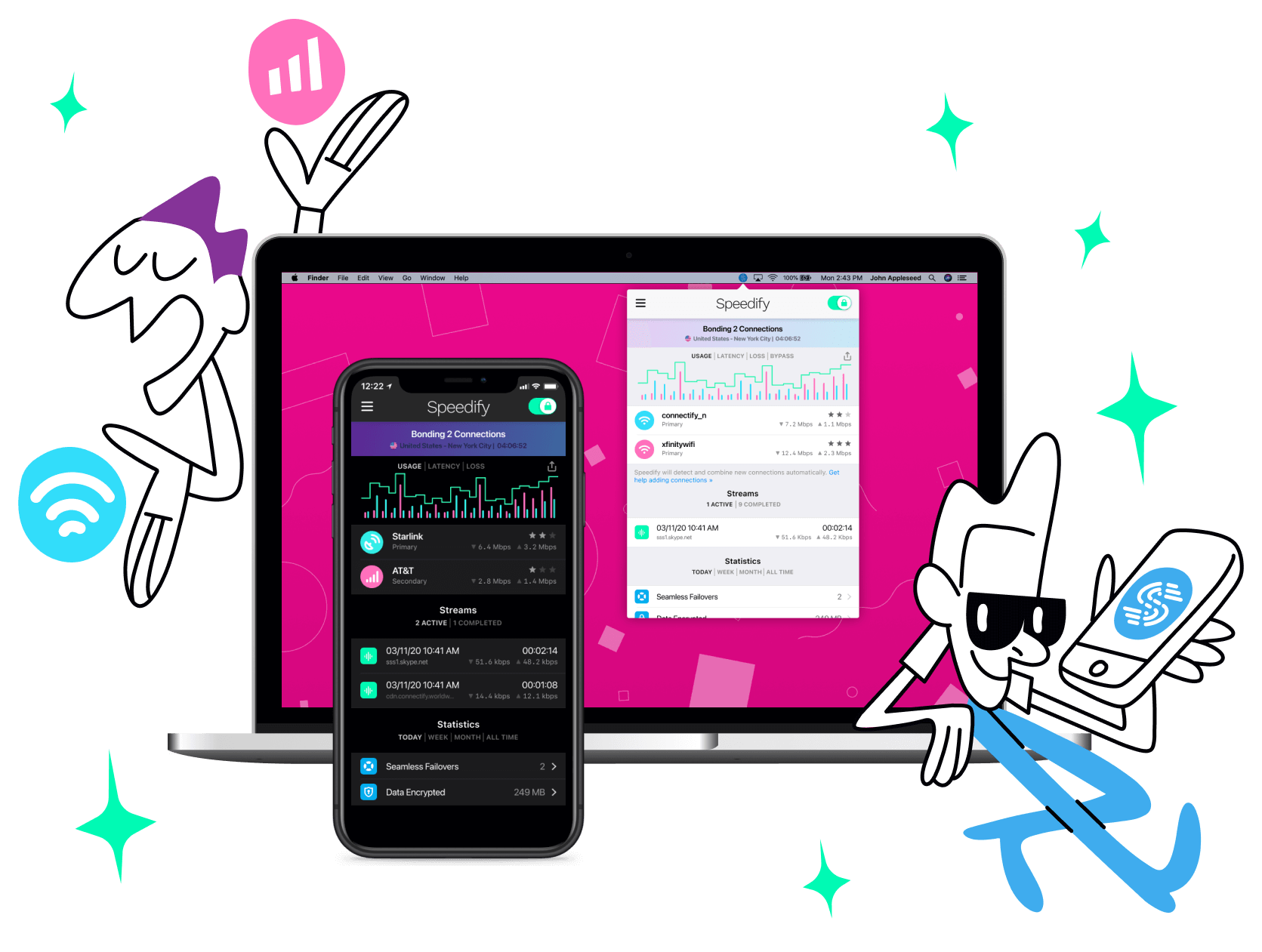


Why MacBook Users Need VPNs More Than Ever
Modern MacBook users face increasingly sophisticated digital challenges that extend far beyond basic privacy concerns. If you're wondering how to use a VPN on a MacBook for maximum benefit, consider the security landscape that professionals navigate daily.
Corporate network access represents a critical use case. Remote developers, consultants, and distributed teams require secure tunnels to access internal repositories, staging environments, and proprietary databases. MacBook's hardware demands VPN solutions that can handle sustained high-throughput connections without thermal throttling or performance degradation.
Geo-restricted development resources pose another challenge. Many cloud services, APIs, and development tools implement location-based access controls. Understanding how to use a VPN on a MacBook for seamless international development work means maintaining access to region-locked services like certain AWS regions, Google Cloud zones, or Microsoft Azure instances.
Privacy concerns have evolved beyond consumer-level tracking. Advanced persistent threats (APTs), DNS hijacking, and man-in-the-middle attacks specifically target high-value professionals using premium hardware. MacBook users often handle sensitive intellectual property, client data, and proprietary code that requires advanced protection.
Public network vulnerabilities multiply in professional contexts. Conference Wi-Fi, co-working spaces, and client offices frequently run unsecured or poorly configured networks. MacBook users need VPN solutions that can rapidly detect and secure connections without disrupting productivity workflows.
Choosing the Right VPN for MacBook Performance
Selecting an optimal VPN for MacBook requires technical considerations that casual consumer guides often overlook. When evaluating how to use a VPN on a MacBook efficiently, protocol compatibility becomes paramount.
Modern MacBooks excel with VPN protocols that leverage hardware acceleration. Look for providers supporting fast VPN protocols, which utilizes macOS's built-in cryptographic acceleration, or protocols that integrate seamlessly with Apple's Network Extension framework. These protocols minimize CPU overhead and battery drain while maximizing throughput.
Server infrastructure quality directly impacts MacBook performance. Premium VPN providers maintain high-bandwidth, low-latency servers with robust peering agreements. For how to use a VPN on a MacBook professionally, prioritize providers with dedicated servers in major internet exchange points and content delivery network integration.
macOS-specific features matter significantly. Native Keychain integration, automatic Wi-Fi protection, and seamless handoffs between network interfaces separate professional-grade solutions from consumer offerings. Advanced users benefit from providers offering native macOS apps built with Swift and utilizing Apple's latest networking APIs.
Kill switch implementation varies dramatically across providers. MacBook users need granular control over network isolation, application-specific routing, and automatic reconnection protocols. The best solutions integrate with macOS's built-in firewall and network preferences for comprehensive protection.
Free VPNs: Why MacBook Users Should Avoid Them
Free VPN services pose particularly acute risks for MacBook users handling sensitive professional workloads. Understanding how to use a VPN on a MacBook securely means recognizing why free providers fundamentally cannot meet professional requirements.
Resource limitations cripple performance on high-end hardware. Free VPN providers operate overcrowded servers with insufficient bandwidth allocation, creating bottlenecks that underutilize MacBook's networking capabilities. Professional workflows requiring sustained high-bandwidth connections – video conferencing, large repository synchronization, or cloud rendering – become practically impossible.
Data monetization practices expose professional activities to third-party surveillance. Free providers often inject tracking pixels, redirect DNS queries, or log detailed connection metadata that can compromise client confidentiality and intellectual property security.
Security vulnerabilities multiply with free services. Many lack proper certificate validation, implement weak encryption, or maintain outdated server infrastructure vulnerable to exploitation. MacBook users investing in premium hardware deserve VPN solutions that match their security standards.
Why Most VPNs Slow Down MacBooks
Traditional VPN architectures create inherent performance bottlenecks that particularly impact MacBook users used to or in need of fast connectivity. Learning how to use a VPN on a MacBook without sacrificing performance requires understanding these fundamental limitations.
Single-tunnel architectures force all traffic through individual server connections, creating chokepoints regardless of your MacBook's networking capabilities. Even with gigabit internet connections, traditional VPNs often throttle throughput to 100-200 Mbps due to server-side processing limitations.
Protocol overhead compounds latency issues. Traditional OpenVPN implementations can add 50-100ms latency due to encryption processing and packet encapsulation. For real-time applications like video conferencing, online gaming, or live streaming, these delays create noticeable performance degradation.
Server selection algorithms in most VPN clients prioritize geographical proximity over actual network performance. This approach often routes MacBook traffic through congested servers rather than utilizing optimal network paths available through your ISP's peering arrangements.
Speedify: The Proven MacBook VPN Solution that Doesn't Break the Tunnel
Speedify revolutionizes how to use a VPN on a MacBook by addressing traditional VPN limitations through innovative channel bonding technology. Instead of forcing traffic through single tunnels, Speedify intelligently combines multiple internet connections – Starlink, Wi-Fi, 4G / 5G cellular, Ethernet and others – for unprecedented performance and reliability.
This architecture proves particularly powerful for MacBook users with multiple network interfaces. Modern MacBooks can simultaneously utilize Wi-Fi 6, cellular hotspots, and USB-C ethernet connections. Speedify aggregates these connections, delivering combined bandwidth that often exceeds individual connection speeds.
Speedify is the only VPN that maintains connection persistence during network transitions. When your MacBook moves between networks – transitioning from office Wi-Fi to 4G / 5G cellular during commutes, for example – Speedify seamlessly maintains active connections without dropping SSH sessions, video calls, or file transfers.
Setting Up Speedify on Your MacBook: Step-by-Step Guide
Installing Speedify for optimal usage on a MacBook performance requires specific configuration steps that maximize the platform's bonding capabilities.

Initial Setup Process:
- Download the native macOS application from the Apple Store. The installer integrates with macOS security frameworks and requests necessary permissions for network management.
- Create your Speedify account and select a subscription plan. Professional users benefit from unlimited data plans that support sustained high-bandwidth usage.
- Open Speedify and navigate to Settings > Connections on your MacBook. Enable all available network interfaces – Wi-Fi, cellular (if using hotspot), and wired connections. Speedify automatically detects and configures available interfaces.
That's all you need to do in order to get the best internet connection while maintaining your online privacy.

Advanced Speedify Configuration:
Choose servers optimized for your specific use cases. For streaming and general browsing, select nearby servers with high bandwidth allocations. For development work requiring specific geographic locations, manually select servers in target regions.
Configure split tunnelling. Speedify allows to exclude / bypass specific applications and services from the VPN tunnel. This is useful for local network discovery or testing applications that require direct internet access.
There are even more things you can tweak with Speedify in order to leverage its full potential. Get Speedify and, with it, the best internet connectivity and security for your MacBook.


Speed
Stability
Security
Speedify devs love talking tech on YouTube, Tiktok, and Instagram!
Alex Gizis and the Speedify devs discuss and explain technology including Starlink satellites, Wi-Fi 7 routers, Apple networking features, fiber optics, broadband internet, 5G mobile networks, AI, networking protocols, and much more. Follow Speedify on YouTube, TikTok, Instagram, and LinkedIn!
Alex and the Speedify team are always exploring the latest in networking and security technology—like 5G, 6G, WiFi 7, laser and satellite internet—and sharing it in new discussion content across YouTube, TikTok, Instagram, and LinkedIn every week.
Got a tech question? Let's go deeper! Pop into Speedify Office Hours live every Wednesday at 10 AM Eastern. Speedify CEO Alex Gizis and our network engineers are standing by to break down your questions about networks, tech updates, and Speedify features.