

Enhancing Network Resilience: A Comprehensive Guide for B2B Decision Makers
Network resilience is a critical consideration for businesses and individuals alike in today's interconnected world. Whether you’re a live streamer, playing games online, working remotely or a CTO, network specialist, or a person involved in technical procurement, understanding how to build and maintain a resilient network is essential.
In this article, we’ll explore what network resilience is, delve into its key characteristics, discuss popular solutions, and highlight why Speedify should be on your radar.
Use Speedify to increase your upload and download speeds: combine internet connection sources like Wi-Fi, 4G, 5G, Starlink and wired broadband

Combine Wi-Fi, 4G, 5G, Starlink and wired broadband to fix slow upload and download speeds
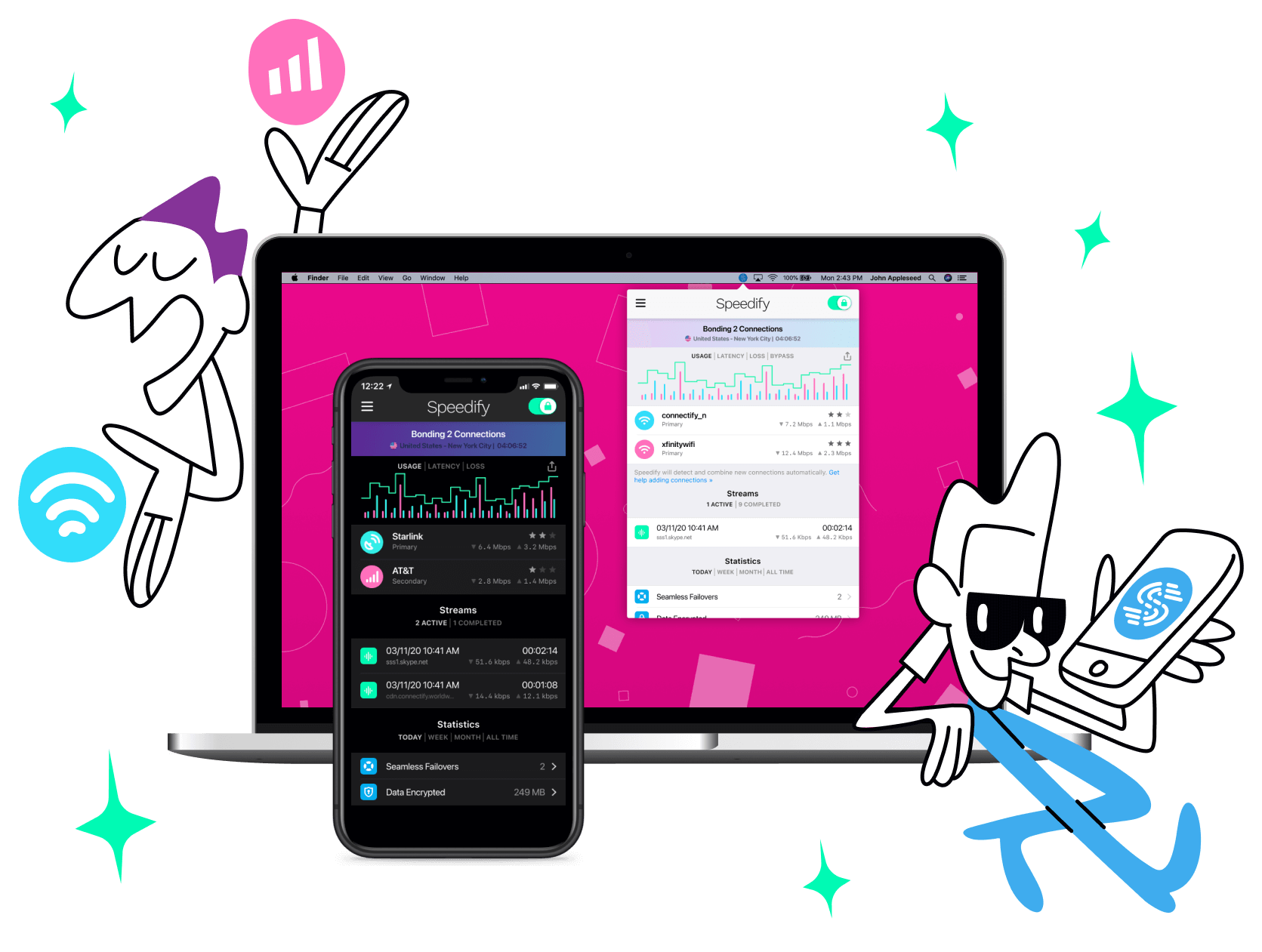
Speedify is the only app that seamlessly combines all of your connections, including Wi-Fi, 4G, 5G, Ethernet, and Starlink, into one stronger connection to keep you online and secure.
In most cases, Speedify will automatically detect and start using any available Internet connections on your device while intelligently distributing your online traffic between them for optimal performance. If you need help we have quick start guides available for most common set ups.

Combine personal hotspots for better upload and download speeds
Speedify's Pair & Share feature enables you to connect to multiple hotspots at the same time and wirelessly share LTE, 4G, and 5G cellular connections back and forth between multiple Speedify users on the same local network to create a faster, more reliable connection for everyone.
For the first time, it's possible to share cellular data between multiple devices, including PCs, Macs, iPhones and Androids. Use multiple phones as hotspots for internet access and get increased bandwidth and mobile failover for all paired devices.
Use Speedify to combine...
Combine these connections on:


Network Resilience - Being Prepared for the Unforseen
Network resilience refers to a network’s ability to withstand disruptions, adapt to changes, and recover quickly from failures. It's the practice of preparing for an unpredictable future in ways that safeguard a network from impact.
A resilient network is able to quickly bounce back from any attacks, outages or other network events. It’s like having a robust safety net that ensures uninterrupted communication, data transfer, and business operations. Resilient networks are essential for maintaining productivity, preventing downtime, and safeguarding against cyber threats.
Redundancy - the Backbone of Network Resilience
Network redundancy is a key component involved in network resilience. It allows you to use your network if something happens to the network infrastructure or even to external parties, such as ISPs.
Redundancy refers to multiple strategies, such as extra network hardware for failures, overprovisioning with additional bandwidth, decentralized distribution of business-critical applications over multiple data centers, etc. These all can reduce the impact of failures. But the most important aspect of redundancy when it comes to network resilience is being able to access the Internet.
Channel Bonding, also known as link aggregation, is a technique that combines multiple network connections (such as Ethernet, Wi-Fi, or cellular) in parallel, into a single, high-bandwidth link. If one connection fails, traffic seamlessly shifts to the remaining active channels. It’s like merging several lanes into a superhighway.
The main purpose of channel bonding is to provide connection redundancy, thus, helping with network resilience.
Popular Solutions for Network Resilience Redundancy
These are five widely used solutions for enhancing network resilience in the B2B space and even in homes recently, especially if the Internet is used for activities such as live streaming, playing games online or even working remotely:
-
Load balancers distribute traffic across multiple servers or Internet connections, ensuring optimal resource utilization. Load balancers automatically reroute traffic if a server or connection becomes unavailable. One of the downsides of load balancing is that activities using only a single network socket to connect to the Internet will not be optimized through load balancing. For instance, video streaming, VPN connections, and large file transfers are not sped up by a load balancer.
-
SD-WAN (Software-Defined Wide Area Network) dynamically manages traffic across different network paths, including satellite, broadband, and cellular. It adapts to changing conditions, optimizing performance and reliability. This results in addressing Internet connectivity issues such as network congestion, jitter, packet loss and service outages. It gives businesses a competitive edge by increasing bandwidth and network reliability.
-
Network failover solutions are failover mechanisms that automatically switch to backup connections when the primary link fails. Examples include dual WAN routers and cellular failover devices. Generally, cellular-based network failovers are the most popular, as they can be deployed anywhere there's a cell signal available.
-
Cloud-based resilience refers to leveraging cloud services, such as Amazon AWS, to ensure that a cloud-based system or application recovers quickly and effectively from disruptions, such as hardware failures, network outages, cyberattacks, etc. Cloud resiliency includes a set of strategies, technologies and best practices designed to minimize downtime, ensure data integrity and maintain uninterrupted service delivery in the cloud environment.
-
Hybrid networks combine wired and wireless connections for flexibility and redundancy. For instance, using both fiber-optic lines and 4G LTE ensures connectivity even if one medium fails. Typical deployment scenarios for hybrid access networks include hybrid routers and aggregation gateways with load balancing functionality.
Speedify - Boosting Network Resilience

Speedify's protocol can open up multiple sockets over each connection. If there’s packet loss on one of the TCP sockets, only the network packets being sent over that socket are delayed, as the TCP protocol will keep trying to send those, while the other sockets can continue sending other packets. This will minimize the negative effects of high latency and packet loss on connection performance, including the cases when you use Speedify with a single Internet connection.
As opposed to the limited “backup flow” ability of MPTCP, Speedify has a more complex approach to the whole thing, with advanced logic and multiple types of connection priorities. Meaning that it will use the connections being bonded according to the performance and priorities set by the user. Speedify will send as much data as it can on:
- non-metered connections, such as wired Ethernet and Wi-Fi, before sending a lot of data through cellular
- lower latency connections, such as wired (cable, DSL), before wireless (cellular, satellite)
- higher bandwidth connections before slower ones.
Reasons to Get Speedify on Your Radar for Network Resilience
Speedify is built for all devices and available anywhere you need better Internet. The core features for network resilience include:
- seamless failover and gapless handoff - Speedify can seamlessly failover to your other working connection(s) without skipping a beat.
- enhanced streaming and QoS - Speedify automatically prioritizes streams over other network traffic to help avoid stuttering, buffering and disconnects during important video calls or livestreams.
- connection priorities and limits - with Speedify you can automatically manage your connections or manually set priority levels to fine tune how and when they should be used. You can even set data and rate limits to prevent overages on costly metered connections.
- super secure encryption - under the hood Speedify operates like a VPN, which means all traffic is encapsulated and passed through a secure VPN tunnel using AES 256 encryption.
Enterprise solutions include Speedify Teams - our best-in-class functionality plus team-oriented features designed with organizations in mind, Speedify SDK - a comprehensive toolkit that can be built into existing software to improve or customize network behavior, and Powered by Speedify embedded solutions for the next generation of routers, networking appliances and smart devices.
Speedify Users for Better Network Resilience
There are many categories of users who can benefit from the improved network resilience offered by Speedify. Target verticals include:
- first responders - mission critical crews like firefighters, emergency medical services, rescue services etc. - it is crucial that these people have the best internet connection they can get in the various scenarios they might be faced with. Whether in a remote area or on top of a mountain, fast and stable connectivity is paramount.
- live streamers and broadcasters - whether it's online influencers, educational services, religious services, or media production companies, everybody needs to avoid dropouts and even that low quality video that you get when your internet connection starts acting up.
- enterprises and even SMBs, for remote work purposes, where you also need an extra layer of security. Important internal calls and client facing ones should not suffer because one of the people on the call has a poor internet connection.
Everybody can benefit from better network resilience using Speedify - there is a solution for everyone. And if you need a custom one, we can make that happen!
Speedify Enterprise-Grade Solutions
Speedify Teams
Increased speed, security, and stability for all of the people and devices in your organization.
Speedify for Routers
Turn your OpenWRT, GL.iNET, or Miri router into a Powered by Speedify device that can bond available 4G, 5G, Wi-Fi, wired, and Starlink connections together.

Speedify Embedded Solutions and Integrations
Embed Speedify software into your app or hardware products and leverage the core channel bonding technology of Speedify in new and interesting ways.