

Speedify Uses Several Starlink Dishes Together as One Faster, More Reliable Internet Connection When One Starlink Dish Isn’t Enough
Should you run one Starlink dish or two? For most homes, one Starlink dish is plenty. For people whose work stops the moment the internet does, one Starlink dish is the weak link.
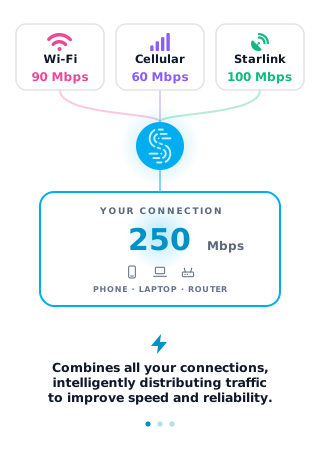
Speedify is an app that uses all your internet connections at the same time, including two or more Starlink dishes, or Starlink plus 4G/5G cellular. Below: one Starlink dish compared with several, when a second one pays off, and when one is enough.
Speedify adds a second internet connection to Starlink for faster uploads and downloads, and failover
Starlink Internet Connection Dropouts Happen to Everyone
Speedify measures thousands of Starlink users in more than 150 countries. From 29 September to 12 October 2026, fixed Starlink dishes went offline for about 37 minutes a day on average, and Starlink dishes on RVs and boats for about 61 minutes a day.
Starlink also switches each dish to a new satellite every 15 seconds, and a switch can cause a short dropout. Even a perfectly installed Starlink dish goes offline, and about 7 in 10 Starlink users on Speedify use Starlink together with a second internet connection, like 4G/5G cellular.
One Starlink Dish Compared with Several Starlink Dishes Running Speedify
| One Starlink Dish | Several Starlink Dishes with Speedify | |
|---|---|---|
| Speed | Limited to one Starlink dish’s upload and download speed | More upload and download speed than one Starlink dish, because Speedify uses all of them at once |
| Satellite switches | Short drops about every 15 seconds | Not covered by a second Starlink dish, because every Starlink dish switches on the same 15-second schedule. Covered by another kind of internet connection, like 4G/5G cellular, Wi-Fi or a wired line |
| Broken Starlink dish | Offline until it’s replaced | Speedify switches your traffic to the other Starlink dish on its own |
| Big uploads | One path, so a drop pauses the upload | Two paths carry the upload together |
| Cost | One Starlink plan | Two Starlink plans plus Speedify |
How Speedify Makes Several Starlink Dishes Faster and More Reliable
Every Starlink dish uses the same address, 192.168.100.1, and a regular router usually uses one Starlink dish at a time. Speedify uses every Starlink dish at the same time and spreads your traffic across all of them. See how Speedify combines internet connections.
If one Starlink dish drops, Speedify switches your traffic to the others on its own. To check on several Starlink dishes from one place, Speedify has a Starlink Control Center that shows each Starlink dish’s status and obstruction map side by side.
When Two or More Starlink Dishes Make Sense
The rural online gamer. A competitive gamer outside cable and fiber range needs low delay and no dropouts. One short drop at the wrong second can cost a match. With two Starlink dishes running Speedify, a drop on one from an obstruction doesn’t end the game. The short drops during satellite switches hit every Starlink dish at the same moment, so a gamer also needs 4G/5G cellular to cover those. More in Is Starlink good for gaming.
The telehealth clinician. A clinician seeing patients by video from a rural practice can’t have a call freeze in the middle of a consultation. With two Starlink dishes running Speedify, appointments keep going when one Starlink dish drops, and Speedify encrypts the session. Clinics that travel to patients can read about internet for mobile clinics.
The boat operator. A fishing boat or yacht at sea has no fallback when its only Starlink dish loses the signal as the boat rolls or a mast blocks the sky. Two Starlink dishes on different parts of the boat, running Speedify, give the boat more speed, and when one Starlink dish is blocked, the other keeps the boat online. For fleets sharing data across many Starlink dishes, see Starlink data pooling for business.
When One Starlink Dish Is Enough
A second Starlink dish isn’t free, and plenty of homes don’t need one. If your work survives the odd short drop, or you mostly browse and stream on one screen at a time, one Starlink dish is the sensible choice.
Where cellular coverage is good, one Starlink dish plus 4G/5G cellular through Speedify often protects you better than two Starlink dishes, because the two internet connections run on separate networks: a Starlink outage doesn’t touch cellular, and a cellular outage doesn’t touch Starlink. Speedify needs that second internet connection either way. With one Starlink dish alone, Speedify can’t add speed or stop drops.
For home users: Download Speedify to use your Starlink dish with a second Starlink dish or your phone’s 4G/5G cellular connection.
For businesses running several Starlink dishes: Speedify can combine every Starlink dish and cellular connection at a site or across a fleet. Contact Us to plan the setup.
Speedify
Get started with Speedify today.
Combine Wi-Fi, 4G/5G cellular, Ethernet, Starlink, and more into one faster, steadier connection. Free to try — no credit card required.
🚀 Speed
Faster uploads and downloads by bonding all your connections at once.
📶 Stability
Automatic failover in under a second when any connection drops.
🔒 Security
AES-256 encryption on every connection, on every network you join.


15M+ downloads worldwide. 75K+ five-star reviews on iOS and Android.