

Get Better Upload Speeds by Combining Multiple Internet Connections Together with Speedify - like Starlink, 4G / 5G Cellular, Wi-Fi, DSL, etc.
A good Internet connection is crucial when you're live streaming on platforms such as Twitch, YouTube, Facebook etc. Even if you have the best content to share out there, if your audience starts seeing low quality, stuttering video, it's least likely they will follow / subscribe to your streams. And there's also the worse matter of buffering from your side... or even dropping out from the live stream. Would you follow somebody who would constantly have these issues while broadcasting live?
So you need the best internet for live streaming you can get. But what upload speed do you need to live stream?
If you're broadcasting video from home or from a studio and you have a good broadband connection, you should be fine. But there are very few who are so lucky. Find out what upload speed you need to live stream in any situation by reading this article.
Quick answer
Should you have a backup 4G, 5G, Starlink, or cable internet connection?
Yes — every internet connection goes down, including Starlink, which drops for ~34 minutes a day on average. A backup connection from a different provider means one outage never takes you fully offline. The most common options are a 4G/5G cellular hotspot, a cable or DSL line, or a second satellite dish.
4G/5G cellular
Works anywhere. Just a SIM or hotspot — no installation needed.
Learn more →Cable / DSL
Best for fixed locations. Different network, so outages rarely overlap.
Learn more →Second Starlink
Adds redundancy and throughput for remote sites or heavy usage.
Learn more →Speedify bonds any two connections into one — automatic failover, more speed, no dropped calls.
Try free →Speedify
Speedify gives you faster, steadier internet by combining Wi-Fi, cellular, and Starlink
Speedify bonds Wi-Fi, 4G/5G cellular, Ethernet, and Starlink into one connection at the same time, giving you more speed, automatic failover when one drops, and AES-256 encryption on every link.
Download Speedify ›More speed
Upload and download speeds combine across every active connection on your device.
Automatic failover
If a connection drops, Speedify moves your traffic to another in milliseconds. Calls stay connected.
Always encrypted
Every link runs through an encrypted tunnel, including public Wi-Fi, cellular, and Starlink.
Speedify Feature · Pair & Share
Speedify Pair & Share: share cellular between your devices, both ways
Most hotspots give. Speedify's Pair & Share gives and takes. Two devices running Speedify pair up and each uses the other's cellular connection simultaneously, so you both get faster uploads, faster downloads, and a steadier connection. No extra hardware, no new data plans, no setup beyond a tap.
Learn how Speedify's Pair & Share works ›More speed
Every device you pair with adds its cellular to yours, and yours to theirs.
Stays connected
If a paired device drops out, Speedify keeps you online on the remaining links.
Always private
Every shared connection runs through AES-256 encryption. Your traffic is yours.
No new gear
Runs on devices already running Speedify, over your local network. Pair once, reconnects automatically.


Is 10 Mbps Upload Good for Streaming?
What upload speed do you need to live stream? Let's break this into smaller pieces in order to better understand.
Internet speed is measured by the download / upload pair of parameters. When service providers advertise their plans, they most likely share the download speed. That is important in general for activities such as:
- web browsing
- watching videos online, including streaming videos on platforms such as Netflix, Hulu, BBC, etc.
- file transfers.
When you're into live streaming, the most important indicator for you is the upload speed the ISP can provide. Here are the recommended Internet upload speeds for live streaming on major platforms:
|
Resolution |
Twitch | YouTube | Facebook Live |
| HD 720p 30fps | 3 Mbps | 1.5 – 4 Mbps | 0.4 – 1 Mbps |
| HD 720p 60fps | 4.5 Mbps | 2.25 – 6 Mbps | 2.25 – 6 Mbps |
| FHD 1080p 30fps | 4.5 Mbps | 3 – 6 Mbps | 3 – 6 Mbps |
| FHD 1080p 60fps | 6 Mbps | 4.5 – 9 Mbps | 4.5 – 9 Mbps |
| QHD 1440p 30fps | 6 – 13 Mbps | ||
| QHD 1440p 60fps | 9 – 18 Mbps | ||
| 4k 2160p 30fps | 13 – 34 Mbps | ||
| 4k 2160p 60fps | 20 – 51 Mbps |
Just remember that these speeds are for live streaming only. As you will be using the same Internet connection for other stuff as well during your live streams - e.g. browsing, chatting, streaming videos - as a general rule, you should add at least 50% to the recommended upload speed above, just to be sure.
What Kind of Internet Connection Do You Need in Order to Stream?
The answer to this question depends on where you want to live stream from and what services you have available to you. Below is a brief general guide on connection types and their upload speeds / latency performance. You can get an idea of what to shoot for when you're asking yourself what upload speed you need to live stream. Please confirm with the Internet service providers in your area the available upload speed and typical latencies.
| Connection type | Typical upload speed | Typical latency | Recommended resolution for live streaming |
| Fiber Optic | 250 - 1,000 Mbps | Lowest | Up to 4k @ 60 fps |
| Cable | 5 - 50 Mbps | Low | Up to 4k @ 30 fps |
| DSL | 1 - 10 Mbps | Low | Up to 1080p @ 30 fps |
| Cellular (4G / LTE) | Variable, up to 20 Mbps | Low | Up to 1440p @ 30 fps |
| Satellite | Variable, up to 38 Mbps | Highest | Up to 1440p @ 60 fps |
Learn more about Fiber vs. cable vs. DSL.
See typical cellular upload speeds.
Check out user reports of Starlink speeds.
7 Steps to Get the Best Upload Speed for Live Streaming
Here are some tips you should follow to get the upload speed you need to live stream:
- Test your connection speed. Look at the upload speed. Is it enough for the video quality you want to stream at?
What to do: if the upload speed is lower than specified in the contract (read the fine print as well!) - contact your ISP. If it's not enough, then upgrade to a superior plan. - Make sure your ISP doesn't throttle your upload traffic / streaming traffic.
- Check for data caps in the contract. As you're live streaming, you're using a lot of traffic. When you hit those caps, the download / upload speeds could significantly drop.
- If possible, always use wired connections when live streaming. This eliminates wireless interference and packet loss.
- Make sure no other devices on your network use the Internet upload bandwidth. This includes computers or mobile devices running backups or video calls at the same time when you're live streaming.
- Use up-to-date network equipment (routers, cellular adapters, etc.) and drivers, if you're live streaming from your computer. An older, not updated router may be the cause for low upload speeds and high latencies.
- Use all available Internet connections at once. Apart from your home / studio connection: tether a phone, use mobile hotspots, get a second connection installed - these are all options you can take into account. You'll also need a channel bonding app like the Speedify multipath VPN.
Speedify Helps You Get the Upload Speed You Need to Live Stream
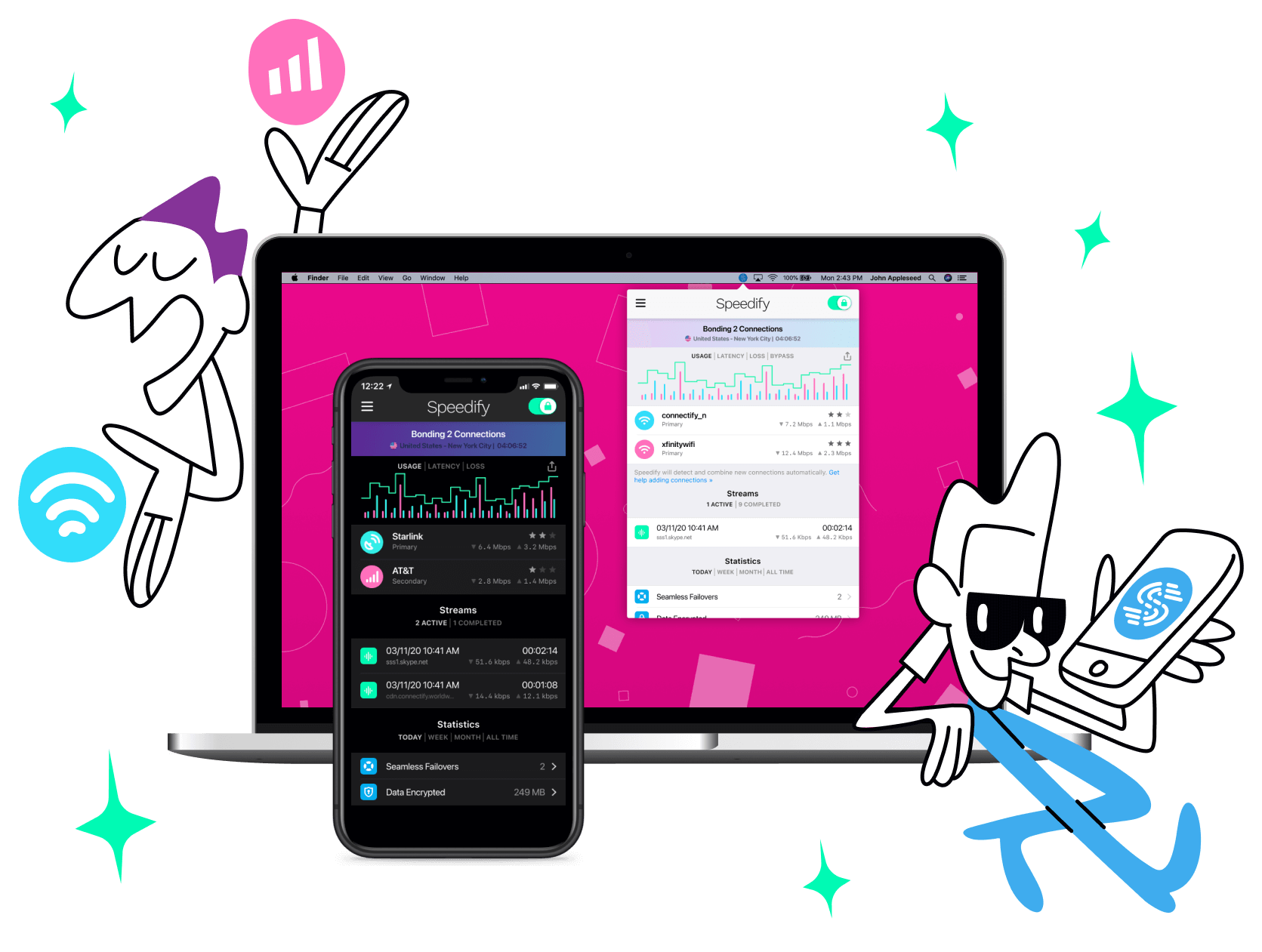
Speedify is the only app that can combine multiple internet sources into one bonded super-connection for more stable and secure live streaming, video calling, and web browsing. It uses channel bonding technology and advanced encryption to provide fast, stable and secure Internet.
Here's how Speedify helps streamers everywhere get the best connectivity:
- evaluates your Internet connection and recommends a supported video quality for your live stream.
- prioritizes live streaming over other types of traffic.
- aggregates the upload speeds of the combined connections - it allows for live streaming at higher quality and higher framerates.
- delivers the lowest latency out of the combined connections.
- minimizes packet loss by automatically resending lost network packets - useful when using wireless connections such as Wi-Fi and cellular.
Speedify is cost-aware, prioritizing wired and Wi-Fi connections over cellular and other metered ones. And if one of your connections happens to drop, Speedify will seamlessly move the live streaming traffic to the other working connection(s), so you won't notice any quality issues.
Get started with Speedify today!
With Speedify you can combine Wi-Fi, 4G / 5G cellular, Ethernet, Starlink and other satellites into one bonded super-connection to improve livestreaming, video calling, gaming, web browsing, and everything else you do online.




Speed
Stability
Security
Speedify engineers love talking tech on YouTube, Tiktok, and Instagram!
Alex Gizis and the Speedify engineers discuss and explain technology including Starlink satellites, Wi-Fi 7 routers, Apple networking features, fiber optics, broadband internet, 5G mobile networks, AI, networking protocols, and much more. Follow Speedify on YouTube, TikTok, Instagram, and LinkedIn!
Alex and the Speedify team are always exploring the latest in networking and security technology—like 5G, 6G, WiFi 7, laser and satellite internet—and sharing it in new discussion content across YouTube, TikTok, Instagram, and LinkedIn every week.
Got a tech question? Let's go deeper! Pop into Speedify Office Hours live every Wednesday at 10 AM Eastern. Speedify CEO Alex Gizis and our network engineers are standing by to break down your questions about networks, tech updates, and Speedify features.