

Collaborative Video Editing: Solving Team Workflow Challenges
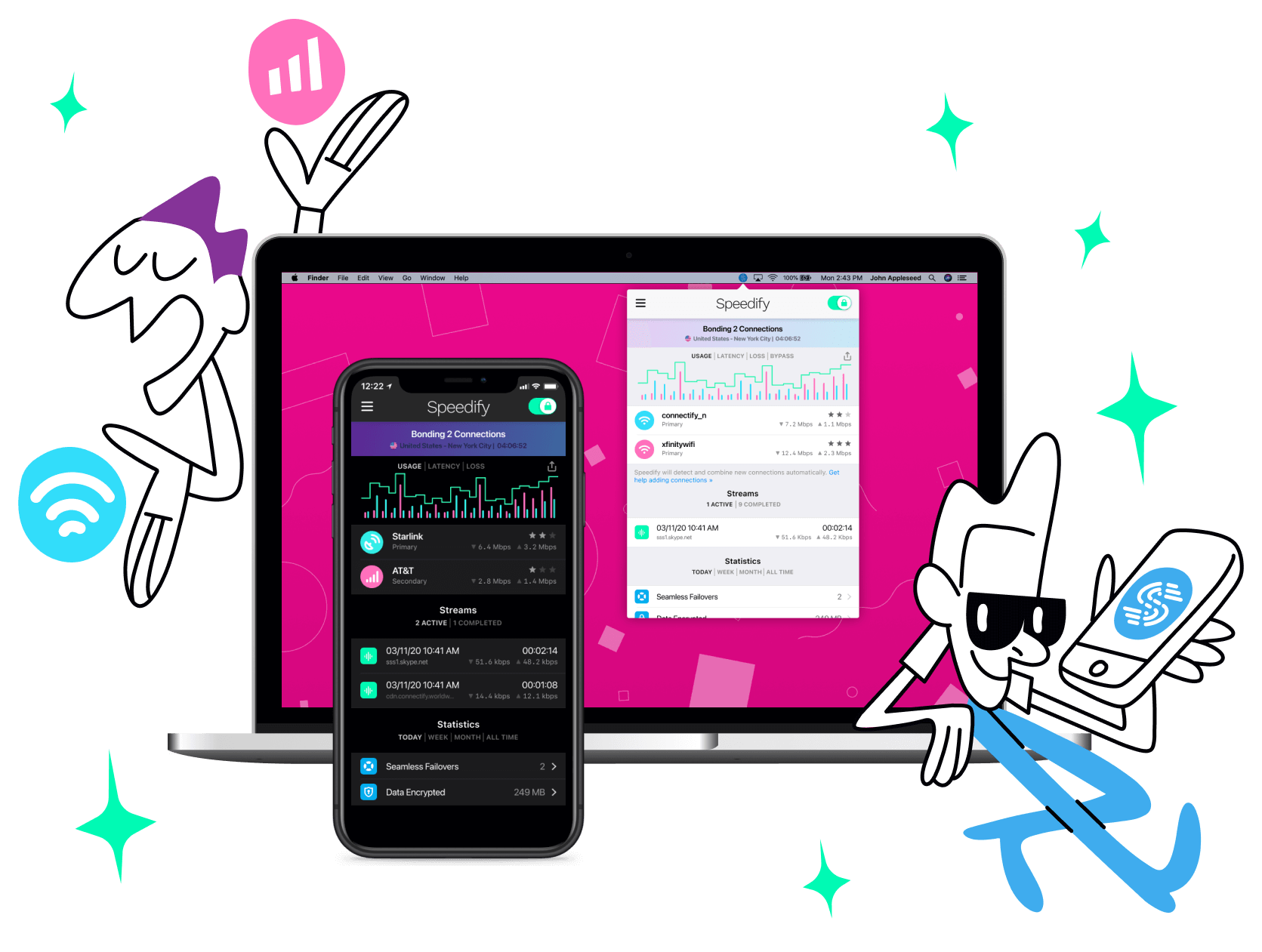
Use Speedify to increase your upload and download speeds: combine internet connection sources like Wi-Fi, 4G, 5G, Starlink and wired broadband

Combine Wi-Fi, 4G, 5G, Starlink and wired broadband to fix slow upload and download speeds
Speedify is the only app that seamlessly combines all of your connections, including Wi-Fi, 4G, 5G, Ethernet, and Starlink, into one stronger connection to keep you online and secure.
In most cases, Speedify will automatically detect and start using any available Internet connections on your device while intelligently distributing your online traffic between them for optimal performance. If you need help we have quick start guides available for most common set ups.

Combine personal hotspots for better upload and download speeds
Speedify's Pair & Share feature enables you to connect to multiple hotspots at the same time and wirelessly share LTE, 4G, and 5G cellular connections back and forth between multiple Speedify users on the same local network to create a faster, more reliable connection for everyone.
For the first time, it's possible to share cellular data between multiple devices, including PCs, Macs, iPhones and Androids. Use multiple phones as hotspots for internet access and get increased bandwidth and mobile failover for all paired devices.
Use Speedify to combine...
Combine these connections on:


What Makes DaVinci Resolve Different than Other Video Editing Programs
Alex Gizis: Can you talk about what makes DaVinci Resolve so different than the other video editing programs out there?
Bob Caniglia: Well, I think that DaVinci Resolve has continued to evolve over the last 15 years, I'll say. DaVinci Resolve is a full blown NLE in the sense that it has two different editing pages: the cut page, the edit page, you have Fusion Visual Effects, you've got Fairlight Audio, and you have DaVinci Color, which is what DaVinci was always known for, color correction.
One of the things that we've developed over the years is the ability to do collaborative workflow. We've done different collaborations, different collaborative workflows.
And with the Blackmagic cloud service and with our cloud storage products and some of the other features we've added into Resolve now, what you can do is share the same project amongst a myriad of people, whether they're editors or colorists or the audio guys, whatever, they can all work in the same project at the same time.
But then we also added the ability to start moving files. So this way, we could share media with everybody this way. Everyone can get going at the same time. And so we've kind of comboed it all. And after we sort of got that all rolling, we also added features into our Blackmagic cameras where the cameras can send the files directly from the camera.
So there's a lot of different ways to do it, but at the end of the day, it doesn't matter where people are. They can work on the same project. And this really helps people, especially like independent filmmakers who, maybe they're doing their own editing, but they want a colorist to help finish this project for them.
Well, they can do it collaboratively and not have to wait forever to get results and things. They can kind of do it all at the same time as needed by sharing the project file, sharing the media and all of that. And it just works uniquely.
Alex Gizis: So one thing I really like is how you're not hardcore trying to lock us into your cloud as hard as let's say, some other competitors. A lot of this stuff, you'll do the cloud storage for us, or we can use Dropbox, the collaboration server, you guys will run it for $5 a month, or you'll give us the software and we can, run it on a server in our closet.
I really like that. And of course, now that I have the option, I'm like, I'll just have them take care of it. But I like that feeling of not being completely trapped.
Bob Caniglia: Well, I think what it is we have all kinds of customers that we're trying to deal with. So our legacy customers that were before the acquisition by Blackmagic, those larger facilities, well, they want to have their own project servers. They want to have their own closed networks, but they still want to be able to do this sort of collaborative workflow in their own environment.
And so we have those tools and they were kind of first. But then it was like, yeah, but what if the guy in LA wants to be working with the guy in New York and how do they do that?
So, let's do the project sharing. But what about moving this the data back and forth so that they have the same files? All right. Well, so it's evolved over time, but it's never been like, Oh, now that we have everything, let's lock it down. Cause that's just not the way that we work.
DaVinci Resolve Proxies
Alex Gizis: So proxies, I know DaVinci Resolve, you're not the only people who support them, but for those who aren't video professionals, can we talk about how that works? Because I think it is kind of nifty when you're working over the internet.
Bob Caniglia: Right, so what we're doing by that is the proxy generator generates proxies from the camera originals because they're more nimble to move. So you can move those faster for people to get started, and then the camera originals can move later. And when you're setting up the workflow to move files, it'll give you the choice of moving proxies or camera originals.
Now, since we developed that process, we also added the ability to record proxies and camera originals at the same time in some of the newer Blackmagic cameras. So, by enabling that, then the proxies are already there, and then you can move them as needed without having to generate them.
Alex Gizis: How small are the proxies? Are they like 480p versions of the video? No. Are they just like pictures?
Bob Caniglia: They're basically real video, real resolution, and they're whatever format you're picking, but they're just smaller, and they're compressed, but they're not so compressed that you can't use them, and that would be counterproductive.
They're just size wise, they become much smaller than, say, camera raw files, because they're larger.
DaVinci Resolve Integrates Blackmagic Design Hardware Capabilities
Alex Gizis: As you were hinting, obviously, Blackmagic has a lot of hardware. Cameras and mixing boards and stuff. Is there cool stuff that happens when I start using Blackmagic hardware with the software? Or is there, as opposed to anyone else's cameras?
Bob Caniglia: Well, that's the thing. The new Ability to record proxies and camera originals in the cameras is new and very cool. The new Pixis 6K camera, which is a full frame 6K camera, has a 10 Gb ethernet port on it. So you can pull files directly off the camera while you're, shooting.
The new UrsaCity 12K LF, it's a large format 12K camera that also has the ability to have a 10 Gb Ethernet port to pull data straight off the camera, but it also has Wi-Fi so you can actually move it off that way too.
Alex Gizis: What kind of bandwidth does a 12K camera use?
Bob Caniglia: The thing about the 12K camera and the 6K camera for that matter, is that we use Blackmagic's own codec, which is Blackmagic RAW.
So Blackmagic RAW files are a lot more nimble than a standard RAW file. And we developed it that way because we wanted people to be able to move the files and use them on a laptop. That's one of the challenges that we knew going forward when we developed the larger sensors, was that unless you can use the files properly and without having to wait every two seconds for it to refresh and play, then what good is it?
So we developed our own codec to make it more nimble, to be able to handle the workflows that we want to support, and that's where we are now. And then getting the footage off the cameras faster and being able to send them directly to, you can stream basically out of the cameras.
So, I mean, added things that we've done, and I still think there's other things that we can add. I don't even know what they are, but I'm sure somebody's thinking about it.
Concerns About Collaborative Video Editing
Alex Gizis: So my friend, Tim, is really concerned about other people jumping in when he's editing the video. And, doing things to his video.
Bob Caniglia: I totally get it. Now, if you are working in a timeline, you have priority and you can assign priorities to it.
So they can't actually work in your timeline, but they can work on the same project at the same time. So that's different. It would be silly if you're like lining up an edit and all of a sudden somebody drops a video on top of your edit and you're like, "Hey, what happened there?" So you have priorities and there's ways to assign who's in charge of the project.
So clearly we have to make Tim in charge, which is fine. So then if somebody else is doing an alternate take or whatnot, then they can work on that and then they can message them in the app and say, "Hey, Tim, what do you think of this?"
They have that ability to prioritize who's in charge and that's obviously necessary, but the fact that everybody can work on the same stuff at the same time, and if there's an edit or, if the colorist wants to grade the project as the guy is editing, then they can see what things look like.
So maybe, they go back and go, "Oh, maybe that shot doesn't work once I balance it" or whatever. So this way they can move faster.
What Makes DaVinci Resolve Stand Out for Collaborative Video Editing
Alex Gizis: I see that some of these other video programs like Descript and Adobe are kind of trying to follow your lead and add collaboration stuff. You guys have more stuff planned in the pipeline to stay ahead and keep improving these collaboration features?
Bob Caniglia: I think at Blackmagic, we're pretty good about just staying in our lane and doing what we need to do or what we think we need to do. And part of that is we come up with ideas that we think will really help the workflow.
Then of course we check in with everybody every once in a while to see, what else can we add. So we get customer feedback along with our own ideas on how to progress the software, progress the hardware.
DaVinci Resolve itself has always been a Swiss army knife, even from the early days of it. Being able to move between different NLE manufacturers, you can move projects between them.
We've always been good about adapting to the new camera technology from other companies. They get involved early on with our Resolve Color guys to make sure that when they launch the new camera that we support their file formats and can deal with that. So that's always been a thing.
And as I say, we don't really pay attention to what everyone else is doing. We're always paying attention to what we're doing and just trying to improve the product as much as we can. And here we are DaVinci. We just did an update the other day, 19.1.
Alex Gizis: So how often do you actually do releases and updates like that?
Bob Caniglia: As often as needed. The other day, the release that we did added all kinds of new features, not just like a bug fix or something like that.
So it's sometimes difficult to keep up with all the new things that come out there, but it is fun to see how it's never finished. It's just one of those products that just keeps evolving.
Alex Gizis: With Speedify for a while, we got into doing a release every three weeks and that was too much, it turned out. So I think that every two months is where we're settling. It still feels pretty agile.
Getting Started with DaVinci Resolve
Alex Gizis: For new people just getting started, what's your advice? How do you get started with DaVinci Resolve?
Bob Caniglia: So what I think is really cool about DaVinci Resolve is that, A, we have training materials on our website. So you can go on our website and we have sample projects and you can download the material and you can download the course guide. And it's like a self taught way to get through Resolve, right?
But we also have tools inside the software. So you can set up your keyboard to mimic whatever NLE you came from. But the thing that I find, cause I don't use it every day, so occasionally I get stuck and I go, "Huh, how did I do that before?" And I just Google it and boom, there's a video.
Cause for some reason people make lots of videos showing people how to do things, especially the new stuff. So not only do we have our own materials, but then the internet, and the guys are just going crazy, making videos, showing people how to use the new things. And I think that's really cool.
So there is an unlimited amount of material out there to learn how to use it and as I say if you google your question you'll find the answer and usually like three videos.
Alex Gizis: I guess it's one of those surprising bonuses about making programs for people who make videos is that you're guaranteed that they'll make videos about making videos for you because they can't help themselves it's what they do.
Bob Caniglia: I think that's pretty cool. And the community itself, there's a whole community, we have our own forum for all of Blackmagic products, including DaVinci. And, oftentimes you get good answers there because especially when people ask about third party products and things like that, that we're not usually up to speed on and don't usually like to comment about, but the end users are always good about saying, "Oh yeah, I use this and I use that." And they love sharing it.
Alex Gizis: Yeah. I think that kind of community tends to form, when you have to put things together to get the complete solution. And given the cameras and the microphones and most of what you guys sell, so I think it is possible to get the complete solution of everything you need from you guys.
But I still think a lot of people are trying to piece together different pieces. And that's where you end up needing a community to help.
Bob Caniglia: A hundred percent. Because every time I see a rigged out camera that has all kinds of, they're never the same. Somebody's always got something attached differently or whatever, and it's all drones. There's another one, right?
Alex Gizis: These days, drones, right? I keep using microphones, but that's not the outfit, is it?
Bob Caniglia: I mean, we don't make microphones, we don't make drones, but our products are used on all these things and underwater stuff. We don't do anything for underwater cameras, but there are housings that people use our cameras in them.
So there are a lot of tools out there and people piece them all together because you still need, you need a tripod, you need a lens, you need different things. That's why we sell through the resellers channel, because those guys can put together bundles with lenses and media and all the things that we don't sell, because if you bought it from us, you just get a camera and okay, now you need other things and you have to go somewhere else anyway. So that's why we tend to use the wide reseller network. And that seems to work out very well because then people can get everything they need in one place.
DaVinci Resolve Pricing Structure and Free License Limitations
Alex Gizis: Should we talk about pricing a little bit? Like, what does this cost?
Bob Caniglia: So, the good thing about Blackmagic Resolve is that if you want to use DaVinci Resolve, you can start for free.
Go to our website and download the free version. And that free version actually does a lot more than people think it does. There are limits to what it will do, but you have to get into the weeds before you're really separating yourself from the studio version. Now you can't go above UHD. So 4k can't go above that resolution in terms of outputting.
You can bring in footage that's higher than that, there's like noise reduction tools and some other things, accessing multiple GPUs, things like that, some of the stereoscopic tools. There are some tools that you need the full version for, but if you buy one of the Blackmagic cameras, the cinema cameras, you'll get a copy of Resolve.
So you'll get that included. And some of the hardware that we sell, some of the color panels and things like that, also come with a license for DaVinci Resolve Studio. But if you were to buy the studio all by yourself, it's $295. And that's a one time thing. It's not a monthly or yearly charge.
Now, even if you're collaborating, if someone's using the free version, they can still collaborate with somebody who's using the paid studio version. If a tool was turned on in the studio version, the person using the free version will see it, but they can't do any adjustments to it.
Alex Gizis: that seems remarkably fair of you, actually.
Bob Caniglia: I think it is too, the fact that you can do it.
Speedify Proven Track Record, Global Scale
Speedify has powered stronger Internet for millions of consumers since 2014
15M
Millions of Speedify downloads worldwide, and growing every day5⭐️
More than 75,000 5-star reviews for Speedify in the iOS and Android app stores82
Points of Speedify presence in datacenters around the globe500TB
Hundreds of terabytes of fast, secure data streamed every week via SpeedifySpeedify Partners
Speedify partners with these amazing organizations to deliver better internet and next-generation networking technology to their customers and employees.


Internet Requirements for Collaborative Video Editing
Alex Gizis: One thing I was wondering about is like, network requirements for collaboration. Like, how fast an internet connection does everyone need to actually be able to work together on a video?
Bob Caniglia: Well, on a base level, you just move the project file, right? So that's really easy. That's light and that just downloads.
The other thing is that we want to be able to move the files from one place to the other. So that way they can get started and not be using material that's stored in the cloud necessarily. You want to just move it through to your premises. And that all is bandwidth dependent, but what it doesn't do is prohibit you from using, doing the project just because you have slow internet. And as soon as you get some of the files to download, say through Dropbox or whatever, then you can get going and get started on it.
So that's where you want to, setting up the workflow is not so much that you're all connected to something in the cloud. It's more about moving the files from one place to another through the cloud. And that way, you're able to get everybody going without having to worry about who has what, internet speed at home and things like that.
Now, when you're on premises and you're sharing through our 10 Gb ports on our cloud store, and then through your 10 Gb network there, then you're really humming with moving files around or whatever, but going through the cloud, this way you're not so dependent upon your actual connection, you're just moving the files as the speed of the network allows.
Alex Gizis: Right, because it's a funny thing, when you're editing videos, there tend to be a bunch of very large clips you have to get before you can go anywhere, but the actual edits, I guess they're tiny little files saying where to clip it and which clip to show next. That's actually really little text files, aren't they?
Bob Caniglia: Right, the DRP, or the DaVinci Resolve project file, that's a small file, so it's really easy. Back before we had this way to share them, I would just email it, and be like, here, whoop. Get started. Here's an email of that. So, and you can throw that into Dropbox too. So that's easy to throw over to somebody if you want to do it that way.
What that becomes though, is that they have a copy of it and you have a copy of it. You're not working on the same one. Whereas the DaVinci Resolve project server ability to everybody updates. And then that same project is updated so that if you're working in a different time zone, you come in the next morning, what would they do overnight?
"Oh, okay. I see what they did. There's Tim's version 3 that we all like." So, that, I think, it's my callback to Tim.
Alex Gizis: Tim will appreciate that.
Bob Caniglia: I'm sure he will. I hope so. So, I think that that's where you're taking this sharing to a different level that everybody's working in the same project, so that way everybody knows exactly where we are instead of having to keep sending an email that says "final final 3" or whatever.
Alex Gizis: Yeah, the bad old days.

Connectivity Tech Discussions
Our Connectivity Tech Discussions Between Two Palms video series shines the spotlight on Alex and technical guests, diving deep into caonversations about the latest Internet technology, including Starlink satellite, WiFi 7, Apple, fiber optics, new routers, remote connectivity, and networking protocols.
Join us and let's talk tech!