
Hybrid Access Improves Quality of Service and Reduces Costs for Network Operators
As markets, customers, and smartphones continue to multiply, Network Operators and MVNOs are facing critical bandwidth issues. In the face of soaring costs and overloaded cellular networks, Carriers have been working for years to develop hybrid access technologies to offload this increased traffic to broadband or DSL and leverage existing investments in infrastructure to no avail.
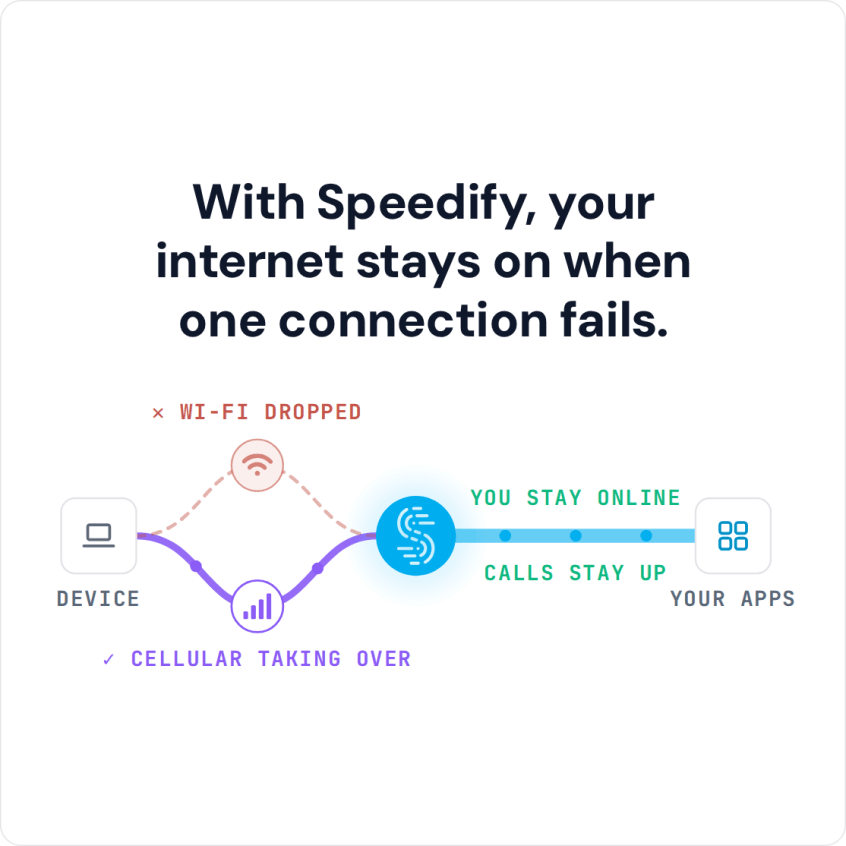
Speedify is link aggregation technology that is easy to implement: it helps network operators and hardware manufacturers enable hybrid access connection aggregation, using fixed broadband and cellular at the same time and moving traffic between them without dropping the session, which improves QoE while reducing LTE usage. That needs both connections in place; on a single connection Speedify works as an encrypted VPN and cannot stop that connection from dropping.
With Speedify, your internet stays on when one connection fails.
Watch now
How Speedify combines internet connections on any hardware
Get started with Speedify for your business
Speedify offers three commercial paths. They work together, and most enterprise customers use two or more.
01
Speedify Teams
Speedify on every supported OS for every team member
Centralized dashboard for billing, user provisioning, and usage analytics
CSV import/export and a RESTful management API
02
Speedify for Routers
License for supported OpenWrt routers
Powered by Speedify hardware lineup ready to deploy out of the box
Miri, GL.iNet and other partner models
Covers every device on the network, with no per-device install
03
Embed Speedify into your product
A · DIY
Build it yourself with the Speedify SDK.
Integrate Speedify into your iOS, Android, Windows, macOS, Linux or QNX product. Full developer documentation, sample code and supported integration paths. Your team owns the build, and the Speedify SDK handles combining the internet connections.
B · CUSTOM ENGINEERING
Have the Speedify team build it for you.
What is Hybrid Access?
Hybrid Access is a technique for offloading data originally intended for transport across cellular networks onto broadband networks whenever possible. This frees up expensive mobile bandwidth for other customers and allows carriers to take better advantage of existing wired telecom infrastructure. It works on the same idea as mobile data offloading to Wi-Fi.
Some of the primary obstacles are:
- iOS and Android devices are unable to tell when a hotspot is “dead” or not functioning properly
- Manually switching between networks is time consuming and cumbersome
- Consumers end up with interrupted internet access during network changeovers
- Consumer concern about hotspot security
Speedify addresses all of these with its technology for combining internet connections.
Speedify Is an All-in-one Hybrid Access Solution
For MVNOs, the benefits of Hybrid Access through Speedify are twofold: moving more traffic off of LTE and onto Wi-Fi results in bigger savings as well as a better internet experience for customers.
Speedify handles combining internet connections and Hybrid Access on mobile devices and laptop/desktop computers. It can be built into existing iOS, Android, Windows and macOS software and runs in the background monitoring and improving network performance for all the apps on the device. Speedify is cost aware and uses policy based routing that can be configured for increased speed or reduced cellular usage. Optional VPN encryption means that Speedify can also keep users secure across public Wi-Fi networks.
Currently, when a consumer connects to a dead hotspot, the device does not automatically fall back to using LTE. Instead, the consumer is stranded without any internet connection. This creates a poor user experience and discourages future use of hotspots. Speedify eliminates this problem.
Speedify Is Used on Millions of Devices Worldwide
Speedify has made internet connections faster and more reliable for businesses and individuals since 2014.
15M+
Speedify downloads worldwide75K+
5-star reviews for Speedify on iOS and Android82
Speedify server points of presence in 50+ cities on 6 continents500TB+
Of internet traffic carried by Speedify every weekSpeedify Partners
Speedify works with these companies to bring faster, more reliable internet and networking technology to their customers and employees.


Learn How Speedify can solve Hybrid Access for your Business
Contact the Speedify team today to schedule a demo or learn more about Speedify enterprise offerings.
What Are Hybrid Access Networks?
An ISP with a copper footprint and a cellular network has two ways to reach a customer and, usually, no way to use both at once. Hybrid access is the architecture that changes that, and it has historically needed gateway hardware at both ends.
Speedify does this in software, without that gateway hardware, which lets an ISP offer a faster, steadier service over the lines it already has.
Take a look at what hybrid access networks are, the forms they take, and how a software approach compares. If you run a regional network, see how rural ISPs use hybrid access.
What Are Examples of Hybrid Networks?
Here are some examples of hybrid networks:
- Home Networks: A typical home network often combines Wi-Fi and Ethernet connections. Devices like laptops and smartphones connect wirelessly to a Wi-Fi router, while desktop computers and gaming consoles are often connected to the router via Ethernet cables.
- Enterprise Networks often combine wired and wireless networks to provide flexible connectivity for employees.
- Wired networks are used for critical infrastructure and servers, while Wi-Fi networks are used for employee devices like laptops and mobile phones.
- Some enterprises also use cellular networks for remote workers and mobile devices.
- Campus Networks such as those found in universities and corporate campuses, often combine wired and wireless networks. Wired networks are used for high-bandwidth applications like research and data transfer, while Wi-Fi networks are used for student and faculty devices.
- Hybrid Cloud Networks combine public and private cloud infrastructure. This allows organizations to leverage the benefits of both public cloud flexibility and private cloud security.
What Are the Main Types of Access Networks?
An access network is a type of network which physically connects an end system to the immediate router (also known as the “edge router”) on a path from the end system to any other distant end system.
The main types of access networks used by ISPs and network carriers are:
- Wired access networks:
- DSL (Digital Subscriber Line),
- Cable Internet,
- Fiber-optic (FTTH),
- Hybrid fiber coaxial (HFC).
- Wireless access networks:
- Wi-Fi,
- Cellular networks (4G, 5G),
- Satellite.
What Is a Hybrid Access Point? Can CPE Be Used as Access Point?
A hybrid access point is a network device that combines both wired and wireless network technologies.
- Unified Network: A hybrid access point simplifies network management by providing a single point of access for both wired and wireless devices.
- Improved Connectivity: It connects every device, regardless of its connection type.
- Enhanced Flexibility: Hybrid access points can be deployed in various scenarios, from small home networks to large enterprise environments.
CPE (Customer Premises Equipment) can be used as access points too.
A CPE device is typically a network device that connects a user’s premises to a service provider’s network. Many CPE devices, such as cable modems, DSL modems, and routers, have built-in Wi-Fi capabilities, allowing them to function as access points.
Mobile Data Traffic Keeps on Growing
Mobile data traffic is on an exponential rise, accounting for a predicted growth of almost 300% in the following years, according to Statista: “In 2022, the average data used per smartphone per month worldwide amounted to 15 GB. The source forecasts that this will increase to around 46 GB per smartphone per month globally in 2028”. Ericsson’s June 2024 Mobility Report has a similar figure when it comes to mobile data traffic per smartphone. But when looking at total mobile network traffic, they forecast a CAGR of 23% between 2023 and 2029, reaching an impressive 466 EB (exabyte)/month
The main drivers for this growth are the rapid redeployment of 5G networks globally and the escalating consumption of video streaming services, social media and other real-time communication applications. Naturally, the numbers are different from region to region, but the overall trends are the same.
Speedify Business Solutions
Speedify Teams
Speedify for Routers

Speedify Embedded Solutions and Integrations
Add Speedify to your own app or hardware with the Speedify SDK. Your product then combines internet connections, fails over automatically when one drops, and encrypts the traffic, using the same technology as the Speedify app.