

Starlink Satellite Internet Is Fast, but Needs a Backup Internet Connection to Be Reliable
Starlink is worth it if you live or travel where cable and fiber internet can’t reach. Starlink says it delivers 45 to 280 Mbps download, with most users over 100 Mbps, and a delay of 25 to 60 milliseconds on land. That’s fast enough for Netflix, web browsing and most online games.
How reliable is Starlink? Good, but not perfect. Your Starlink dish switches satellites about every 15 seconds, and a switch, a storm or something blocking its view can drop your internet for a moment. You won’t notice while browsing, but video calls and live streams can freeze. The team behind Speedify, an app that uses all of your internet connections at the same time, tested Starlink for exactly this. Below: how they tested it, what they found, and how to keep Starlink online through the gaps.
Starlink Index: what thousands of real Starlink connections measure
Sep 29 to Oct 12, 2026Daily downtime
46 min
3.2% of connected time, across all dishes
Median latency
55 ms
the worst 10% of users see 295 ms
Avg packet loss
0.19%
vs 0.07% on T‑Mobile
Avg jitter
1.2 ms
vs 6.8 ms on Verizon
What Starlink users pair with
Starlink Internet Connection Dropouts Happen to Everyone
Speedify measures thousands of Starlink users in more than 150 countries. From 29 September to 12 October 2026, fixed Starlink dishes went offline for about 37 minutes a day on average, and Starlink dishes on RVs and boats for about 61 minutes a day.
Starlink also switches each dish to a new satellite every 15 seconds, and a switch can cause a short dropout. Even a perfectly installed Starlink dish goes offline, and about 7 in 10 Starlink users on Speedify use Starlink together with a second internet connection, like 4G/5G cellular.
How the Speedify Team Tests Its Starlink Internet Connection
Speedify’s Starlink dish sits on the roof of its office building in Philadelphia, near the Delaware Riverfront. Speedify’s engineers gather data on everyday uses: downloads, uploads, streaming and gaming. They look mostly at the MOS score, a standard rating of how well an internet connection will work for voice calls, based on its delay, how much that delay jumps around, and how much data gets lost on the way.
For the live stream in the video above, the team used Starlink as the main internet connection and Comcast cable as the second, together with Speedify, and tracked how much each one carried. They also recorded every time Speedify stepped in and moved more traffic to Comcast because Starlink faltered.
What the Starlink Reliability Tests Found
The team’s conclusion: for browsing and downloads, Starlink on its own does the job. For anything that can’t pause, like voice and video calls or live streaming, you need a second internet connection used together with Starlink to keep the short dropouts from freezing the call or stream.
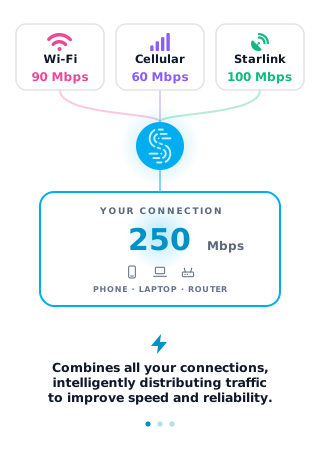
That’s what Speedify does: it sends your traffic over Starlink and your second internet connection at the same time, and if Starlink drops, it switches your traffic to the other internet connection automatically. With Starlink alone, Speedify can’t speed up downloads and uploads or prevent dropouts: it needs that second internet connection, like 4G/5G cellular or cable. A second Starlink dish does not cover the short dropouts, because every Starlink dish switches satellites on the same 15-second schedule.
In this video, a YouTube creator who covers Starlink explains how to make Starlink faster and more reliable.
Where to Find More Starlink Setup Videos From Speedify
Subscribe to Speedify’s YouTube channel for more videos on Starlink, from unboxing to setting it up with another internet connection and Speedify.
Speedify
Get started with Speedify today.
Speedify combines Wi-Fi, 4G/5G cellular, Ethernet, Starlink and satellite into one faster, more reliable internet connection. Free to try: 5 GB a month with a free account. No credit card required.
🚀 Speed
Faster uploads and downloads, because Speedify uses all your internet connections at once.
📶 Stability
If one internet connection drops, Speedify moves your traffic to the others in milliseconds.
🔒 Security
AES-256 encryption on every internet connection, on any network you join.


15M+ downloads worldwide. 75K+ five-star reviews on iOS and Android.