
Can You Stream on a Wireless Connection?
Live streaming over Wi-Fi or 4G/5G cellular works right up to the moment the signal fades or a neighboring network crowds the airwaves: then the software encoding your video gives up on frames it cannot send, and viewers see stutter. Wireless internet connections are shared and variable, which makes any single one risky.
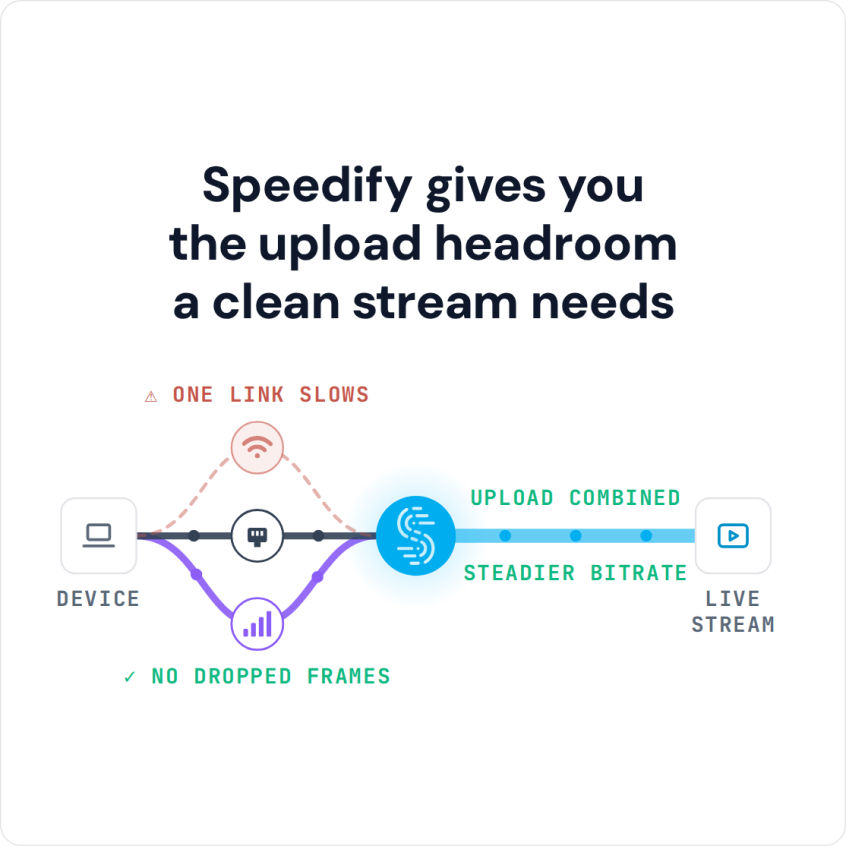
Speedify is an app that streams over Wi-Fi, 4G/5G cellular, Ethernet, Starlink and satellite internet connections at the same time, so a fade on one stays invisible to viewers. Speedify needs two or more connections for that; on a single connection it works as an encrypted VPN and cannot stop that connection from dropping. Read on for what goes wrong on wireless internet connections, five practical tips, and the steadier upload you get once you stream through Speedify.
Speedify gives you the upload headroom a clean stream needs
You can be on a wireless internet connection in three places:
- in your home, via your wireless router
- on the street, in restaurants, cafes, on buses, subways, etc., via public WiFi networks
- on you, via your smartphone or dedicated MiFi device.
When it comes to live streaming on wireless connections, things tend to get more complicated. You need a certain bandwidth to be able to stream in HD at least and you also need a stable Internet connection. This is actually the biggest challenge when it comes to live streaming on wireless connections such as WiFi or 4G/5G cellular.
Reasons Why Live Streaming on Wireless Connections Can Go Bad
Almost everyone has had slow and unreliable internet at some point, and it will keep happening. If you’re just browsing or replying to emails, you can probably wait until the problems are resolved, or switch to a metered connection such as 4G/5G cellular until the WiFi recovers. But what if you’re live streaming? Can you afford to put your audience on hold while you switch connections, or live stream in 4K on cellular alone?
Here are some common, real-world cases when wireless connections (such as WiFi, 4G/5G cellular, satellite) have stability issues:
- Most common: signal strength drops when the distance from the WiFi router or cell tower to your device increases. And when there are walls or other objects that obstruct the direct signal path.
- There is wireless interference from other devices.
- Your Internet service provider has issues: outages, temporary maintenance works, etc.
- The WiFi hotspot is “broken” (out of order, no connectivity, etc.) and your device clings onto the sticky WiFi network.
As you’re live streaming, the issues above are translated into:
- lower quality video, if you’re using adaptive live stream transcoding, or if the platform you’re streaming to has this capability itself (e.g. YouTube)
- buffering: remember the loading wheel? Or the “hiccups” in video and audio?
- disconnects: if you’re offline for a longer period of time, the live stream may be dropped altogether.
So where does this leave you? You may lose channel followers, viewers or even the game you’re streaming.
5 Tips to Improve Live Streaming on Wireless Connections
Now that you understand the importance of fast and reliable Internet connectivity when live streaming on wireless connections like WiFi or 4G/5G cellular, here are some tips to make it better:
- Make sure your Internet plan meets the bandwidth / speed requirements of your live stream: your upload speed has to stay above the bitrate you stream at, with room to spare. If you want some overhead for parallel online tasks, you need extra upload bandwidth.
- Use Ethernet instead of WiFi / cellular whenever that’s possible. If you’re streaming at home from your computer, it’s worth running a cable from your router to your streaming device. At least you’ll get rid of the signal drop and interference factors.
- Upgrade your router / modem and any WiFi repeaters you may have. This can impact your speed and stability, as equipment manufacturers constantly identify issues and release firmware updates for their products. Plus, modern networking devices can better handle higher bandwidths and live streams.
- Avoid crowded areas and live streaming on shared Internet connections. For example, if someone else is using the same WiFi network you’re streaming on, it impacts the available bandwidth.
- Use all your available wireless connections at once. At home, you have your WiFi connection and your smartphone’s 4G/5G cellular; when you’re traveling or outdoors, you have public WiFi and 4G/5G cellular. You can live stream using both connections simultaneously with Speedify, which can combine multiple internet sources into one connection for more stable and secure live streaming, video calling and web browsing.
Speedify for Hassle-Free Live Streaming on WiFi and 4G/5G Cellular
Speedify combines multiple internet sources at once. As long as you’re connected to more than one internet source, Speedify’s automatic failover protection keeps you online when one of them drops.
This is especially important when having no Internet connection can impact your real time online activities:
- live streaming: Speedify prioritizes live streams over other types of Internet traffic. So your Twitch, YouTube or other streams should be protected.
- working remotely: being unable to attend online meetings and video conferences, as well as being in touch with your colleagues.
- online gaming: you shouldn’t lose the game because of an Internet glitch.
In conclusion, live streaming on wireless networks is doable as long as you use all available internet sources at once. Combining them cuts down on buffering and connection drops.
Speedify
Get started with Speedify today.
Speedify combines Wi-Fi, 4G/5G cellular, Ethernet, Starlink and satellite into one faster, more reliable internet connection. Free to try: 5 GB a month with a free account. No credit card required.
🚀 Speed
Faster uploads and downloads, because Speedify uses all your internet connections at once.
📶 Stability
If one internet connection drops, Speedify moves your traffic to the others in milliseconds.
🔒 Security
AES-256 encryption on every internet connection, on any network you join.



15M+ downloads worldwide. 75K+ five-star reviews on iOS and Android.