

macOS Internet Slow? Use Speedify to Combine Wi-Fi, 4G / 5G Cellular, Starlink and Other Connections Together at the Same Time
When your Mac internet is slow, it shows first in video: a stream that drops to a blur, a call where you freeze mid-sentence. The Mac is usually fine; the connection carrying it is not, and you are not the only one with this problem.
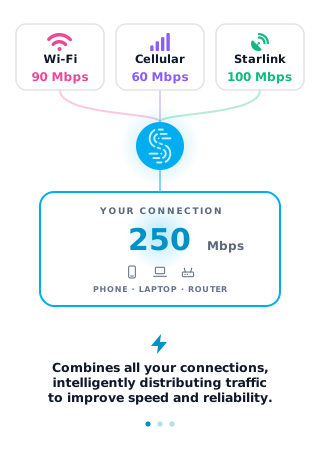
Speedify is an app that uses every internet connection your Mac can reach at the same time (Wi-Fi, 4G/5G cellular, Ethernet, Starlink and satellite) instead of one at a time. The speed gain needs at least two connections: on a single connection, Speedify works as an encrypted VPN and can be a little slower.
Speedify gets you faster upload and download speeds on the device you already have.
Slow internet gets in the way of everyday Mac use, such as:
- having video calls while working remotely;
- remote learning;
- live streaming to your community;
- playing games online;
- trying to enjoy your favorite videos on YouTube, Netflix, etc.
Slow browsing and download / upload speeds are also noticeable when you get slow Internet on your Mac.
When this happens, you can troubleshoot the cause on the Mac, or add a second internet connection at the same time for faster, more stable downloads.
This article covers both: the checks that find the cause, and how using all your available internet connections at once gives you faster downloads and a connection that stays up when one network drops.
Internet Slow on Mac but Not Other Devices: Start with a Speed Test
Macs depend on the internet for updates and for apps that sync online, so a slow connection shows up everywhere.
To confirm the internet is slow on your Mac, run a speed test on the Mac and on another device on the same network:
- If the internet is slow on your Mac but not other devices, the cause is on the Mac: restart it, install any macOS update, and check Activity Monitor for apps using the network in the background. An antivirus scan can also rule out unwanted software.
- If the slow Internet connection appears on multiple devices, then it’s almost certainly a network problem.
When you have macOS Internet slow issues on your Mac, you’ll notice that apps lag too, as they wait to sync online. The reasons for such problems include, but are not limited to:
- poor connection in rural or remote areas;
- temporary ISP infrastructure issues;
- router or modem issues, such as outdated firmware or a router that needs a restart;
- you’re too far from the Wi-Fi router / hotspot.
The signs of slow internet on a Mac include:
- websites / apps take forever to load or refresh;
- videos are buffering;
- you experience stuttering and buffering when video conferencing;
- downloads / uploads are slow.
How to Fix Slow Internet Problems on macOS: Use All Available Connections at the Same Time
The checks in this article find the cause. When the cause is a weak or crowded network, the fix is a second internet connection used at the same time, which gives you fast and stable connectivity in a few minutes. Speedify is a VPN that combines internet connections to do that.
Speedify lets you use all of your available connections at once on your macOS device. That means “at once”, not “switching between them”: here’s the difference.
Speedify sends traffic over every network connected to your Mac (Wi-Fi, wired Ethernet, cellular) according to how each one is performing. If one of the connections drops (for example, you connect to a sticky Wi-Fi hotspot), Speedify moves the traffic to cellular or wired Ethernet, even while streaming, and you would only notice it in the app’s stats.
How to use Speedify on macOS
- Get it from the Mac App Store or the Speedify website (Speedify needs macOS 11.5 or later).
- Use the built-in Wi-Fi and wired Ethernet on your MacBook, iMac, Mac Pro or Mac mini, and add more connections through the USB ports, such as a USB Ethernet adapter or an iPhone shared over USB. USB Wi-Fi adapters work only on Intel Macs with macOS 11 Big Sur or older, and Android USB tethering does not work on a Mac with Speedify.
- Run Speedify. Speedify recognizes each new connection and starts using it automatically.
You can find more details about combining different connection types in the Speedify knowledge base.
Speedify Also Encrypts Mac Traffic on Public Wi-Fi and Restrictive Networks
Aside from getting you fast and stable Internet connectivity, Speedify uses servers in the cloud and encrypts your traffic to and from those servers. This means that your online activity is safe from hackers and cyber criminals that might be lurking on public Wi-Fi networks for example.
This also helps when the network you’re connected to restricts access to certain websites and apps, mostly streaming and social media ones such as YouTube, Facebook and TikTok. Many school and office networks do this. Because Speedify encrypts the traffic, the network sees only an encrypted connection to a Speedify server, not the sites you open.
You can also connect to a server of your choice, for example one in the country you are in, which keeps the delay low. Speedify does not unblock streaming libraries licensed by region: streaming services still show the library of the country you are in.
With two or more internet connections combined, Speedify gives your Mac faster downloads and uploads and keeps calls and streams going when one connection drops.
Root Causes Behind your iMac’s Slow Internet Bottleneck
Here’s what often slows down the internet on an iMac, especially in a home or remote setup:
- Single-connection bottlenecks: macOS sends traffic over one interface (Wi-Fi or Ethernet) at a time, even if others are available.
- Wi-Fi interference or congestion: 2.4 GHz noise, overlapping networks, or mesh system quirks.
- High latency or jitter from DSL, satellite (e.g., Starlink during peak hours), or long-haul fiber routes.
- ISP issues: traffic shaping, slow DNS responses, or a congested local network at peak hours.
- Coverage limitations: the Mac is too far from the router or behind thick walls.
Symptoms include:
- Safari and Chrome stalling on page loads
- Constant buffering on Apple TV+ and YouTube
- Choppy FaceTime and Zoom calls
- App Store downloads crawling under 1 Mbps
Built-in tools such as Wireless Diagnostics, Activity Monitor and ping help you find the cause but do not fix it. When the cause is a weak or overloaded connection, Speedify helps by adding a second internet connection at the same time.
Common Technical Causes of Slow Internet on a Mac
A slow internet connection on your Mac can stem from multiple sources, and the root cause isn’t always immediately obvious. If the Wi-Fi will not connect at all, see common causes of Mac Wi-Fi not working. Below are the most common technical issues:
- Wi-Fi Signal Interference: modern Macs use 802.11ac or Wi-Fi 6 for fast wireless connections. Interference from neighboring networks, thick walls or a poorly placed router weakens the signal, and the speed drops with it.
- Outdated macOS or Network Drivers: outdated firmware or macOS versions can cause network problems such as slow DNS lookups, dropped packets or uneven speeds.
- Background Processes and Bandwidth Hogs: Activity Monitor often shows background processes, such as iCloud syncs, Dropbox or Time Machine, using a large share of the bandwidth and slowing everything else down.
- ISP-Level Throttling or Network Congestion: even on a gigabit plan, ISPs sometimes shape or throttle certain types of traffic. If the connection is fine on other devices but slow on your Mac, the cause is more likely a setting on the Mac or a VPN running on it.
Troubleshooting Guide for Mac when Internet Is Slow
If you’d like to troubleshoot your slow internet on Mac before adding a second internet connection, consider the following steps:
Test Multiple Networks: connect your Mac to a different Wi-Fi or Ethernet connection. If performance improves, the issue may be with your router or local network.
Use macOS Wireless Diagnostics: hold the Option key, click the Wi-Fi icon in the menu bar, and select Open Wireless Diagnostics. This built-in tool provides detailed logs and performance metrics.
Reset Network Configuration: in System Settings > Network, select the connection, click Details, open TCP/IP and click Renew DHCP Lease (on macOS 12 and older: System Preferences > Network > Advanced > TCP/IP). For persistent issues, delete the network preference files in /Library/Preferences/SystemConfiguration/ and restart the Mac.


Reset Network Settings: go to System Settings > Network, remove your current Wi-Fi service, then add it again. You may also flush DNS using Terminal:
sudo dscacheutil -flushcache; sudo killall -HUP mDNSResponder
Channel Analysis: use Wireless Diagnostics (Option+click the Wi-Fi icon) to see how crowded each Wi-Fi channel is, then switch your router to a less congested channel.
Monitor Network Utilization: use Activity Monitor‘s Network tab to find bandwidth-heavy processes. The Terminal command nettop -P shows network use per process.
Speedify
Get started with Speedify today.
Speedify combines Wi-Fi, 4G/5G cellular, Ethernet, Starlink and satellite into one faster, more reliable internet connection. Free to try: 5 GB a month with a free account. No credit card required.
🚀 Speed
Faster uploads and downloads, because Speedify uses all your internet connections at once.
📶 Stability
If one internet connection drops, Speedify moves your traffic to the others in milliseconds.
🔒 Security
AES-256 encryption on every internet connection, on any network you join.


15M+ downloads worldwide. 75K+ five-star reviews on iOS and Android.