

Understanding the Satellite Internet Landscape: Amazon Leo vs Starlink
In this article based on our Connectivity Tech Discussions series, we dive deep into the Leo vs Starlink solutions: comparing the technology they use, expected performance, coverage, and pricing. We also share how Speedify's bonded internet solution provides seamless failover between satellite providers for ultimate reliability.
Imagine a world where internet access knows no bounds. SpaceX's Starlink and Amazon Leo (previously Project Kuiper) are competing to make this a reality. These revolutionary satellite networks promise to connect even the most remote corners of the globe. But challenges abound.
Technical hurdles, regulatory mazes, and fierce competition stand in their way. Yet the potential rewards are staggering. Universal internet access could transform education, healthcare, and commerce worldwide. As these tech giants race to launch their constellations, the future of global communication hangs in the balance. The winner may reshape our connected world forever.
Should you get a second Starlink?
Is Starlink giving you great download speeds but weak uploads and random dropouts? Even with 100+ Mbps Starlink download speeds, many users get stuck with under 25 Mbps uploads, unstable connection issues.
A powerful way to upgrade your Starlink speed and stability is to run two Starlink dishes. But to actually combine both Starlink connections into one faster, stronger internet link, you need connection bonding software like Speedify.
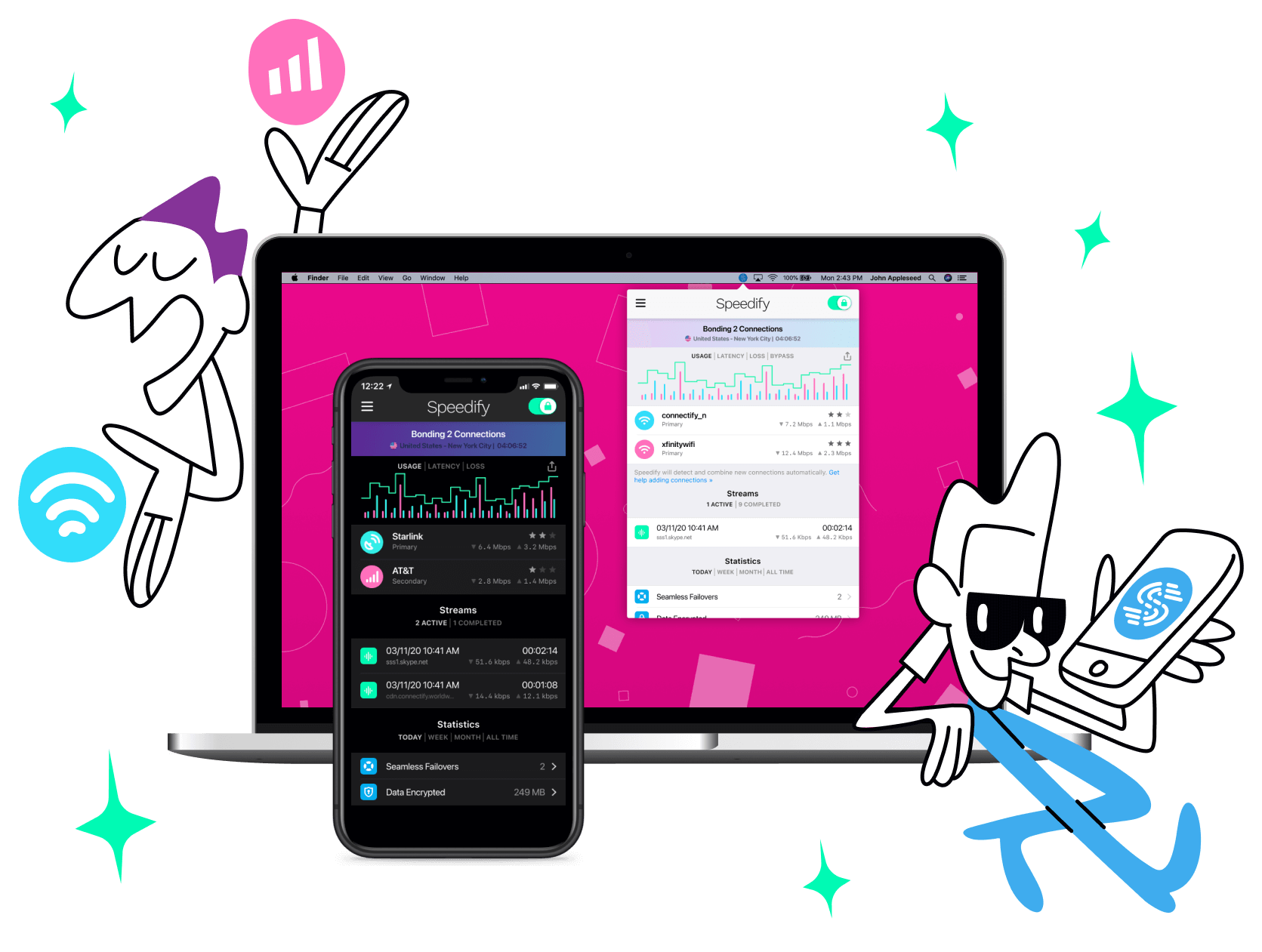
Speedify bonds your Starlink dishes for more upload and download bandwidth, smoother Zoom and Teams calls, and far more reliable livestreams. And when one dish drops, as Starlink often does, the other instantly takes over without lag or interruptions.
If you want more reliable, faster Starlink uploads and downloads, bonding multiple Starlink connections with Speedify is the most effective way to level up your satellite internet.
Get instant Speedify alerts about Starlink interruptions and updates

Use Speedify to increase your upload and download speeds: combine internet connection sources like Wi-Fi, 4G, 5G, Starlink and wired broadband

Combine Wi-Fi, 4G, 5G, Starlink and wired broadband to fix slow upload and download speeds
Speedify is the only app that seamlessly combines all of your connections, including Wi-Fi, 4G, 5G, Ethernet, and Starlink, into one stronger connection to keep you online and secure.
In most cases, Speedify will automatically detect and start using any available Internet connections on your device while intelligently distributing your online traffic between them for optimal performance. If you need help we have quick start guides available for most common set ups.

Combine personal hotspots for better upload and download speeds
Speedify's Pair & Share feature enables you to connect to multiple hotspots at the same time and wirelessly share LTE, 4G, and 5G cellular connections back and forth between multiple Speedify users on the same local network to create a faster, more reliable connection for everyone.
For the first time, it's possible to share cellular data between multiple devices, including PCs, Macs, iPhones and Androids. Use multiple phones as hotspots for internet access and get increased bandwidth and mobile failover for all paired devices.
Use Speedify to combine...
Combine these connections on:


What is Amazon Leo?
Let's start by addressing a common misunderstanding. Amazon Leo is not affiliated with Jeff Bezos' Blue Origin. This is Amazon's own project. It aims to bring fast and reliable satellite internet to locations all over the world.
Most probably Starlink's biggest competitor, Amazon Leo has some clearly defined goals. Here's Amazon Leo at a glance from what we know so far:
- Planned Satellite Constellation: Over 3,000 satellites (3,232 satellites to be exact)
- Primary Goal: Provide affordable, high-speed internet globally
- Satellite deployment date: early 2025
- Service roll out date: 2025
Leo vs Starlink, the Technical Battleground: Satellite Deployment and Performance
Both Starlink and Amazon Leo will have similar main infrastructure elements: the satellites, the ground antennas and the satellite dishes. Both will use Low Earth Orbit (LEO) satellites.
When comparing Leo vs Starlink's satellite constellations, one can see that Starlink clearly has more satellites planned and they orbit at a different altitude:
Starlink:
- Current satellite count: Over 6,000
- Orbital altitude: Approximately 400 kilometers
Amazon Leo:
- Planned satellite count: More than 3,000
- Orbital altitude: Around 500 kilometers
One of the differentiators of Amazon Leo lies in its orbital strategy. Their satellites, orbiting 100 kilometers above Starlink's, expand their geographical reach. This higher altitude grants each unit a broader coverage area. But, this comes with a critical engineering challenge.
Radio wave propagation follows an inverse squared law. Signal strength diminishes exponentially with distance. Leo satellites orbit higher, resulting in a 40% loss in signal power compared to Starlink's lower-altitude network. This elevation difference impacts transmission strength significantly.
To counteract reduced signal strength, Leo plans to use slightly larger antennas. By increasing antenna size by roughly 20%, they can restore signal performance.
Orbital Considerations: Low Earth vs. Geosynchronous
How do traditional satellite networks differ from Starlink and Amazon Leo? Currently there are 3 main orbits that can hold satellites:
- Low Earth Orbit (LEO) - 300 - 1,500 km, closest orbit to Earth
- Medium Earth Orbit (MEO) - 7,000 - 20,000 km
- Geostationary Orbit (GEO) - 35,786 km - a satellite in this orbit revolves around the Earth at a constant speed, so it appears to be in a fixed position in the sky.
As most public communication satellites are deployed in LEO and GEO, here's how these compare:
Starlink, Amazon Leo: LEO Satellites
- Dramatically lower latency (20-40 ms)
- Higher bandwidth potential
- More responsive for real-time applications
- Lower power transmission requirements
Other providers: GEO Satellites
- Extreme latency (500+ ms)
- Restricted bandwidth
- Requires large, fixed directional dishes
- Less suitable for modern internet applications
MIMO Antenna Technology: Must Have for Starlink and Leo
Both Starlink and Leo systems leverage Multiple Input, Multiple Output (MIMO) antenna technology. This represents a quantum leap from traditional satellite communication methods.
How MIMO antennas help communications:
- They replace single large dish with multiple smaller, omnidirectional antennas
- Typically arranged in rows and columns (Starlink uses 64 antennas)
- Sophisticated software combines signals, creating a "virtual" directional antenna
- Enables dynamic tracking of moving satellites in real-time
These systems will calculate and compensate signal travel time differences from the satellites across multiple small antennas. The user gets a seamless, high-performance communication matrix, which results in better performance.
Amazon Leo vs Starlink: Speedify - Another Must Have for Satellite Redundancy
Speedify's channel bonding technology can be used alongside Leo and Starlink networks. Users can get a more reliable internet connection especially during satellite transitions.
Starlink currently experiences synchronized satellite switches every 15 seconds. These transitions can cause brief connectivity interruptions. Speedify can provide seamless failover with both Leo and Starlink connections.
Speedify can combine a satellite connection with an existing DSL, cable, tethered phone or another broadband internet. This way, internet would be still available even during those satellite switches.
Better yet, Speedify can also combine Starlink AND Amazon Leo connections together. Having two satellite connections used together with Speedify will definitely get you that "always online" award so valuable when live streaming or being on a video call.
Speedify Proven Track Record, Global Scale
Speedify has powered stronger Internet for millions of consumers since 2014
15M
Millions of Speedify downloads worldwide, and growing every day5⭐️
More than 75,000 5-star reviews for Speedify in the iOS and Android app stores82
Points of Speedify presence in datacenters around the globe500TB
Hundreds of terabytes of fast, secure data streamed every week via SpeedifySpeedify Partners
Speedify partners with these amazing organizations to deliver better internet and next-generation networking technology to their customers and employees.


Amazon Leo - Pricing and Plans and How They Compare to Existing Starlink Plans
Amazon Leo are developing 3 distinct performance tiers to address various market needs:
Ultra Compact Model (direct competitor for Starlink Mini)
- 7-inch square design customer terminal
- Maximum Speed: 100 Mbps
- Ideal for mobile and lightweight applications
- Designed for maximum portability and accessibility
Standard Model (direct competitor for Starlink for Homes)
- 11-inches square design customer terminal
- Maximum Speed: 400 Mbps
- Balanced performance for residential and small business use
- Cost of production: $400 or less
High-Bandwidth Model (direct competitor for Starlink for Businesses)
- 19x30 inches rectangular design terminal
- Maximum Speed: 1 Gbps
- Designed for high-bandwidth professional environments
- Targeting demanding business and institutional users
While Starlink currently leads in deployment of its solution, Leo's strategic approach and Amazon's resources position it as a formidable competitor. This competition offers quicker, more dependable, and more accessible internet connectivity. Both businesses and consumers will benefit from this, especially in areas with poor internet coverage. And for those who need uninterrupted connectivity, there's always Speedify to use together with your satellite internet.

Connectivity Tech Discussions
Our Connectivity Tech Discussions Between Two Palms video series shines the spotlight on Alex and technical guests, diving deep into caonversations about the latest Internet technology, including Starlink satellite, WiFi 7, Apple, fiber optics, new routers, remote connectivity, and networking protocols.
Join us and let's talk tech!